

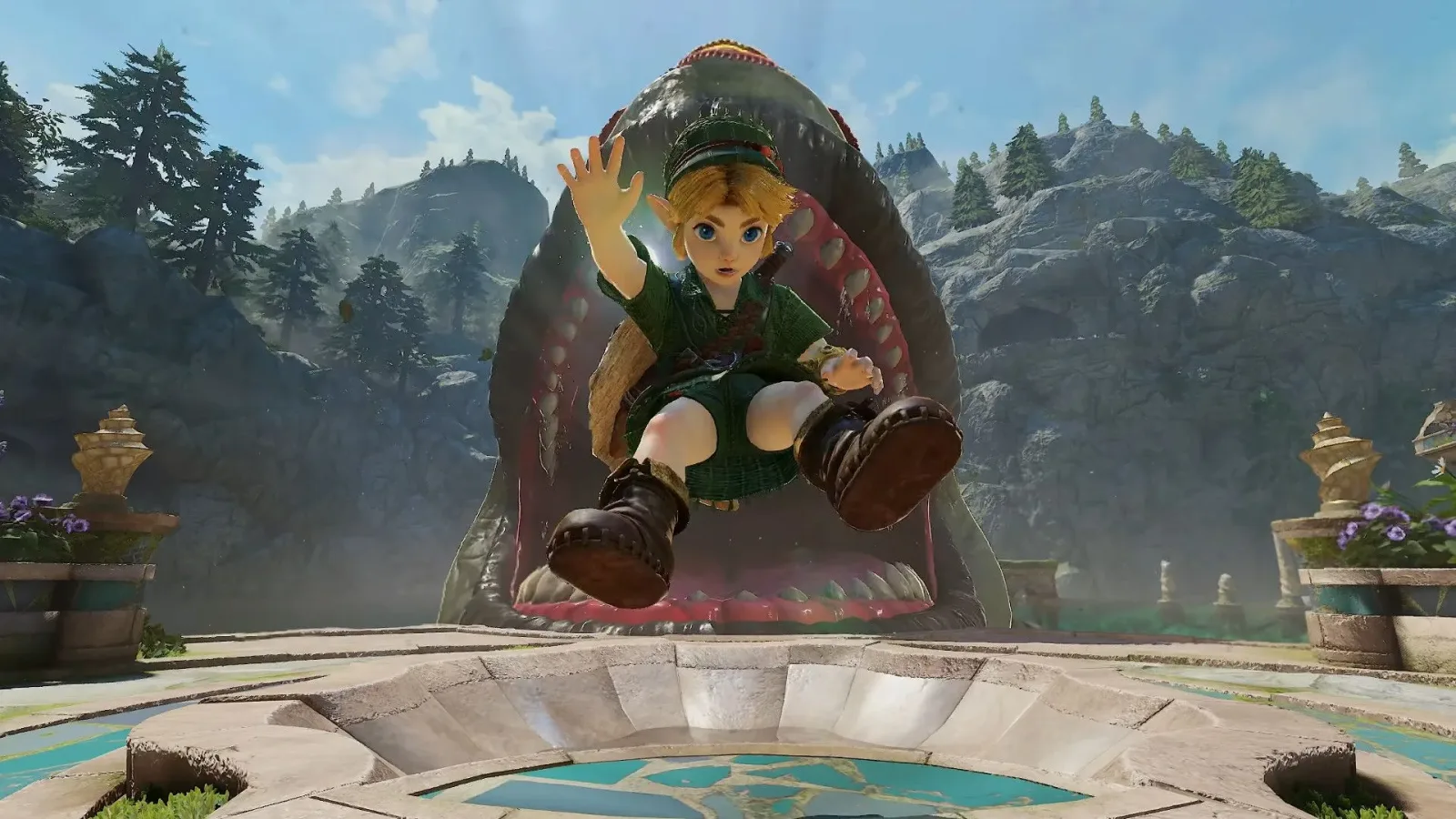
Nintendo's upcoming The Legend of Zelda: Ocarina of Time remake is preserving much of the 1998 adventure's identity, but it is not treating every original limitation as sacred. A new gameplay demonstration has confirmed several fundamental control changes: Link now has a dedicated jump button, the camera can be freely moved with the right stick, and the familiar technique of repeatedly rolling to travel faster has been replaced by a more straightforward sprint.
Those may sound like modest additions when viewed next to modern action-adventure games, especially newer Zelda entries. For Ocarina of Time, however, they touch systems that defined how players moved through Hyrule for nearly three decades. The original game was designed around an analog stick, a fixed camera framework, context-sensitive actions, and carefully bounded movement options. Its remake seems intent on retaining the world, dungeon flow, and classic structure while smoothing out some of the controls that have long felt dated to returning players.
The changes will likely spark a familiar remake debate. Some fans will welcome a version that feels less cumbersome without fundamentally changing the adventure. Others may wonder whether altering movement and traversal shifts the feel of one of Nintendo's most influential games. Either way, the remake is making more than a purely visual pass over Link's N64 quest.
A button for a move Link could not freely perform
The headline change is simple: Link can now jump whenever the player presses the assigned button. In the original Nintendo 64 release, jumping was not a general-purpose action. Link would leap automatically when he ran toward an appropriate edge or gap, while other forms of vertical movement were dictated by context, equipment, climbing surfaces, ladders, or scripted interactions.
For useful background on this topic, read The Legend of Zelda: Ocarina of Time remake Sets November 5, 2026 Launch.
That design made sense within the game's original controls and encounter design. Automatic jumps allowed the game to communicate where Link could safely clear a gap without forcing the player to precisely judge every leap. It also helped preserve the deliberate pace of platforming segments, many of which were built around ledges, moving platforms, timing challenges, and the camera's limitations.
Still, the absence of a jump button has always been one of the first surprises for newcomers. It was especially noticeable on the Nintendo 64, a system that also hosted Super Mario 64, whose entire design revolved around a highly flexible jump moveset. The contrast helped make Link's restricted mobility feel unusual even in 1998. Over the years, players have repeatedly asked for a way to hop on command, whether for convenience, exploration, combat expression, or simply the satisfaction of having direct control over a basic character action.
Nintendo producer Eiji Aonuma acknowledged during the gameplay presentation that a jump button and adjustable camera may appear obvious to people familiar with more recent installments. But obvious does not mean insignificant. These additions change the immediate relationship between player input and Link's movement, which is a major adjustment for a game originally built around automatic responses.
The demonstration establishes that players can now tap a button to make Link hop. What has not been detailed is the full extent of that move: Nintendo has not outlined whether it has any combat application, whether it can be used to bypass environmental boundaries, or whether it is governed by special restrictions in certain spaces. Those unanswered questions matter because even a small jump can have broad effects on navigation and level design.
For now, the key point is that the remake addresses an extremely old community request without indicating that it is rebuilding Hyrule into a completely different kind of open-ended platforming game.
Rolling is no longer the best way to get around
The other major adjustment concerns one of the original game's most enduring movement quirks. In classic Ocarina of Time, performing repeated forward rolls is slightly faster than simply running. Players quickly discovered that Link could cover ground more efficiently by constantly tapping the roll input, turning travel across Hyrule Field and other broad spaces into a rhythm of dives and recoveries.
It became such a recognizable behavior that it has remained relevant in speedrunning. Players chasing quicker completion times still use the technique, because every small movement advantage can matter when a route is optimized. Outside of speedrunning, many longtime fans adopted rolling simply because it was hard to ignore once they knew it worked.
The remake appears to directly solve that awkward incentive. Rather than encouraging players to repeatedly mash a button to move efficiently, Nintendo has added a sprint. Holding the roll button lets Link burst into a faster run, providing a clear and more natural method of crossing terrain at speed.
This is more than a quality-of-life tweak. It changes the game's movement language. In the original, rolling had two purposes: it was a short evasive animation and, when spammed, an unofficial travel technique. The remake separates the desire to go fast from the need to repeatedly perform a defensive-looking action. That should make ordinary exploration look cleaner and feel less physically demanding for players.
Notably, the gameplay shown so far does not indicate that sprinting is restricted by a stamina meter. If the final game allows Link to keep dashing indefinitely, the hold-to-sprint command may become the remake's default fastest way to move through the world. That would be a sizable practical difference for repeat players who know the map and spend a great deal of time traveling between destinations.
It could also affect how newcomers experience the adventure's scale. Hyrule Field was monumental by 1998 standards, and its lengthier crossings contributed to the sense of traveling through a connected kingdom. Faster travel could make familiar routes less tedious, though it may also subtly compress the feeling of distance. The final balance will depend on sprint speed, how often the game expects players to use it, and whether any areas place limits on the ability.
Right-stick camera control brings a modern expectation to classic Hyrule
The remake also gives players the ability to rotate the camera using the right stick, another capability unavailable on the original Nintendo 64 controller setup. The N64 version relied heavily on Z-targeting and contextual camera behavior, with C buttons serving numerous functions across the game's interface. It was a landmark system for 3D games at the time, but it can feel restrictive beside contemporary third-person controls.
Free right-stick camera movement should make basic exploration more comfortable, letting players look around environments without needing to reposition Link or depend solely on automatic angles. This could be particularly useful in dense locations, interiors, and spaces where players want to inspect vertical landmarks or search for points of interest.
At the same time, camera changes can be deceptively consequential in a game with puzzle rooms and carefully framed reveals. Ocarina of Time often used camera placement to direct attention toward doors, mechanisms, enemies, platforms, and environmental clues. The remake will need to retain that guidance while allowing greater player control. Aonuma's comments suggest Nintendo sees the feature as a modernization of the interface rather than a rejection of the original game's design principles.
A faithful remake with carefully chosen mechanical updates
Based on the footage discussed so far, Hyrule itself appears largely recognizable. The remake's biggest visible difference is its updated presentation, while the underlying world and adventure remain close to their original form. That approach will appeal to players looking for a familiar journey with less friction, but it may leave others uncertain about how transformative the project really is.
Visual remakes often face an unusually difficult standard when the original is as historically important as Ocarina of Time. The 1998 release established ideas that shaped 3D action-adventure design for years, from lock-on combat and environmental navigation to cinematic storytelling in a 3D world. Any revision is judged both as a new game and as an interpretation of a foundational classic.
The newly confirmed controls show Nintendo is willing to modify elements that once seemed inseparable from the game's identity. Yet these are targeted changes rather than evidence of a sweeping redesign. Link is more responsive, faster to move, and easier to aim visually, but the remake is still presenting itself as the same central quest through Hyrule.
That middle ground may be exactly what many players want. A dedicated jump button answers a request that has followed the game for 28 years. Sprinting removes the strange pressure to roll endlessly across every open area. Right-stick control aligns the camera with habits players have developed across generations of games. None of those changes automatically guarantee that every fan will prefer this version's overall look or philosophy, but they make the remake a more substantial gameplay revision than a simple graphical upgrade.
November release window confirmed
Nintendo has set the Ocarina of Time remake for release in November. The announcement places Link's return in an unusually crowded month, one that also includes the planned arrival of Grand Theft Auto 6.
There are still important details to learn ahead of launch, including how freely the new jump functions in every environment, whether sprinting has hidden limits, and how the updated controls interact with the game's combat and puzzles. For veterans, those specifics will determine whether the remake feels like a respectful refinement or a more meaningful reinterpretation. For players meeting this Hyrule for the first time, the changes may simply make one of gaming's most celebrated adventures feel more immediately approachable.
Community
Discussion
Start the conversation.
No comments have been posted yet.