

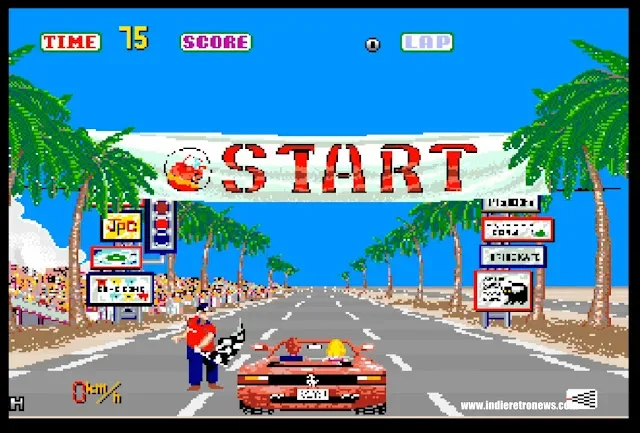
OutRun AGA is a newly released fan-made reimagining of Sega's defining arcade racer for Commodore Amiga hardware. Developed by retrodnagames, the project has an unusually specific goal: to give Amiga owners a version of the open-road racing classic designed around the capabilities of the machine's more advanced AGA-era configuration, rather than accepting the compromises associated with the official port released decades ago.
That makes this more than a simple retrospective conversion. OutRun AGA is presented as an ambitious ground-up effort, written in old-school assembly language and designed to run on hardware close to what Commodore users could have owned in 1993. Its technical approach is rooted in the Amiga itself, leaning on the platform's custom-chip architecture and a blitter-driven rendering method rather than treating the computer as a generic processor platform.
The result is particularly notable for retro hardware enthusiasts because it is aimed at real machines, not merely modern emulation environments. Players will need a PAL-based AGA Amiga, a standard 68020 CPU, and 4MB of fast RAM. Those requirements place the project firmly in the upper tier of classic Amiga configurations, while still keeping its intended target within the historical period the developer is seeking to evoke.
A Different Route for an Arcade Icon
OutRun remains one of the most recognizable arcade racing games ever made. Its identity comes from more than speed: the branching roads, shifting scenery, time pressure, and unforgettable sense of a coastal drive all helped distinguish it from racing games built around conventional lap competition. Sega's original arcade release became a landmark, but adapting an arcade game of that kind to home systems was always difficult.
For useful background on this topic, read Fix It Felix Jr. Brings Arcade Repairs to Amstrad CPC Plus and GX4000.
The Amiga was capable of impressive audiovisual work, yet arcade-style scaling racers were demanding in ways that exposed the differences between home computers and dedicated arcade boards. A convincing version needs to sustain the illusion of rapid movement while constantly redrawing the road, roadside objects, distant environments, traffic, and other visual elements. Maintaining that feeling of speed is as important as reproducing individual cars or backgrounds.
OutRun AGA enters that history as a response to the limitations players associated with the official Amiga adaptation. Rather than making a minor patch or adjustment, retrodnagames has built a new interpretation intended to better suit the machine's later AGA hardware. The premise is appealingly direct: use the Amiga's strengths as aggressively as possible and build an arcade racer around them from the outset.
It is also a reminder that the Amiga scene remains active long after the platform's commercial era. New games, ports, demos, tools, and hardware projects continue to appear because dedicated developers are still interested in exploring what these systems can do when development is not bound by the commercial schedules and memory constraints of their original release windows.
Assembly Code and Native Amiga Design
Retrodnagames coded OutRun AGA entirely in assembly language. For a project trying to reach a particular performance target on period hardware, that decision is significant. Assembly development gives a programmer extremely direct control over how a machine's processor and specialized hardware are used. It is demanding work, but it can be especially valuable on a system where every cycle, memory transfer, and display operation matters.
The project is described as being purely blitter-driven. On Amiga hardware, the blitter is a custom chip built to handle graphical operations efficiently, including moving and manipulating blocks of image data. In a fast-moving racing game, a development strategy centered on this dedicated hardware can help define the visual approach and performance behavior of the game.
This matters because OutRun AGA is not designed around the idea that a faster processor should simply brute-force better results. Its performance is tied to the native Amiga custom chips and the blitter-based design. As a consequence, installing a faster CPU will not make the game run faster. That may sound counterintuitive to players accustomed to modern PC gaming, where processor upgrades can improve frame rates, but it is an appropriate reflection of how tightly software can be coupled to classic hardware.
In practical terms, the game's expected speed is based on its intended configuration: a standard 68020-powered AGA Amiga with 4MB of fast RAM. The emphasis is not on scaling upward through modern accelerator cards. Instead, it is on delivering its intended experience on a close-to-original Commodore setup.
Hardware Requirements Are Part of the Project's Identity
The required PAL AGA configuration is not a footnote. It is central to what OutRun AGA is trying to accomplish. AGA, short for Advanced Graphics Architecture, arrived in Commodore's later Amiga systems and expanded the display capabilities available compared with earlier models. By targeting that environment, the project has a stronger foundation for its arcade-focused visual ambitions than an earlier baseline Amiga configuration would provide.
The PAL requirement is equally worth noting. Retro software can be sensitive to video standards, timing, refresh behavior, and region-specific expectations. Anyone preparing to play on original hardware should therefore pay attention to the stated PAL target rather than assuming that every Amiga setup will behave identically.
The standard 68020 CPU requirement also helps clarify the intended audience. OutRun AGA is not framed as a release for the most basic Amiga systems. It is for users with an AGA machine and the specified memory configuration, and it seeks to make the most of that particular level of hardware without requiring a faster processor upgrade.
That design philosophy has value beyond technical novelty. It gives the release a clear historical frame: this is an attempt to imagine an Amiga OutRun experience built for the sort of Commodore hardware available around 1993. Rather than asking what the game could become with later expansion hardware, the project asks what might have been possible if the original conversion had taken a more focused route on contemporary AGA machines.
No Modern Shortcuts in the Development Approach
Retrodnagames has also stated that no generative AI was used during OutRun AGA's creation. The developer's stated aim is an authentic arcade experience, and that declaration places the work within a hands-on tradition that remains important to many retro developers and players.
For this kind of release, authenticity can mean several things at once. It can refer to the use of period-appropriate programming techniques, the decision to run on original hardware, the visual and mechanical goal of recreating an arcade sensation, and the straightforward craft of building the software directly for a specific machine. OutRun AGA's assembly-language implementation and reliance on native chips already speak strongly to that ethos; the developer's stance on generative AI makes the intended creative process explicit as well.
Of course, authenticity does not require a project to be a museum piece. Fan-made releases are often exciting precisely because they allow developers to revisit old hardware with the benefit of hindsight, persistence, and a community eager to test the limits of systems that commercial publishers have long since left behind. The achievement is not that the software was made under the exact constraints of 1993, but that it has been shaped to feel at home on hardware from that era.
Why OutRun AGA Stands Out
The retro scene has no shortage of ports, conversions, and tributes, but OutRun AGA stands apart because of the clarity of its technical mission. It is not simply bringing a familiar name to an older platform. It is trying to replace a version that many fans felt did not meet the potential of the Amiga, while making the replacement answerable to genuine period hardware.
That makes performance an essential part of the conversation. A racing game inspired by OutRun lives or dies on motion, rhythm, responsiveness, and the persuasive rush of the road unfolding ahead. A project designed around the blitter and AGA Amiga architecture is therefore making a commitment not just to graphical detail, but to the conditions necessary for that arcade feeling.
For Amiga collectors and active users, the release offers another reason to keep an AGA machine configured and maintained. For retro game fans more broadly, it is a compelling example of a long-running truth: classic platforms still have new stories to tell when developers are willing to study their architecture deeply enough.
OutRun AGA arrives as both a tribute to Sega's arcade original and a focused technical showcase for Commodore's later Amiga hardware. With a PAL AGA Amiga, 4MB of fast RAM, and a standard 68020 CPU, players can experience the project on the kind of system it was built to serve. Faster CPUs need not apply; in this case, the custom chips are the engine driving the ride.
Community
Discussion
Start the conversation.
No comments have been posted yet.