


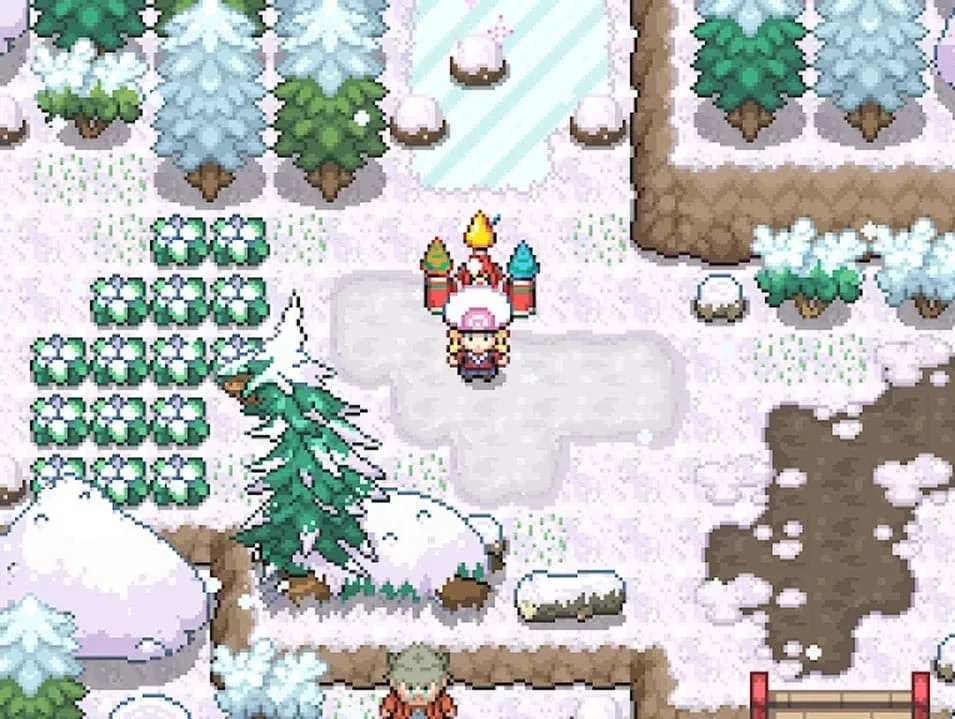
Pokémon Axón is inviting players into Karelia, a newly introduced region that frames its adventure around an "Ancient Russia" aesthetic while mixing in elements closer to a more recent era. The project comes from a Spanish developer and presents a large original setting shaped by Slavic-inspired cultural references, extensive settlement exploration, secret areas, regional Pokémon forms and entirely new creature designs.
Its most immediately striking idea is the setting. Pokémon stories have often taken players through regions built around broad real-world influences, but Axón places particular attention on a version of Karelia intended to evoke the scale, architecture and cultural atmosphere associated with Russia and the wider Slavic world. That approach gives the game a distinct identity before players even reach its new Pokémon and starter choices.
Although the project uses the "Ancient Russia" description, its setting is not being positioned as a literal historical recreation. The developer has explained that Karelia is not especially far removed from the present day. Instead, the game appears to use the label as a tonal shorthand for a world where Slavic cultural inspiration is highly visible across communities, locations and characterful details.
A large Karelia region with cities, towns and secrets
Scale is a major part of Pokémon Axón's pitch. Karelia contains 25 towns and 36 cities, giving the region a substantial number of named places for players to encounter during the adventure. Beyond the main settlements, the game also includes additional locations and concealed areas, encouraging exploration beyond the most obvious routes.
For useful background on this topic, read Songs of Glimmerwick Makes Magic School Feel Like a Place to Linger.
That number of towns and cities suggests that the project is aiming for a journey built around variety rather than a single uniform interpretation of its inspiration. Russia spans an enormous geographic area and contains many cultures, landscapes and local identities; Axón's approach appears designed to reflect a sense of that breadth through a region with many destinations instead of only a handful of major hubs.
The result is a premise with room for very different kinds of Pokémon locations. A city may communicate one side of Karelia's identity, while a smaller town, roadside stop or hidden area can reveal another. The available details do not outline every individual destination or story beat, but the advertised settlement count makes it clear that exploration is central to the experience.
For Pokémon fans, regional identity matters as much as raw map size. The most memorable series settings tend to connect architecture, routes, local traditions, Pokémon habitats and character design into a consistent whole. Axón is attempting to establish that kind of personality through its cultural framing, while still delivering the familiar appeal of travelling from place to place and uncovering what lies off the expected path.
Vodka is a recurring piece of the region's personality
One notable recurring theme in Pokémon Axón is vodka. The drink is treated as a prominent cultural reference within the game's presentation, appearing in examples such as a street stall and an Ursaring relaxing with a bottle. It is also directly tied to one of the project's newly revealed Pokémon concepts.
That choice gives the game a playful, exaggerated visual motif. Pokémon has a long tradition of turning everyday items, foods, myths and local associations into creatures and environmental details. Axón applies that same design language to one of the cultural signposts most widely associated with Russia, using it both as background flavour and as the basis for an original Pokémon family.
As with the rest of Karelia's setting, this is best understood as stylized fantasy rather than a comprehensive account of any real culture or history. The game's use of Slavic-influenced ideas is part of its fictional worldbuilding, and its comedic visual touches sit alongside the more conventional Pokémon adventure structure of travelling, meeting creatures and discovering new areas.
Gimmishot and Vhodkengo join the game as convergent species
Pokémon Axón has revealed a new convergent species line called Gimmishot and Vhodkengo. The pair is described as recalling the evolutionary line of Gholdengo, but they are presented as a separate species concept rather than simply another regional form. Their design revolves around collecting a mysterious liquor in large quantities, firmly connecting them to the game's vodka motif.
The distinction is meaningful for players who follow newer Pokémon design terminology. Regional variants generally reimagine an existing Pokémon species for a different environment, retaining its basic identity while changing its appearance, typing or evolution path. Convergent species, by comparison, are Pokémon that resemble familiar creatures because of a similar concept or evolutionary outcome, but are treated as distinct species in their own right.
Gimmishot and Vhodkengo therefore appear to use the recognizable silhouette and progression associated with Gimmighoul and Gholdengo as a creative starting point, while taking the idea in a separate direction. Their names also underline the intended connection to alcohol-themed imagery. The reveal gives Axón a creature concept that is immediately recognizable to modern Pokémon players while remaining closely tied to the identity of Karelia.
Original species and reinterpretations are often among the most closely watched features of a Pokémon fan project. They can make a familiar monster-collecting format feel particular to one region, especially when their designs are rooted in the setting rather than introduced as isolated curiosities. In Axón's case, the convergent line is one of the clearest examples so far of its setting and Pokémon concepts being developed together.
Regional starter options include Snivy, Totodile and Litten
Players beginning their journey in Pokémon Axón will not be choosing from an entirely unknown trio. Instead, the project offers regional variants of Snivy, Totodile and Litten as its starter Pokémon. The selection brings together starters from several different generations, with Snivy originating in the Unova games, Totodile in Johto and Litten in Alola.
Using regional versions of established Pokémon gives Axón a useful balance. These starters carry built-in familiarity, since players already know their standard forms and evolutionary families, but regional redesigns can still make the opening decision feel fresh. The concept also fits the broader premise of travelling through a region whose environment and cultural influences have created a different expression of Pokémon species fans already recognize.
No additional details have been outlined here about the variants' types, evolution changes, abilities or battle roles. That leaves the starter trio as an intriguing early choice rather than a fully explained one. Players interested in a particular starter may want to discover how Axón's versions differ through the game itself instead of expecting the usual characteristics of Snivy, Totodile or Litten to remain unchanged.
The trio also indicates that Axón is not restricting itself to a single generation of Pokémon ideas. By drawing from Johto, Unova and Alola at the outset, the project signals a willingness to combine different eras of the wider Pokémon catalogue within its own regional framework.
An original journey built around a specific atmosphere
Pokémon Axón's appeal rests on more than any one feature. Karelia's large list of towns and cities, its hidden locations, its Slavic-inspired tone, its regional starter variants and its vodka-themed convergent species all point toward a project with a strong authorial theme. Rather than offering a generic new map, it is trying to make its setting the reason players remember the journey.
There is also an understandable degree of uncertainty around a project of this kind. The available overview highlights its premise and several featured Pokémon, but does not provide a complete breakdown of every mechanic, story event, platform or future update plan. The best picture currently available is of an adventure focused on exploring a substantial original region with a deliberately unusual cultural flavour.
For players curious about the game, Pokémon Axón is available to download through its official website. Its central proposition is straightforward: a new Pokémon adventure set in a fictional Karelia, one that uses broad Slavic inspiration and a sizable map to create a very different backdrop for familiar Pokémon traditions.
Community
Discussion
Start the conversation.
No comments have been posted yet.