

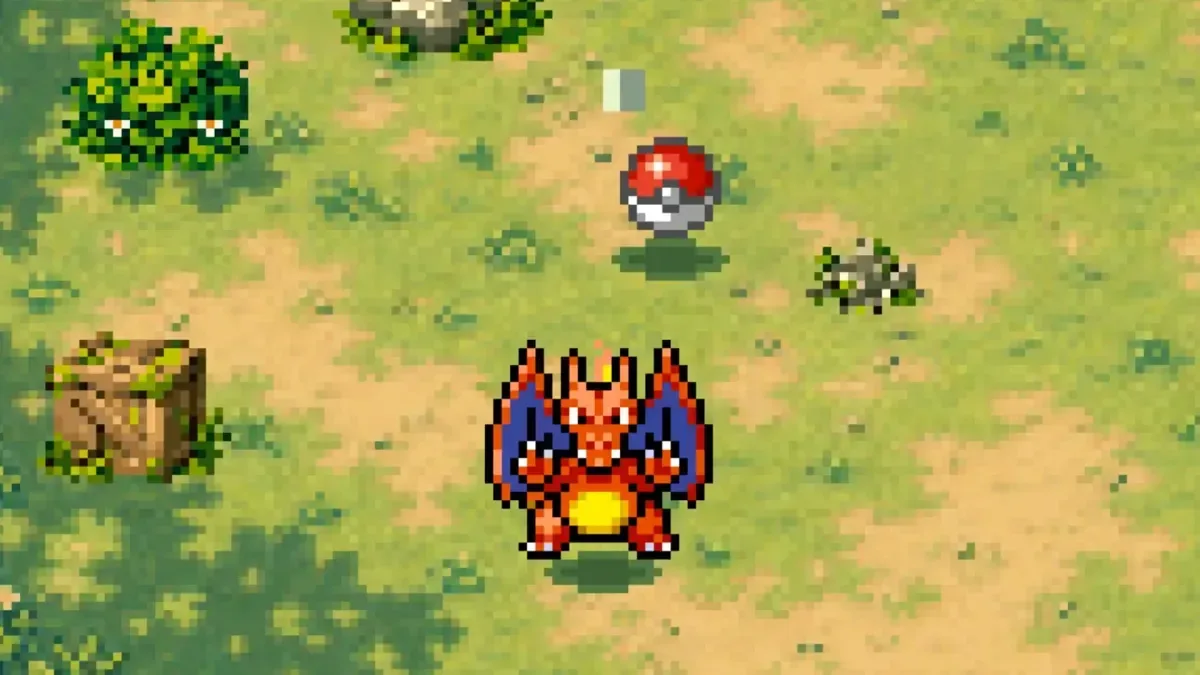
Pokémon Emerald Arena, the fan-made ROM hack that reworks parts of Pokémon Emerald around real-time arena combat, has received another round of updates. The project now lets players catch arena Pokémon with Poké Balls and add them to their party, while a new pause-menu option allows active moves to be changed during a fight.
The update represents a meaningful expansion of the hack's central idea. Pokémon Emerald was originally built around turn-based encounters, with players and opponents choosing moves through menus before watching each action resolve in sequence. Emerald Arena retains the familiar Hoenn framework but introduces a separate combat approach for a growing selection of creatures: direct, real-time battles in an arena environment.
It remains an early and selective implementation rather than a complete conversion of the entire game. Only a limited group of Pokémon currently supports the arena format, estimated at more than 20 creatures. Pokémon outside that supported pool continue to use the traditional battle system. Even so, the new features make the real-time mode feel less like an isolated demonstration and more connected to the wider adventure.
Poké Balls Now Matter Inside the Arena
Perhaps the most important addition is the ability to use Poké Balls during arena encounters. Players can now catch Pokémon in that mode, and successful captures place those Pokémon into the player's team. That is a major step for a Pokémon-focused project, since recruitment and party building are fundamental to the series' appeal.
For useful background on this topic, read Crash Bash Online Brings PS1 Party Battles to Browsers.
Before this change, the arena's real-time action could stand apart from the usual rhythm of exploring, finding Pokémon, catching them and assembling a flexible team. Letting arena battles feed captured monsters back into the party helps close that gap. It gives encounters a practical reward beyond simply testing the new battle system, while also creating a stronger reason to seek out compatible fighters.
How extensively this system will develop is still unclear. There is no indication that every Pokémon, location or encounter has been rebuilt for arena play, and the project's supported roster remains limited. But the capture feature establishes an important foundation: real-time arena opponents are no longer merely combatants to defeat, but potential additions to a player's roster.
Move Switching Adds Tactical Flexibility
The update also introduces on-the-fly move changes. During an arena battle, players can open a menu that pauses the action and select a different active move. This is a relatively simple quality-of-life addition, but it addresses a key challenge in translating Pokémon's move-based design into a real-time format.
In a conventional Pokémon battle, the player is constantly choosing among a creature's available attacks, status moves and other options. A real-time system can risk reducing that choice if it limits a Pokémon to one action at a time without an easy way to adapt. The new menu keeps the pace manageable while preserving the importance of a Pokémon's wider moveset.
Pausing while making the selection is especially useful. It means players do not have to wrestle with menus while reacting to attacks in real time, and it should make the feature more approachable for anyone accustomed to the original games' deliberate command structure. The change was also a frequently requested feature within the project's community, making it both a mechanical improvement and a response to player feedback.
More Hoenn Starters Join the Supported Roster
The arena-compatible selection has expanded as well. The latest additions include Pokémon from Hoenn's three starter families: Treecko, Grovyle and Sceptile; Torchic, Combusken and Blaziken; and Mudkip, Marshtomp and Swampert.
Adding all three evolutionary lines is a sensible milestone for a hack based on Pokémon Emerald. These are some of the region's most recognizable Pokémon, and they offer very different identities for real-time combat. Treecko's line suggests speed and mobility, Torchic's line brings the appeal of increasingly powerful Fire- and Fighting-oriented forms, and Mudkip's line supplies bulkier Water/Ground options by the time it reaches Swampert.
The additions also give players more room to compare how the arena system handles different creatures and evolution stages. A real-time Pokémon battle mode needs more than a large number of names; each fighter needs to feel functional enough to justify its inclusion. Expanding by complete evolutionary families could be a practical way to test that balance while giving the roster a more coherent shape.
For now, the division between arena-ready Pokémon and the standard battle system remains central to the hack. Players should expect some encounters to transition into the new real-time format while others continue to behave much as they do in the original Emerald. That hybrid approach may be necessary during development, though it also means the overall experience can vary depending on which Pokémon are involved.
A Promising Concept Still Being Refined
Pokémon Emerald Arena is an ambitious reinterpretation of a Game Boy Advance classic, but it is also still being refined. Earlier versions showed rough edges, including bugs, unusual behavior and visual inconsistencies. Developer German Burgardt has continued to polish the project while adding features, and this update indicates that work is happening on both usability and the amount of available content.
ROM hacks often evolve in public through frequent patches, experiments and community feedback. That process can be especially visible in a project attempting a dramatic systems-level change rather than a more familiar challenge run, story rewrite or roster adjustment. Converting a turn-based RPG's battles into real-time action is a large technical and design undertaking, and it can expose issues that are not present in a conventional hack.
The latest changes show an effort to improve the experience in ways players will immediately notice. Capturing Pokémon gives arena battles a clearer place in progression. Move switching gives players greater control once combat begins. More supported species make the system feel less restricted. Together, those features point toward an arena mode that is becoming more integrated with the structure people expect from a Pokémon game.
AI-Generated Art Remains a Point of Debate
The project has also drawn criticism over its use of AI-generated visuals in battle-arena assets. German Burgardt has described the project as AI-assisted, and generated art remains present in a number of its visual elements. Concerns raised by players and observers include the quality and consistency of those assets, along with broader objections to generative systems being trained on creative work without clear permission or compensation for artists.
Burgardt has said he would look into replacing the generated visuals with human-made art, but there is no confirmation that a change has happened. As a result, the issue remains unresolved. For some players, the real-time battle concept and technical experimentation will be the main draw; for others, the continued use of generated assets may be a reason to avoid the project regardless of its gameplay progress.
That conversation is likely to continue as the hack develops. Visual presentation matters particularly strongly in a retro project based on a beloved game, where players often value sprite work, pixel art and fan-made craftsmanship as much as mechanical changes. Replacing AI-generated material with original work by human artists could make the presentation more cohesive while answering a major concern surrounding the hack.
What Comes Next for Emerald Arena
There is no announced timetable for when the remaining Pokémon might receive arena support, or whether the project ultimately aims to convert all of Emerald's battling to real-time combat. At present, Pokémon Emerald Arena is best viewed as an evolving fan project with a distinctive premise rather than a finished replacement for the original game's battle system.
Still, this update gives the concept more substance. Catchable arena Pokémon, party integration, selectable moves and the arrival of Hoenn's starter lines all make the mode more compelling than a basic combat experiment. If future patches continue to improve stability, broaden the roster and address the project's contested visual assets, Emerald Arena could become an increasingly notable example of how far a Pokémon Emerald ROM hack can push the Game Boy Advance original in a new direction.
Community
Discussion
Start the conversation.
No comments have been posted yet.