


Pokémon cards may be highly visible as collectibles, but their real depth appears once they hit the table. Building a functional Pokémon Trading Card Game deck is about much more than collecting powerful-looking Pokémon or filling a list with personal favorites. A competitive deck needs to find its cards quickly, establish a board reliably, manage its resources, and present a threat that an opponent must answer.
That can be a daunting prospect for players moving beyond casual games. The modern Pokémon TCG has a huge player base, major events with prize pools exceeding $1 million, and a constantly evolving competitive environment. Fortunately, the principles behind a solid deck are less mysterious than they first seem.
Drew Stephenson, runner-up at the 2026 Pokémon Europe International Championships, along with World Championship TCG commentators Joe Bernard and Ross Gilbert, have highlighted several fundamentals that can help new and experienced players approach deckbuilding with a clearer plan. Their advice begins with an important change in perspective: do not start with the flashiest attacker. Start with the machinery that lets the deck work.
1. Choose the engine before choosing the stars
In Pokémon TCG terms, an engine is the interconnected group of cards that helps a deck draw, search, discard, recycle, or otherwise access the pieces it needs. It is what turns a stack of individually good cards into a strategy that functions from game to game.
For useful background on this topic, read Hidemaro Fujibayashi Says Zelda's Future Should Be Built on New Ideas, Not Recycled Ones.
Gilbert's guidance is straightforward: players should think about their engine first rather than selecting a deck solely around a favorite Pokémon. Once a player knows how their list will draw through cards and put Pokémon into play, it becomes far easier to choose attackers that benefit from that setup.
This is a valuable rule because Pokémon TCG games can be decided early. A deck that cannot find its Basic Pokémon, evolve on time, access Energy, or reach the correct Trainer card may never get a meaningful chance to use its strongest attacks. Conversely, a deck with a dependable engine can recover from an imperfect opening hand and keep applying pressure over multiple turns.
Stephenson similarly frames a deck as a system rather than a collection. Every inclusion should have a relationship with other cards in the list. If an Item card searches for a particular Pokémon, for example, players should ask whether that target is sufficiently accessible and whether finding it advances the wider game plan. A card that only looks useful in isolation may create awkward hands if it does not connect to the rest of the deck.
When examining an engine, ask a few practical questions:
- How will the deck get its initial Pokémon into play?
- How will it draw additional cards once its hand becomes small?
- How does it locate evolution pieces, attackers, and Energy at the right time?
- Can it continue operating if a key Pokémon is Knocked Out?
- Does each search or draw card have several useful targets?
The goal is not necessarily to make every game play identically. It is to make sure the deck can begin playing its intended game often enough that individual variance does not decide every match.
2. Give Trainer cards the respect they deserve
Newer players often devote too much space to Pokémon and Energy while treating Trainer cards as optional support. That is one of the quickest ways to make a deck inconsistent. Powerful Pokémon do not matter much if they remain in the deck, cannot evolve, or arrive a turn too late.
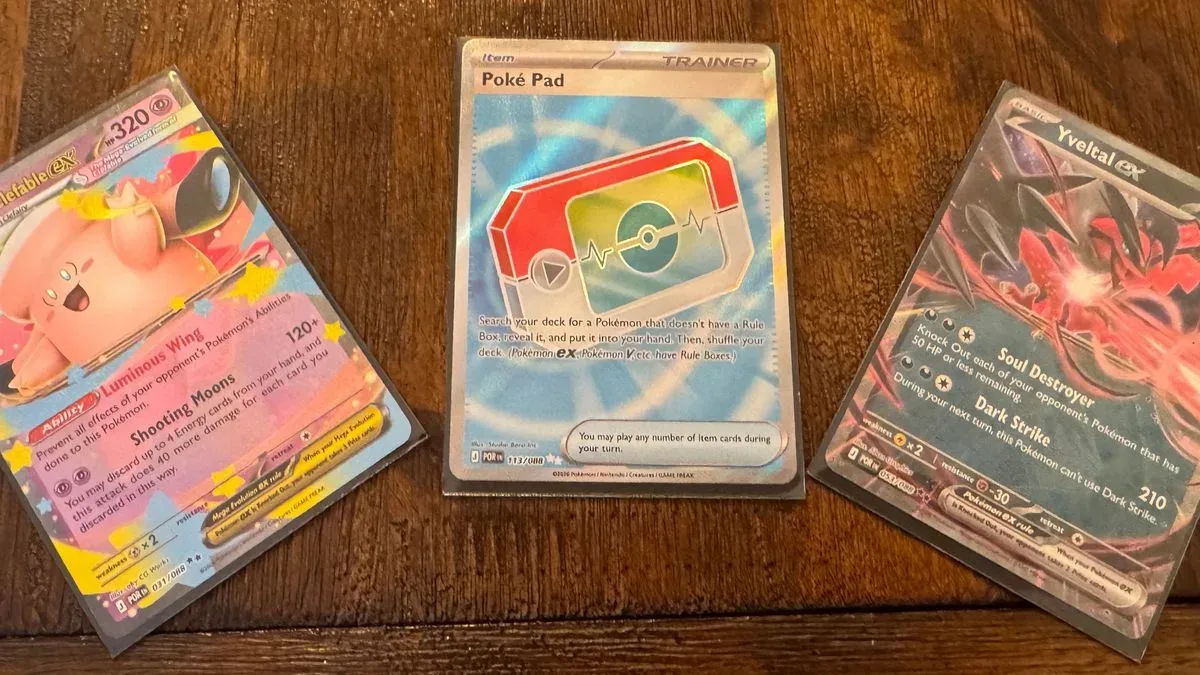
Stephenson stresses that Trainer cards are especially important because the game puts limits on some basic actions. A player can generally attach only one Energy from hand each turn, and evolution has its own timing constraints. Item cards are different: players can use as many as they are able to play during their turn. That gives Items enormous potential to search for pieces, shape a hand, and build a board before an attack is even declared.
Bernard identifies searching and drawing as the core requirements. Before adding narrow counters or extra attackers, a deck should contain enough Trainers to ensure it actually gets into the game. This can mean searching for Basic Pokémon on the opening turns, finding evolution cards afterward, drawing into follow-up options, or retrieving the resources needed after a difficult knockout.
It is useful to think of Trainer cards as the deck's decision-making tools. Pokémon may provide the main attacks, but Trainers let the player decide when those attacks become available. They also make turns flexible. A hand full of Pokémon might offer potential; a hand with the right Trainers offers a route to realizing that potential immediately.
That does not mean every Trainer card belongs in every deck. The important point is function. A well-built list has enough cards dedicated to finding, drawing, and sequencing its core pieces that it can execute the same broad plan with regularity.
3. Build around three Trainer pillars
While exact card choices change with the format, Gilbert highlights three enduring Trainer functions that deserve special attention: Pokémon search, draw Supporters, and gusting effects. Together, they address the most common needs of a competitive deck: assembling a board, refilling the hand, and interacting directly with an opponent's board.
Pokémon search Items
Search cards reduce the chance of missing the Pokémon necessary to set up. Gilbert points to cards such as Buddy-Buddy Poffin and Ultra Ball as examples of search Items players may consider when legal in the relevant format. Ultra Ball is particularly flexible because it can find any type of Pokémon, a trait Bernard singles out as a major strength.
Search cards are not only about opening turns. They can find a replacement attacker, locate an evolution at the correct moment, or turn an otherwise weak hand into a playable one. Their value rises further when the rest of the deck can make effective use of the cards they fetch.
Draw Supporters
Supporters that refresh or expand a hand form another essential part of consistency. Gilbert and Bernard both mention Lillie's Determination as a particularly strong example in the current environment. Stephenson explains that its effect shuffles the hand into the deck and draws eight cards, potentially providing a fresh collection of engine pieces and setup options.
A strong draw Supporter can do more than rescue a bad hand. It can help a player find the final card needed for a knockout, recover after spending resources, or assemble a multi-card sequence. Because Supporter use is limited, deciding when to play a draw card rather than a more specialized option is also part of the skill involved.
Gusting effects
Finally, competitive decks need a way to influence which opposing Pokémon is Active. Cards such as Boss's Orders can bring a Benched Pokémon forward, a maneuver generally known as gusting. Gilbert notes that gusting has been fundamental since the Base Set era, and it remains important because it lets players target vulnerable support Pokémon or attackers that are being prepared on the Bench.
Bernard describes gusting as a way to create a faster win condition. Rather than attacking only what an opponent presents, a player can choose a target that disrupts the opposing setup or offers a more efficient path through Prize cards. The exact timing matters greatly: using a gust effect too early can waste an opportunity, while holding it for the correct turn can decide a match.
4. Make your strategy consistent before adding narrow counters
It is tempting to fill a deck with "tech" cards: single-card answers designed to defeat a particular popular matchup. These choices can be valuable, but Bernard cautions against allowing matchup anxiety to overwhelm the central strategy of a deck.
Players should absolutely understand the metagame and know what they are likely to face at tournaments. A counter that targets a deck rarely encountered at an event may simply become a dead card. More importantly, a list packed with one-of answers can lose the ability to reliably perform its own primary plan.
Simplicity has real competitive value. When a deck runs high counts of the cards it needs most, it has a better chance of drawing them naturally and accessing them through its search cards. Clean lists with repeated copies of core pieces are easier to pilot, easier to test, and more likely to execute the intended strategy from one round to the next.
Before adding a tech card, players can ask whether it improves enough matchups to justify the lost consistency. If it does, it may earn a slot. If its only purpose is to solve a rare scenario, the better choice may be another copy of a card that makes the deck function every game.
5. Learn from proven lists, then create your own edge
Online deck databases and tournament results have made it easier than ever to find established Pokémon TCG lists. Gilbert recommends using Limitless TCG to examine individual decks and see how frequently certain cards appear. Copying, or "netdecking," a proven list is not a shortcut that prevents learning; it can be one of the best ways to learn why successful decks use particular counts and combinations.
A player can take a successful list, play numerous games with it, identify which choices feel awkward or especially useful, and then adapt the deck to their own decision-making style. This process gives changes a purpose. Rather than altering cards at random, the player understands what the original list is trying to accomplish and can judge whether a revision truly improves it.
Stephenson also sees an opportunity in the widespread reliance on published tournament lists. When many players expect the same established strategies, an unexpected card choice or a less familiar combination can produce a meaningful advantage. He notes that creative and "spicy" strategies can succeed precisely because opponents have become accustomed to certain patterns.
Innovation should not mean abandoning the fundamentals. The best surprise is still supported by a functional engine, sufficient search, dependable draw, and a clear route to winning. Creativity becomes powerful when it is built on consistency rather than used as a substitute for it.
For players looking to move from collecting to competing, the path is clear: establish an engine, prioritize Trainers, cover the three key Trainer functions, keep the deck's plan reliable, and test thoughtful changes. Pokémon TCG deckbuilding is an ongoing process, not a single finished list. The more games a player plays, the more clearly they can see whether their deck is doing what it was built to do.


Community
Discussion
Start the conversation.
No comments have been posted yet.