

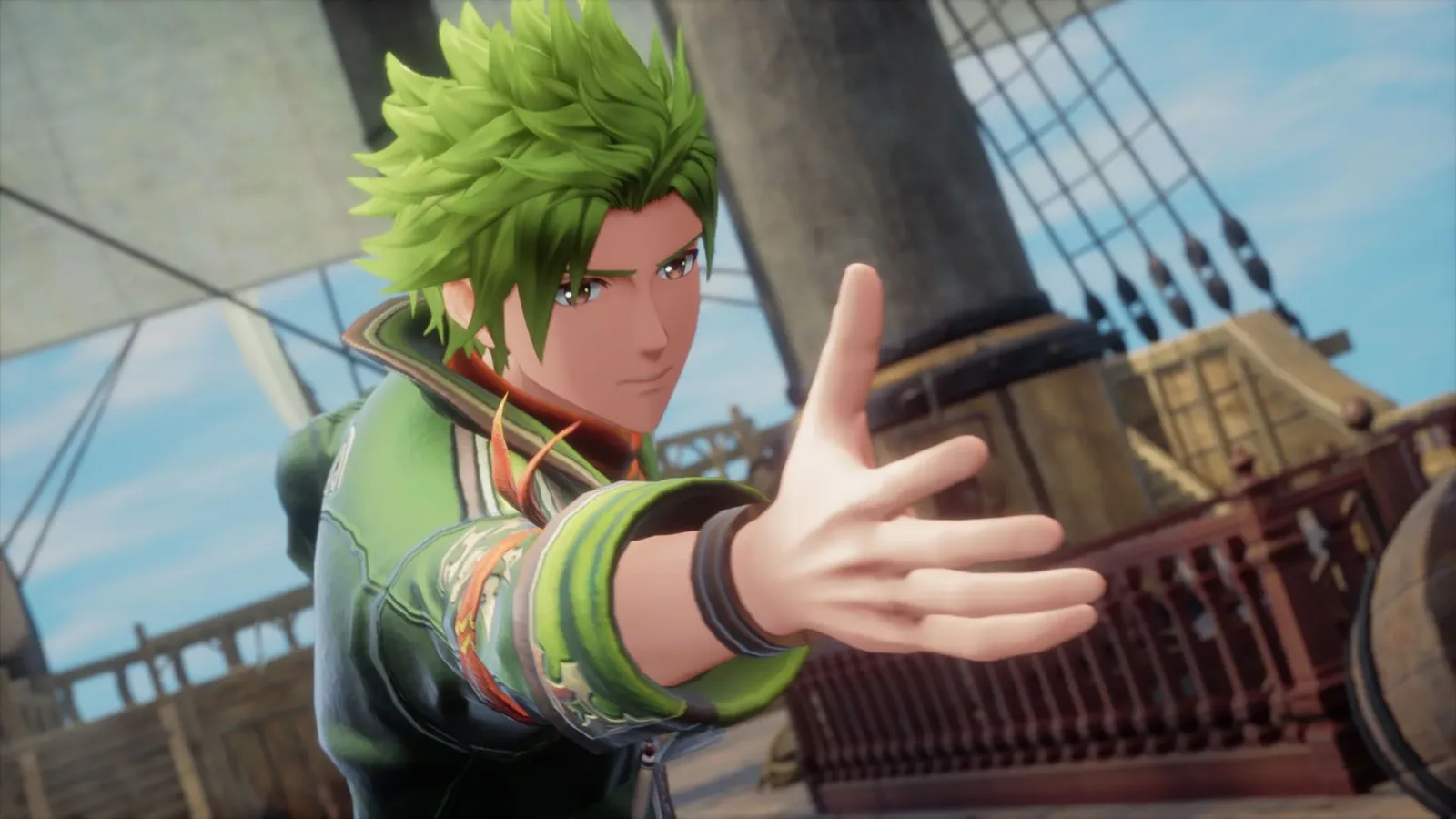
Romancing SaGa 3: Destinies United has a familiar premise on paper. It is a 3D remake of the 1995 JRPG, it uses turn-based battles, and it asks players to guide a party through dangerous dungeons packed with monsters. Yet a recent hands-on session suggests that the remake's most compelling quality may be how little it wants combat to become routine.
Rather than treating each random encounter or dungeon fight as a brief obstacle on the way to the next story beat, Romancing SaGa 3: Destinies United appears determined to make every battle an opportunity. The key is its Glimmer system: an idea-driven mechanic that can transform a standard attack into a new ability in the middle of combat. Combined with readable party formations, weapon-based experimentation, and powerful United Attacks, it gives the remake a battle loop that rewards curiosity just as much as efficient damage dealing.
That approach may be especially welcome for players who have watched the SaGa series from a distance. The franchise has long had a reputation for distinctive systems and an unconventional structure, which can make it intimidating to newcomers. But the opening impression from this combat-focused slice is not one of impenetrable complexity. Instead, it is of a game constantly presenting another lever to pull, another move to try, and another reason to see what happens if a party takes a chance.
A strange party is an immediate strength
The preview begins by throwing players directly into a capable but decidedly unusual adventuring group. Khalid leads the party, joined by Peony, a fairy wielding an oversized spear; a masked figure with the look of a costumed superhero; and Flurry, a snowman with especially prominent eyebrows. It is a line-up with enough personality in its silhouettes alone to make the team feel memorable before the larger story has a chance to establish everyone's history.
For useful background on this topic, read Escape From Playtime week-one update Adds Public Lobbies, Lore and Group Balance Changes.
That oddball energy matters because JRPG combat can often become abstract. Players may spend dozens of hours looking at numerical damage, elemental weaknesses, status effects, and ability lists. A party whose members are immediately visually distinct helps make those systems feel attached to characters rather than faceless units. When Peony turns a basic spear strike into something more dramatic, or when Flurry contributes to a larger combo, the battle is not simply delivering a better calculation. It is building the identity of a group.
The remake's core loop starts in recognizable fashion. Enemies are encountered in the overworld, and striking first grants an advantage before combat moves into turn-based commands. That foundation is intentionally approachable. Players understand the broad rhythm: select actions, consider turn order, locate weaknesses, and survive long enough to wear down the opposition.
Romancing SaGa 3: Destinies United begins to separate itself from that template once its mechanics start interacting. The point is not merely to choose the strongest option already available. It is to consider whether a seemingly ordinary action might produce a more exciting one.
Glimmer turns attacks into discoveries
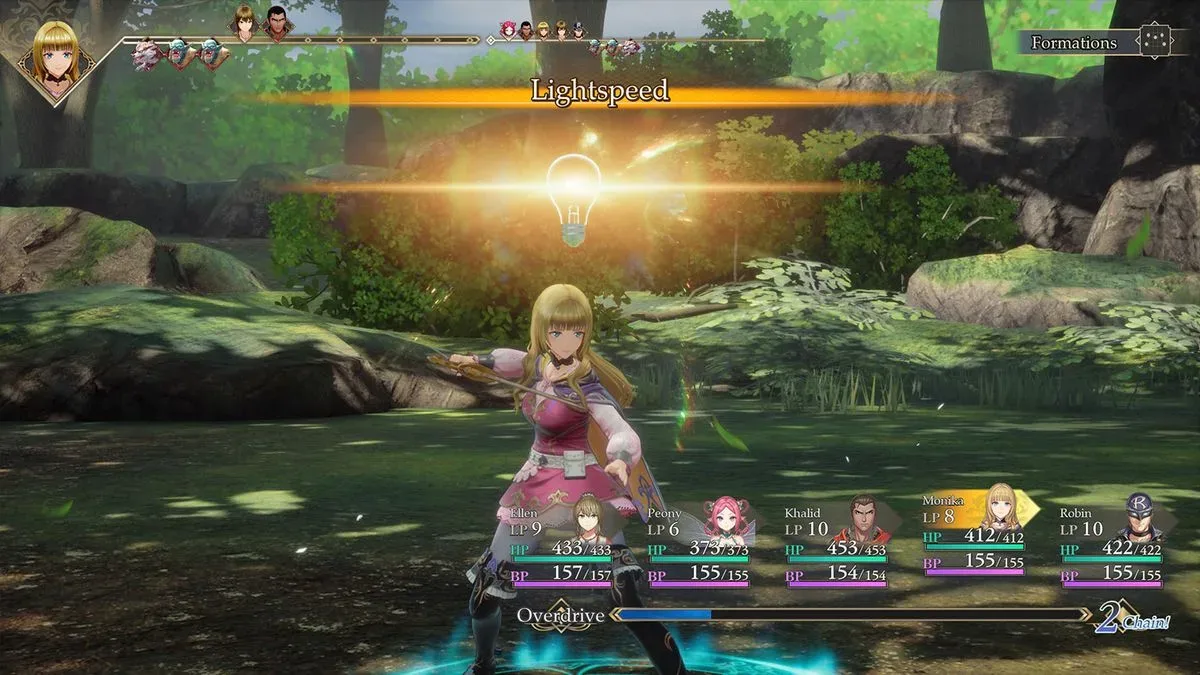
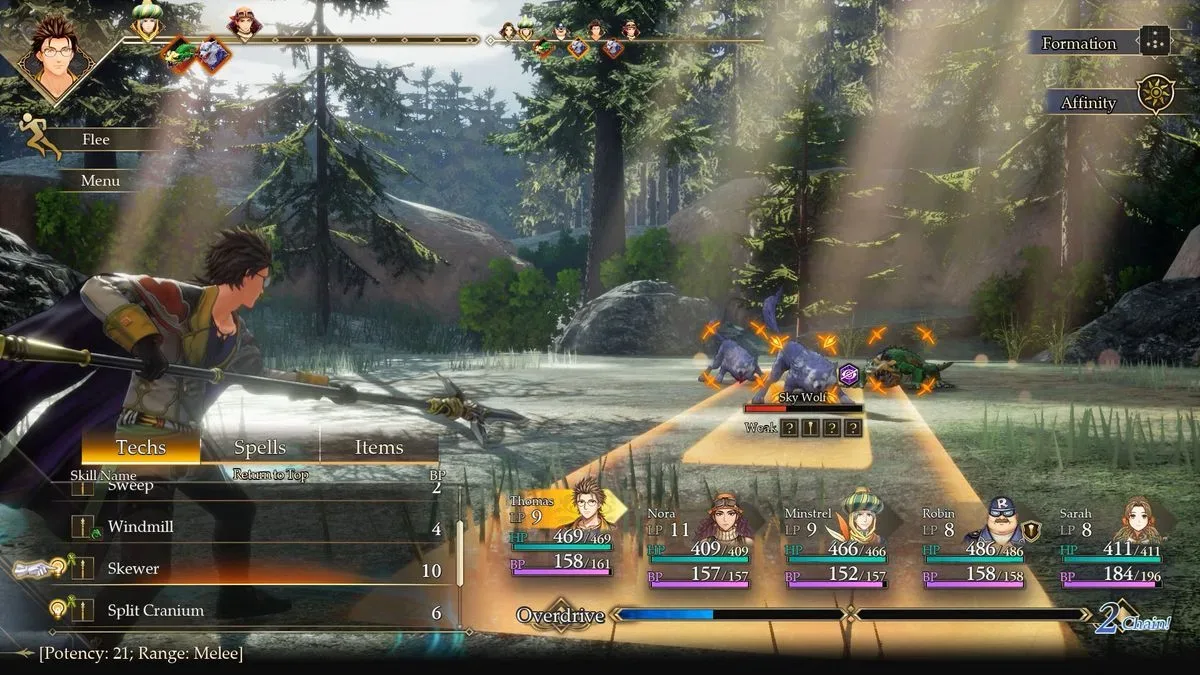
The Glimmer system is the feature most likely to define the remake's battles. A lightbulb icon beside an attack signals that it has the potential to evolve into something new. In the hands-on session, using Peony's Spear Attack can lead to a fresh technique called Giant Swing. Once learned, the new move is added to her growing selection of combat options.
It is a simple idea with a meaningful effect on player behavior. Normally, a basic attack in a turn-based RPG is something a player may use only when conserving resources or when an enemy is nearly defeated. Here, even a familiar command can carry the possibility of a breakthrough. An encounter that might otherwise be solved through the same reliable routine suddenly contains a small but tantalizing gamble.
That makes the act of choosing an attack more interesting. A player can focus on exploiting an opponent's known weakness and pursuing the safest route to victory. Or they can use an attack with Glimmer potential and see whether the party member discovers a stronger technique. The choice is not entirely detached from tactical considerations, but it introduces an improvisational streak to a genre often built around carefully planned ability rotations.
There are limits. Characters have a finite number of ability slots, so accumulating techniques is not simply a matter of endlessly collecting every move forever. That restriction should make decisions about a character's kit more important over time. It also prevents discovery from becoming a purely automatic process: finding an ability is exciting, but deciding what remains equipped should be part of shaping the party.
Weapon choice adds another layer. Certain attacks and spells can only be Glimmered while a character has the appropriate weapon equipped. The preview did not provide enough time to explore weapon swapping in depth, but the implication is clear. A character's loadout influences not only what they can use immediately, but also which future possibilities can emerge in battle. Players interested in building specialized roles, or simply uncovering more techniques, should have room to experiment.
The result is a system that gives ordinary battles a sense of discovery. Multi-hit moves, area attacks, and powerful kicks are not merely handed over at a predetermined level-up screen. They can feel like results of active engagement with the combat system. Whether that thrill retains its power through an entire RPG remains an open question, but it is an effective hook in a shorter session.
Formations make strategy easier to read
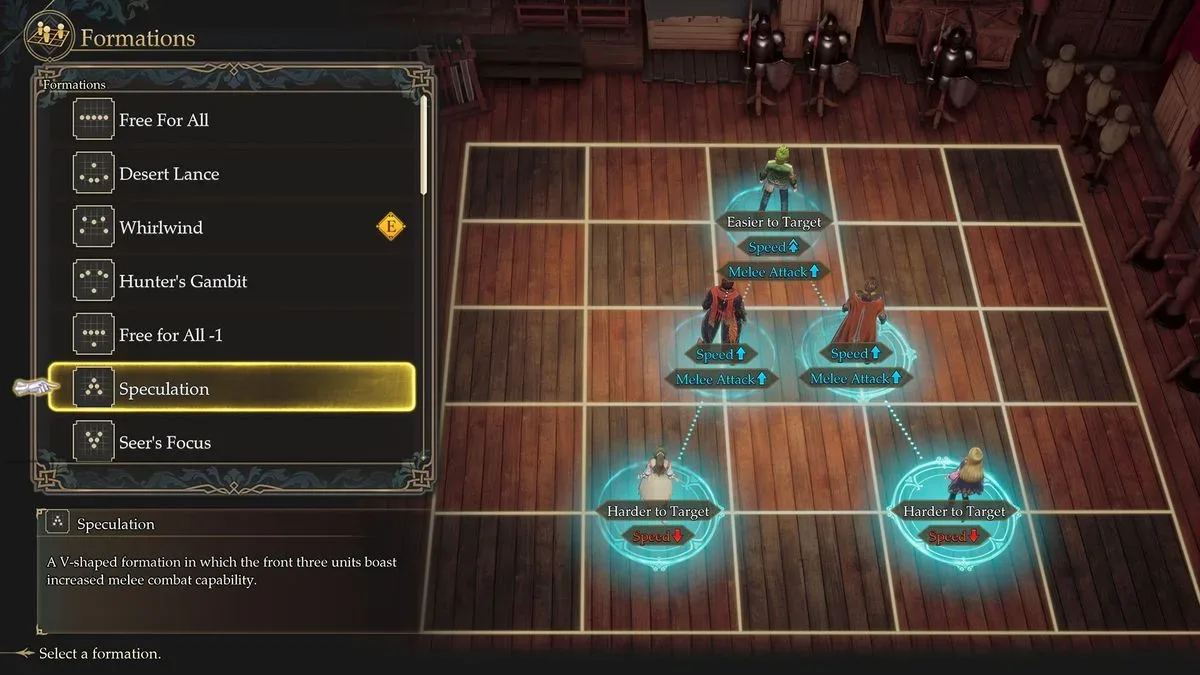
Glimmer may provide the surprise, but party formations offer a more deliberate tactical tool. From the menus, players can assign the group to predetermined arrangements that modify different attributes. These formations are designed to be understood quickly, avoiding the need to build an intricate custom grid before seeing any benefit.
Speculation, for example, places the team in a V-shaped layout and improves melee capability for the three characters at the front. Whirlwind instead boosts speed across the party, helping its members act earlier in the turn order. Those are straightforward trade-offs, but they can be substantial in a turn-based fight. An aggressive arrangement can help a melee-heavy team press an advantage, while a speed-focused setup can make the difference between interrupting a dangerous enemy plan and reacting after damage has already been done.
Formations also complement the game's unusual cast. Instead of treating the party as a collection of isolated fighters, the system emphasizes that positioning and group composition matter. It encourages players to think about how their spear-wielding fairy, snowman, masked combatant, and leader work together rather than only asking which individual move deals the highest damage.
Most importantly, the formations shown so far seem legible. In an RPG overflowing with interconnected systems, a mechanic that communicates its purpose at a glance can be a major advantage. Players can try a new arrangement, observe the change in battle, and adjust without feeling buried beneath opaque terminology.
A dragon battle puts the systems together
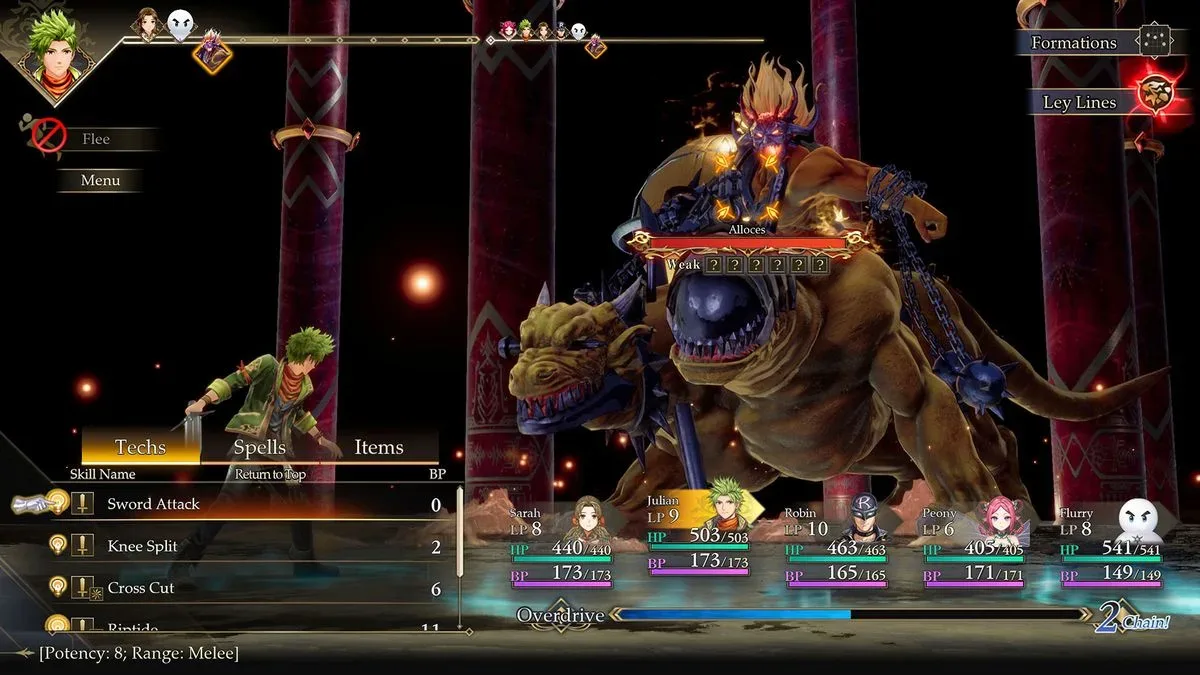
The dungeon culminates in a confrontation with Gwayne, a formidable dragon boss. This fight serves as a useful test for the systems introduced on the way there. The party must search for weaknesses, apply the techniques gained during exploration, and manage a longer battle that asks more than a quick sequence of basic commands.
As the fight continues, another mechanic comes into focus: the Overdrive meter. Once it is fully charged, the party can trigger a United Attack, chaining multiple members' actions together for major damage. It is a natural payoff for a combat design built around assembling a varied group of abilities. The party does not just grow stronger one move at a time; eventually, its members can combine their strengths into a more dramatic group assault.
United Attacks also ensure that the larger battle rhythm has an escalation point. Glimmer produces the excitement of unexpected progression, formations define the party's tactical posture, and Overdrive supplies a high-impact reward for sustained combat. Against a boss such as Gwayne, those systems can turn a fight into a process of discovery and momentum rather than a simple endurance test.
The hands-on session ended just before the dragon could be defeated, leaving the outcome unresolved. Still, reaching that point appears to have accomplished what a preview should: it made the prospect of returning to the party and pushing further into the game considerably more appealing.
An intriguing remake for JRPG fans and newcomers
Romancing SaGa 3: Destinies United is scheduled to launch on February 16, 2027 for PC, PlayStation 5, Xbox Series X, Nintendo Switch 2, and Nintendo Switch. The remake arrives with a foundation rooted in a beloved 1995 game, but its early appeal is not limited to nostalgia. Its combat ideas have the potential to draw in people who are new to SaGa and want a turn-based RPG that treats experimentation as a central part of the fun.
There is still much to learn about the full experience, including how the Glimmer system develops across a complete campaign, how demanding party management becomes, and how frequently the game asks players to adapt their strategy. But the early signs are promising. Romancing SaGa 3: Destinies United understands that a battle can be more than a hurdle between destinations. With the right mix of risk, improvisation, and a party full of delightful weirdos, even a standard enemy encounter can become a reason to keep playing.
Community
Discussion
Start the conversation.
No comments have been posted yet.