

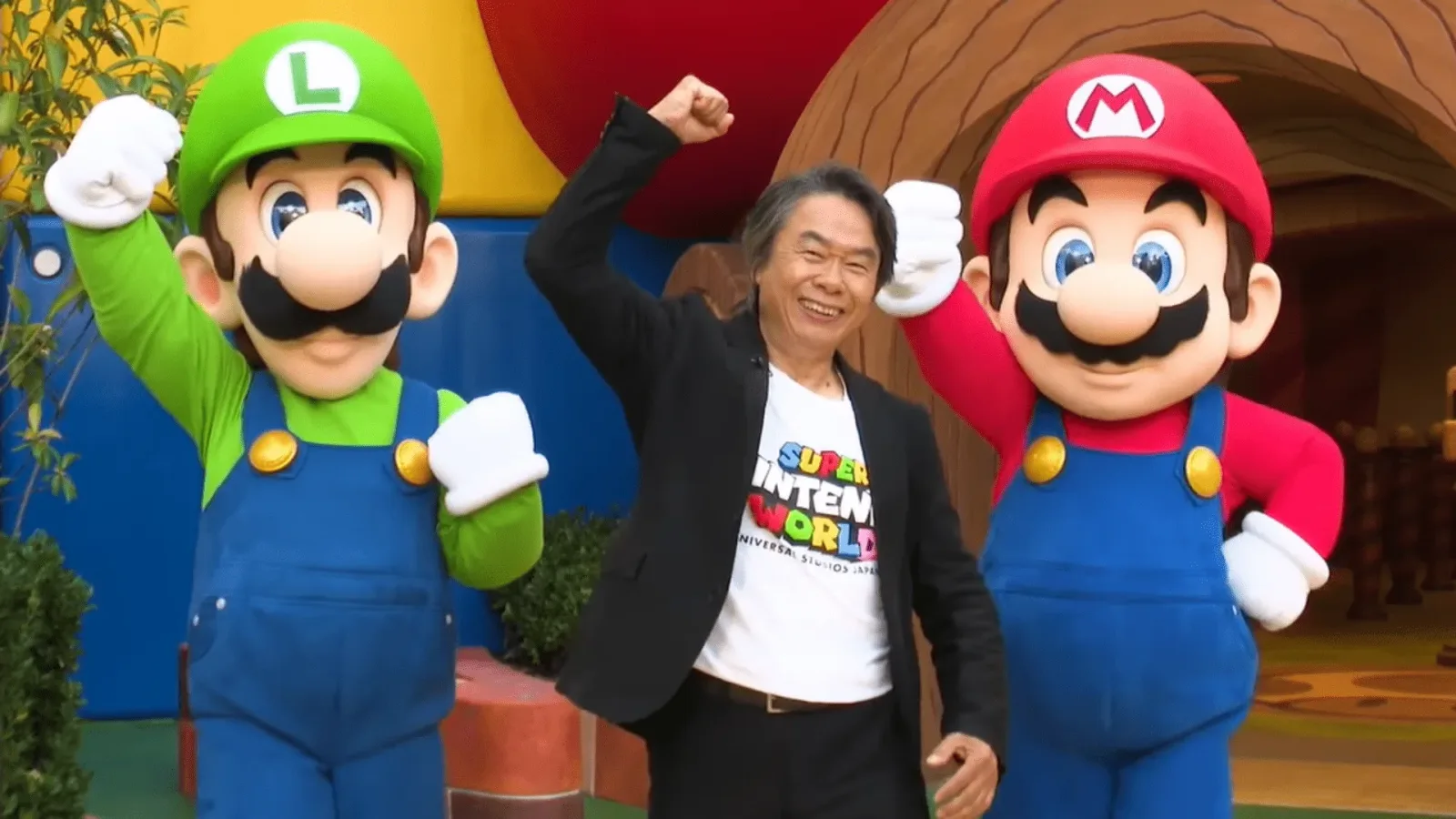
Shigeru Miyamoto says he still has multiple projects in development, offering a brief but intriguing update on his continuing work at Nintendo. The legendary designer, whose creative legacy includes Super Mario, The Legend of Zelda, Donkey Kong, Pikmin, and Nintendogs, addressed his future while discussing a major recent honor from the Japanese government.
Miyamoto has received the Japanese Order of Culture, making him the first game developer to be awarded the distinction. The honor has previously gone to figures from fields including science, mathematics, music, acting, and literature. For a creator whose characters and game worlds have become internationally recognizable across nearly five decades, the recognition marks an important moment not just for Miyamoto, but for video games as a cultural medium.
In comments translated from an interview with Denfaminicogamer, Miyamoto was asked whether the award might represent a natural closing point for a career spanning 49 years. His answer did not suggest an immediate retirement. Instead, he said he does not know how long he will be able to continue working, but intends to make the most of the time he has and pursue the things he wants to create. He also confirmed that he has several projects in progress.
That last detail will inevitably inspire speculation among Nintendo fans. Miyamoto's name has been linked to some of the company's most enduring game series, and any indication that he is working on something new draws attention. But his current responsibilities make it difficult to assume these projects are all, or even primarily, unannounced video games.
For useful background on this topic, read Shigeru Miyamoto Sees AI as a Prompt to Refocus Game Development.
A career that shaped Nintendo's identity
It is difficult to separate Nintendo's modern identity from Miyamoto's work. He joined the company in 1977, at a time when Nintendo was still developing its position in the arcade business and years before it became the global console powerhouse it is today. His early contributions helped establish a design philosophy built around clear play, visual character, surprising interactions, and ideas that could communicate across language barriers.
Donkey Kong was a foundational success, introducing Mario--then known as Jumpman--to the world. Mario subsequently became the central figure in Nintendo's catalogue and, for many people, one of the defining symbols of video games as a whole. Super Mario Bros. helped shape the expectations for home-console platform games, while The Legend of Zelda established a different kind of adventure: one driven by exploration, discovery, tools, secrets, and player curiosity.
The influence continued through later work associated with Miyamoto. Pikmin brought his interest in nature, scale, and indirect control into a strategy-adventure format. Nintendogs showed Nintendo's willingness to make accessible software that reached well beyond conventional gaming audiences. His work has also touched countless other Nintendo projects through supervision, production, and creative guidance.
Because of that history, even a small statement about several active projects carries unusual weight. However, Nintendo in the 2020s is not defined exclusively by game hardware and software. Its characters now appear in feature films, dedicated theme-park areas, merchandise, events, and other entertainment ventures. Miyamoto has played a highly visible role in that broader expansion.
Why the projects may extend beyond games
In recent years, Miyamoto has often been seen in connection with Nintendo's efforts to take its properties into physical and cinematic spaces. He has been deeply involved with Super Nintendo World, the themed attraction area that has expanded through Universal Studios parks. The lands translate familiar locations, enemies, power-ups, music, and interactive ideas from Nintendo games into real-world experiences.
That role is significant because theme parks require a different kind of creative oversight from conventional game development. A designer must consider how visitors move through a space, what catches the eye from a distance, how a setting feels at full scale, and how people who may not play games can immediately understand its appeal. Miyamoto's long-standing emphasis on intuitive design makes him a natural fit for work of that kind.
He has also been involved as a producer on the Super Mario Bros. films. Nintendo's movie ambitions are no longer a one-off experiment: a new Super Mario Bros. movie is on the way, and a live-action The Legend of Zelda film is also in development. Both franchises are among Nintendo's most valuable and recognizable properties, so their transition to cinema is being watched closely by fans.
Given Miyamoto's recent public-facing work, his reference to ongoing projects could potentially include movies, attractions, or other entertainment initiatives. There are also rumors surrounding possible film adaptations based on Donkey Kong, Luigi's Mansion, and Star Fox. Those projects have not been formally confirmed, and they should not be treated as evidence of what Miyamoto meant. Still, they illustrate why fans should avoid jumping straight to assumptions about a new game announcement.
No specific projects have been identified
The important limitation is straightforward: Miyamoto did not name the projects he is currently working on. There is no official confirmation that his comments point to a new Mario platformer, a Zelda game, a Pikmin sequel, a Donkey Kong title, or any other particular Nintendo release. There is likewise no confirmation that the work relates to a film, a park expansion, or another media project.
For now, the comments are best understood as an indication that Miyamoto remains creatively engaged. Nintendo has many internal teams, producers, and development partners working across a wide range of games, and Miyamoto's modern role is broader than the hands-on designer credit fans may associate with his earliest work. A project bearing his involvement could take many forms, from early concept consultation to franchise stewardship or production support.
That uncertainty may be less exciting than a concrete reveal, but it is also fitting for Nintendo's current direction. The company has increasingly positioned its best-known worlds as entertainment brands that can function in several formats at once. A Mario project might be a game, a movie, an attraction, a retail experience, or something that bridges those areas. The same increasingly applies to Zelda, Donkey Kong, and other parts of Nintendo's catalogue.
The significance of the Order of Culture
The Order of Culture gives added context to Miyamoto's reflections on the length of his career. The award recognizes achievements that have contributed to Japanese culture, and Miyamoto's inclusion is notable because it places game development alongside disciplines more traditionally represented by its recipients. Video games have long been a major part of Japan's cultural influence, but awards of this kind underscore the growing recognition of the people who helped build that influence.
Miyamoto's response was not framed as a farewell. Rather than presenting the recognition as a reason to step away, he expressed a desire to continue enjoying his work while he can. That attitude aligns with his public role at Nintendo in recent years: he remains a prominent ambassador for the company's creative values, whether discussing a game character, appearing at a park presentation, or helping introduce Nintendo properties to movie audiences.
Miyamoto's update does not confirm what Nintendo will announce next, but it does confirm that one of the industry's most influential creators is still pursuing new work.
What fans should take from the update
Fans hoping for a surprise game reveal will need to wait for more specific information. Nintendo has not attached Miyamoto's remarks to an announcement, and there is no basis to assign his unnamed projects to any one series. Speculation is understandable given his history, but the details currently available do not support firm conclusions.
What is clear is that Miyamoto continues to be active at a moment when Nintendo is widening the reach of its characters. With Super Nintendo World continuing to bring game settings into theme parks, the next Mario film in development, and The Legend of Zelda preparing for its own cinematic adaptation, there are numerous areas where his experience could be relevant.
Whether the projects ultimately turn out to be games, films, attractions, or something else entirely, Miyamoto's comments suggest he has no intention of treating his nearly half-century at Nintendo as a finished story just yet. For a creator whose ideas helped define generations of play, that continued involvement remains meaningful--even if the next result may not arrive on a console.
Community
Discussion
Start the conversation.
No comments have been posted yet.