

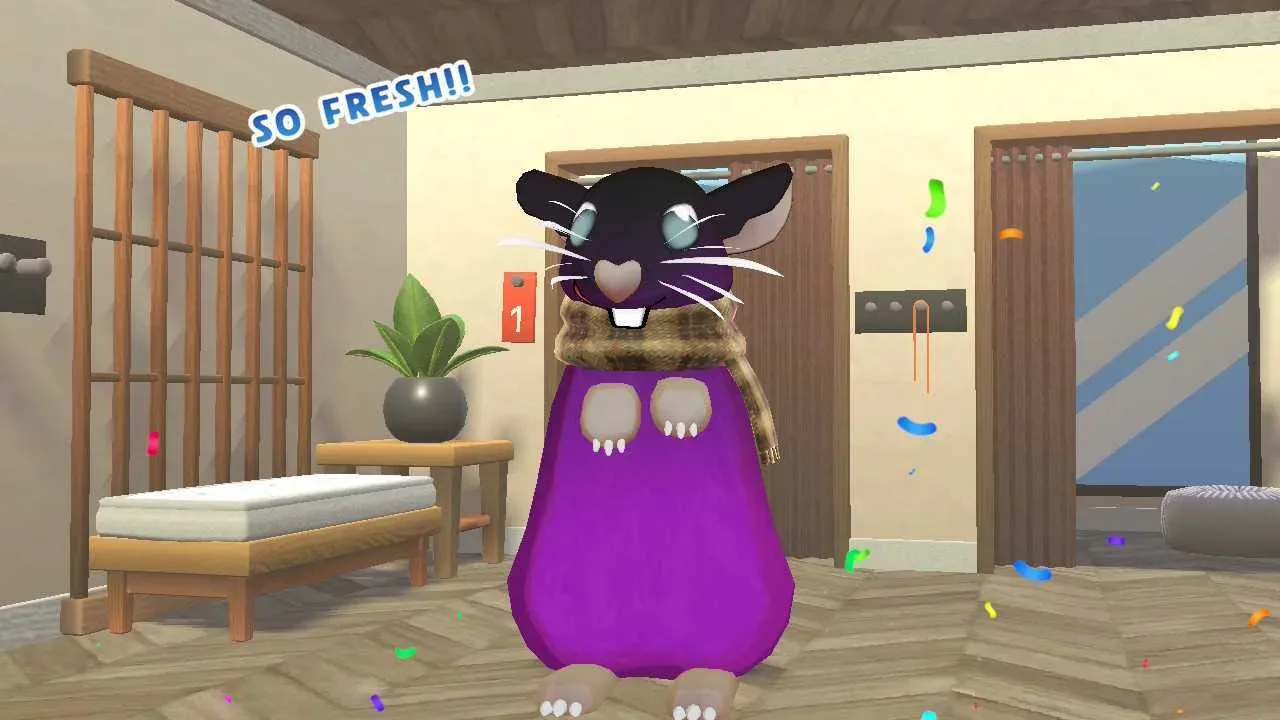
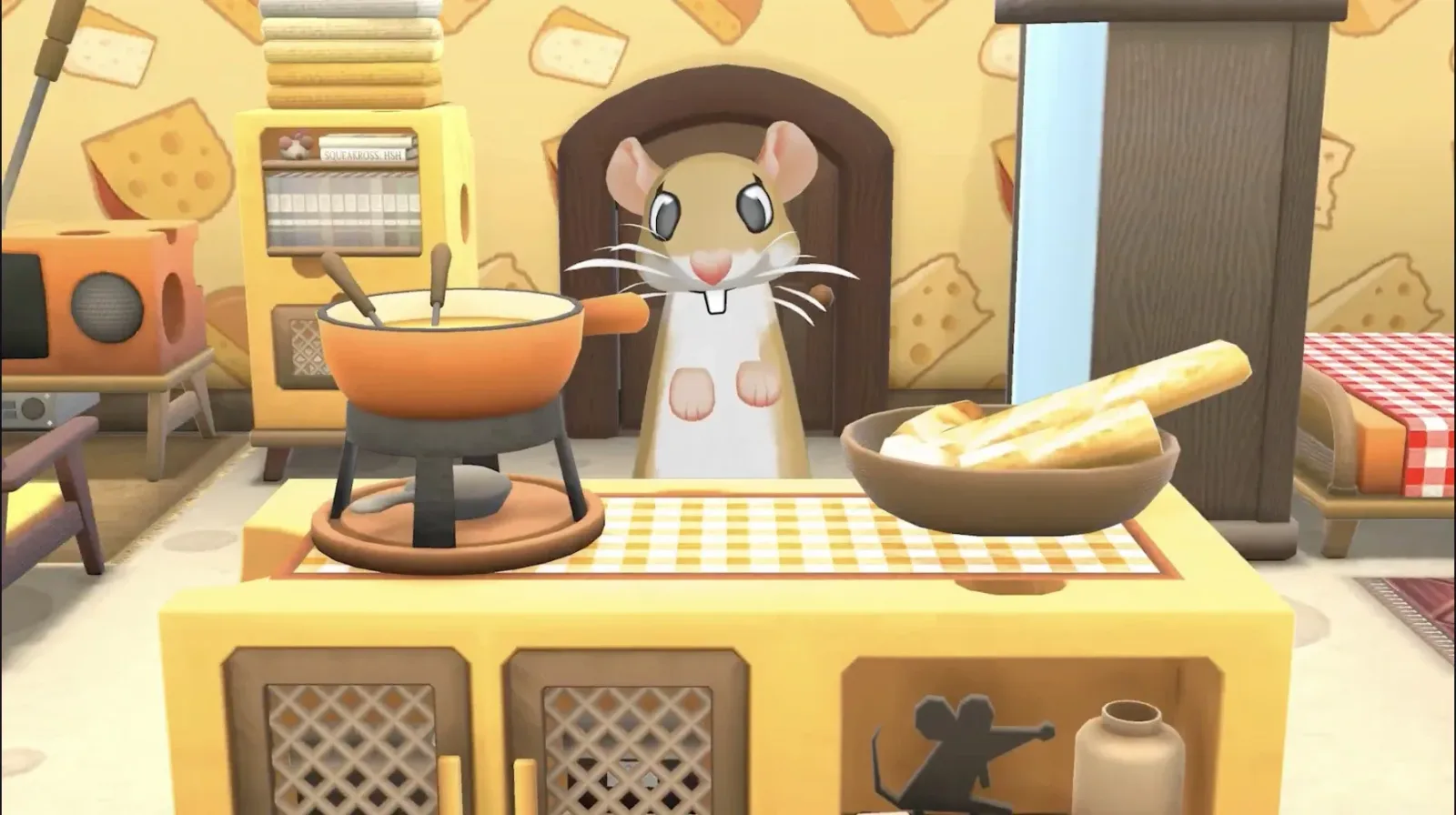
Squeakross: Home Squeak Home has an immediately understandable proposition for anyone who finds satisfaction in filling a Picross grid one square at a time: every completed nonogram becomes a new object for a tiny mouse's home. It is a puzzle game built around an exceptionally cozy reward loop, pairing clue-based grid solving with furnishing, decorating, and personalizing an otherwise empty house.
Players take the role of a mouse who has moved into a home with plenty of potential but very little inside it. Rather than acquiring furniture through a conventional store or currency system, the essentials have to be earned by solving puzzles. Beds, tables, chairs, and more decorative objects are all tied to nonogram boards, so the act of building a livable home is directly connected to working through increasingly elaborate logic challenges.
The result is a charming combination of two very different but compatible pleasures. One is the slow, deliberate concentration of a nonogram. The other is the freedom to look at an empty room and gradually make it feel personal. Squeakross uses that structure to give each completed puzzle a tangible purpose beyond checking it off a list.
A familiar puzzle format with a homebuilding payoff
Nonograms, also known to many players through the Picross name, ask players to use numbered clues along the edges of a grid. Those numbers indicate the sequences of filled spaces hidden within each row and column. By comparing the clues, marking certainty, and ruling out impossible placements, players reveal a final pixel-art image.
For useful background on this topic, read Prince of Persia: The Lost Crown Is Fully Playable Free on Switch Until September 30.
In Squeakross: Home Squeak Home, those hidden images correspond to household items and decorations. The format makes the puzzle theme feel unusually literal: solve a grid for a furnishing, then place that furnishing in the mouse's house. A successfully completed board is not just an image in a gallery; it is a new part of the player's growing space.
The early selection naturally encourages players to focus on practical basics. A bed and a nightstand can help establish a proper bedroom, while tables and chairs begin to give the interior the shape of a real home. From there, decorative items can turn a functional setup into something more expressive. The appeal is not solely in unlocking every object, but in deciding where it belongs and what kind of room it helps create.
That decorating layer is likely to be especially appealing to players who enjoy arranging furniture in life-simulation games but would rather pursue it through a focused single-player puzzle structure. There is a recognizable satisfaction in earning an item through logic, then finding exactly the right place for it. The game turns organization, collecting, and interior design into rewards for careful deduction.
More than 800 puzzles for a long-term cozy project
The Nintendo Switch store listing states that Squeakross includes more than 800 puzzles. That is a substantial total for a game centered on nonograms, particularly when the boards are also linked to the home-customization system. It gives the experience the potential to function as a long-running ritual rather than a short puzzle diversion.
The puzzle layouts are not restricted to a single standard square shape. Their dimensions can shift to suit the objects being created, which adds variety even before difficulty enters the equation. A piece of furniture with an unusual silhouette may call for a differently proportioned board, changing how players read the clue sets and build their solution strategy.
That variety matters in a genre where repetition can otherwise become overly mechanical. Traditional nonograms already invite methodical habits--start with the largest clues, identify forced spaces, cross off exclusions--but altered grid shapes can make each new board feel like a distinct small problem. Some finished images will be readily recognizable as the item being unlocked, while others may look abstract until the solution is complete.
Squeakross also builds replay value into individual furniture unlocks. Completing a puzzle opens a more difficult version of it. Solving that harder variation allows players to change the color of the associated furniture or to place multiple copies of it. In practical terms, this means a player who wants a more coordinated room, matching furnishings, or repeated decorative elements has a reason to revisit familiar item themes at a higher challenge level.
It is a smart use of difficulty progression. The tougher puzzles are not presented only as an obstacle for dedicated completionists; they are connected to more flexibility in the decorating system. Players who simply want the basics can keep expanding their home, while those who enjoy deeper puzzle work can unlock greater control over its final appearance.
Helpful tools without abandoning the logic challenge
Nonograms can be relaxing, but they can also become frustrating when a single wrong assumption disrupts an entire grid. Squeakross includes several quality-of-life features designed to keep players moving. Visual indicators can show when a line has been fully completed and can flag errors, making it easier to understand whether a chosen approach is working.
The game also offers a night mode that darkens the puzzle field. It is a small feature, but one that fits the title's laid-back presentation and makes sense for a game likely to be played during a quiet evening session. Puzzle games often benefit from interfaces that reduce visual strain, especially when players are studying grids for long stretches.
When a board proves especially stubborn, players can ask their mouse avatar for assistance. The presence of an in-world help option gives the support system some personality while preserving the game's central fantasy: this is not merely a sequence of abstract boards, but a homebuilding journey shared with a very small resident who has a great deal invested in the results.
These accessibility-minded touches are important because Squeakross appears designed to welcome both veteran Picross players and people arriving primarily for the decorating premise. Experienced solvers can work through large numbers of puzzles at their own pace, while newcomers have visual feedback and hints available when they need a nudge. The game's appeal rests on calm persistence, not on punishing players for taking a wrong turn.
A mouse house made personal
The furniture is only part of the customization. The mouse protagonist can also be dressed in accessories, adding another layer of personality to the experience. Among the early unlockable clothing options is a scarf, an appropriately seasonal choice for a game so closely aligned with autumn and winter comfort.
That small wardrobe component reinforces the game's broader tone. Squeakross is not treating its house as a sterile puzzle hub. It wants the space and its inhabitant to feel lived in. Players can work toward a home that reflects their own aesthetic preferences while giving their mouse a look to match.
The combination of furniture placement, decorative objects, color variations, multiples of items, and accessories suggests a game where two players may progress through many of the same puzzles but end up with notably different homes. One player may prioritize a sensible bedroom and living area before adding details. Another may pursue a more decorative vision from the start. The nonogram structure keeps progress orderly, but the house itself leaves room for expression.
Rodent facts add another gentle surprise
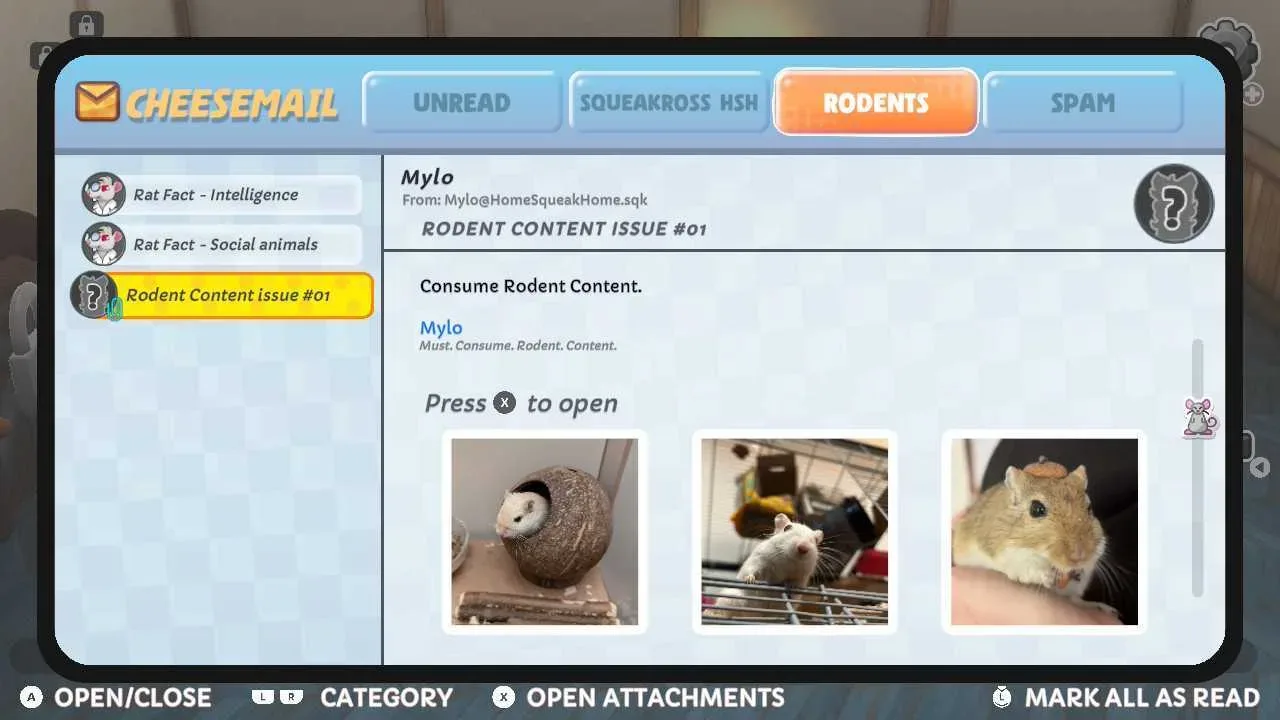
As players advance, Squeakross sends in-game emails acknowledging puzzle milestones and sharing facts about rats. Occasionally, those messages include real photographs of rodents. It is an unexpectedly earnest detail that extends the game's mouse-centered theme beyond the house and puzzle boards.
For animal lovers, those notes may be a delightful extra reward between major unlocks. For everyone else, they are a playful reminder that the game is committed to its premise. Even its messages aim to make the experience feel like a small, ongoing correspondence rather than a purely menu-driven list of challenges.
It also gives the title a distinctive identity in a crowded puzzle genre. Plenty of games can offer a large collection of nonograms. Squeakross: Home Squeak Home separates itself by making every board part of a larger domestic project, then supporting that premise with customization, a tiny protagonist, and real-world rodent trivia.
A strong fit for players seeking slow, satisfying progress
Squeakross: Home Squeak Home is positioned as a game for people who enjoy steady progress measured in solved grids and newly placed objects. Its loop is simple but effective: inspect clues, fill squares, reveal an item, and make the house a little warmer. With over 800 puzzles listed for Nintendo Switch, plus harder versions that unlock more furnishing options, there appears to be plenty of room for that routine to grow.
For Picross regulars, the varied board dimensions and optional tougher puzzles provide a clear reason to investigate. For decorating-game fans, the mouse house offers a more structured route to building a personal space. And for players who simply want a calm game with scarves, furniture, nighttime puzzle sessions, and occasional rodent photos, Squeakross has an unusually specific kind of comfort to offer.
Community
Discussion
Start the conversation.
No comments have been posted yet.