

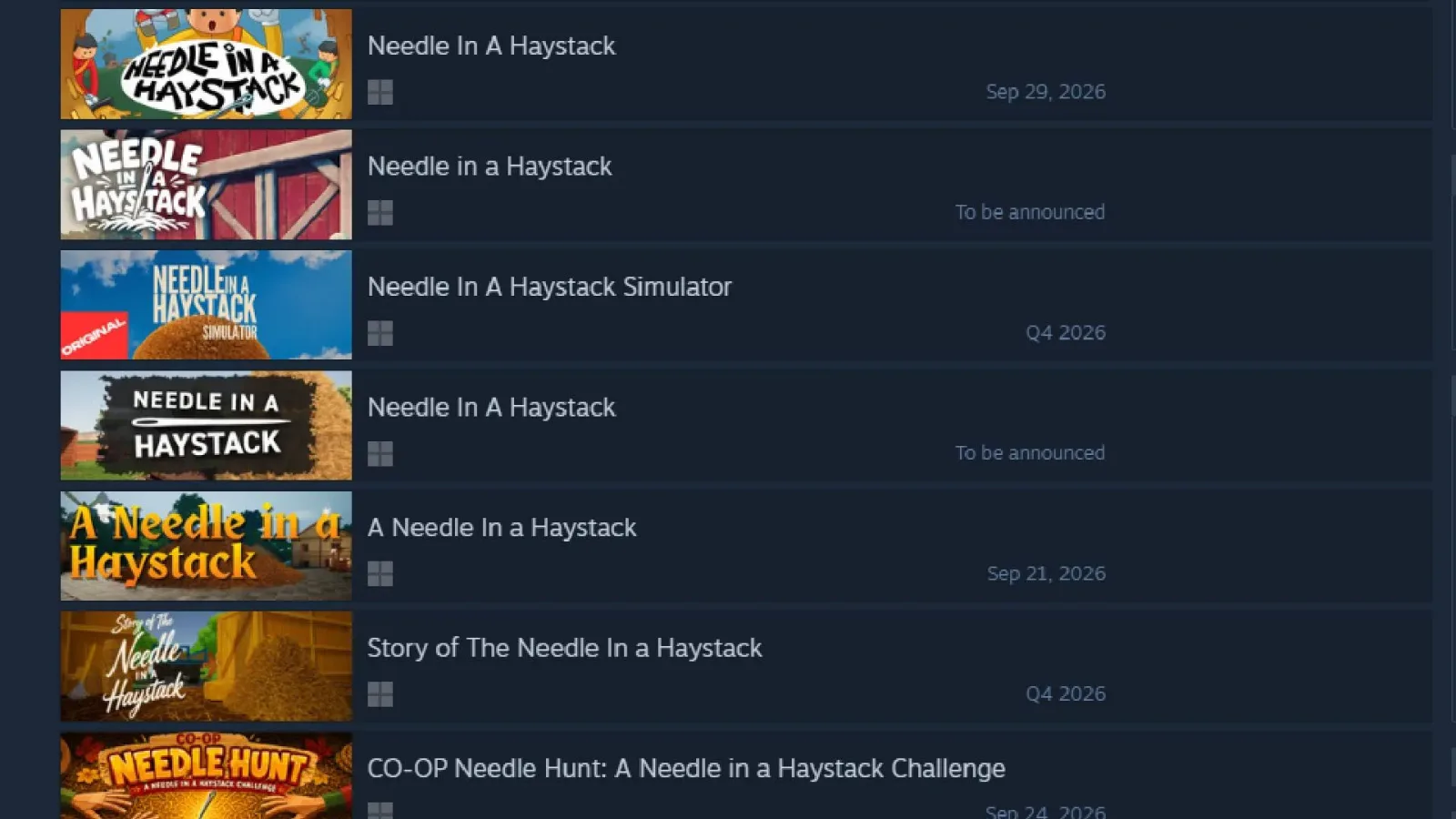
Steam's enormous catalog has long been both its greatest strength and one of its toughest problems. The PC storefront can give a tiny independent project access to a global audience, but it can also turn finding a specific game into a difficult search through thousands of similar names, genres, and storefront images. For one upcoming novelty simulator, that problem has become especially literal.
Needle In A Haystack Simulator, an upcoming game built around the intentionally laborious task suggested by its title, drew major attention after a clip circulated widely in August. The footage of players searching through a massive haystack for a single needle had reportedly amassed more than 50 million views on Twitter. Yet players trying to locate the original Steam listing by searching for "needle in a haystack" now face an unusual obstacle: a growing number of similarly named games that appeared shortly after the project went viral.
At least eight lookalike listings reportedly surfaced within days of the original game's late-August viral moment. Further searches identify more than 10 in total, including titles such as A Needle in a Haystack, CO-OP Needle Hunt: A Needle in a Haystack Challenge, Story of The Needle in a Haystack, Needle in a Million Haystacks, Hay! One Billion!, and Find the Needle. The original Needle in a Haystack Simulator is not currently due until Q4 2026, while some of these similarly conceived projects are listed with earlier planned release windows.
A Search Result Problem Before Release
Copycat games are hardly a new phenomenon. A successful concept, trailer, mechanic, or even an appealing visual style has often inspired competitors to move quickly, particularly in digital storefronts with low barriers to publishing. What makes this case stand out is the speed and scale of the overlap. The original game had not launched when the imitators began to fill out searches for its basic premise.
For useful background on this topic, read Resident Evil Movie Hides 10 Game References for Sharp-Eyed Fans.
Many of the listings appear to retain the central joke almost unchanged: players are asked to locate a needle in an enormous amount of hay. That is not a broad genre in the usual sense. It is a highly specific viral concept, and the similar wording makes it much more likely that someone who saw the original clip could buy, wishlist, or download something else by mistake.
The situation has reportedly pushed the original developer to alter the game's Steam presentation. Its key art now includes a prominent red notice identifying it as the original version, while the description emphasizes that it is "the one and only." That kind of defensive branding may be understandable, but it also creates an unfortunate first impression. Instead of allowing the store page to sell the game's unusual premise, the creator has to spend valuable visual and written space distinguishing it from projects that arrived afterward.
For a small developer, visibility is not a secondary concern. A viral clip can be a rare opportunity to build wishlists, collect feedback, and establish name recognition before launch. If search results become crowded with near-identical titles immediately afterward, the attention generated by the original work can be diluted at precisely the moment it should be most valuable.
Why Steam Discovery Makes the Issue More Serious
Steam's marketplace is vast, and its discovery systems rely on a mixture of search, tags, recommendations, user activity, curator lists, featured promotions, and seasonal events. In theory, that variety offers multiple ways for good games to find an audience. In practice, an exact or approximate title search is often the first tool players use after watching a trailer, a stream clip, or a social-media post.
That creates an opening for games that borrow a newly popular project's wording or obvious premise. A player may remember only that they saw "the needle in the haystack game," type those words into Steam, and encounter a cluster of products all apparently promising the same experience. The original may still be present, but it has to compete for attention against listings that did not have to establish the idea in the public imagination.
This does not mean every game about a similar subject is necessarily a bad-faith imitation. Game ideas can overlap naturally, especially with simple concepts. A treasure hunt, an organization game, or a hidden-object challenge can take many forms. But when naming, timing, visual framing, and the core activity all closely align with a title that has just gone viral, it becomes much harder for consumers to identify which project inspired the interest in the first place.
The potential harm is not limited to a single purchase. Wishlists influence the momentum surrounding an upcoming Steam release, and attention can affect how communities, streamers, and recommendation systems treat a game. If players split their interest across numerous nearly identical pages--or assume the concept has become an oversaturated fad--they may never reach the developer who initially caught their attention.
Similar Patterns Around Other Viral Games
Needle in a Haystack Simulator is not the only example of a sudden rush of comparable Steam listings. The surprise success of Meccha Chameleon has also been followed by numerous games built around substantially the same idea, sometimes changing only superficial details such as character models. Some apparent variations swap in animals, while others lean into more sexualized character designs, but the recognizable hook remains much the same.
Another case involves Librarian: Tidy Up the Arcane Library!, a cozy game centered on organizing an enchanted library. That game was already surrounded by debate over AI, and its visibility was followed by many organization-focused listings set in other locations. The broader activity--sorting and tidying objects--is certainly not exclusive to one game, but the rapid arrival of pages with matching presentation has intensified concerns about storefront clutter and opportunistic publishing.
Together, these examples suggest a recurring cycle. A distinctive project gains traction. Its premise becomes easy to summarize in a few words. Similar games appear rapidly, often with titles designed to catch adjacent searches. By the time players look for the project they actually saw, the storefront can already resemble a crowded shelf of knockoffs.
The AI Question and the Limits of Storefront Disclosure
Some of the needle-searching listings do not include AI disclosures. That absence does not prove that generative AI was used in their creation, and it would be wrong to treat unusual logos, fast turnaround times, or familiar-looking promotional art as conclusive evidence by themselves. Still, the speed with which so many closely related pages have appeared has fueled understandable suspicion that AI tools may be helping some developers produce artwork, text, concepts, or other store assets at a faster pace.
Valve's Steam policies require developers to disclose certain uses of AI in the development process, particularly around material included in a game and how live-generated content is handled. Those disclosures can provide useful context, but they do not resolve the central copycat question. A game can be made without AI and still imitate another project's title, imagery, or viral hook. Conversely, a developer's use of AI does not automatically make a game a clone.
The larger concern is that generative tools may lower the effort needed to produce convincing storefront material at scale. If a creator can rapidly assemble logos, capsule art, descriptions, and basic prototypes around whatever idea is trending this week, the number of competing listings can increase faster than players and platform moderation systems can evaluate them. The result is not merely more games; it is more noise around the games that made an idea compelling in the first place.
What Could Help Players and Developers
There is no simple rule that can separate legitimate genre competition from imitation without creating new problems. Developers should be able to make hidden-object games, cleaning games, survival games, or absurd simulation games without needing permission from whoever released something similar first. Steam also hosts an enormous range of experimental projects, and overly rigid restrictions could hurt newcomers and niche creators.
However, the platform could explore measures focused on consumer clarity and search quality rather than ownership of an idea. Better handling of near-identical titles, clearer surfacing of original release dates, stronger review of misleading store assets, and search tools that help users find exact projects could all reduce confusion. A system that detects sudden waves of extremely similar listings following a viral reveal might also justify additional review, especially when product names appear constructed to intercept searches.
- More precise title search: Exact-title matches and established listings could be made more prominent when users search for a known game.
- Clearer listing history: Prominent "announced" or "first listed" dates could give players more context when several games make the same claim.
- Improved similarity controls: Storefront checks could examine potentially confusing combinations of title wording, capsule art, and descriptions.
- Better event curation: Major discovery events such as Steam Next Fest could benefit from safeguards against an influx of low-effort, highly derivative submissions.
These steps would not eliminate imitation, nor should they attempt to declare a single owner of every gameplay idea. Their purpose would be to ensure that shoppers can find what they came looking for and that creators are not forced to compete against an instant pile-on of search-optimized lookalikes.
A Tedious Joke With a Real Consequence
There is an ironic fit between the game at the center of this situation and the storefront issue it exposes. Needle in a Haystack Simulator turns an impossibly tedious search into the joke. On Steam, the original game itself risks becoming the needle: a distinctive project obscured by a growing haystack of similarly named alternatives.
For players, that means more time spent verifying which page belongs to the game they actually saw. For independent developers, it can mean a viral breakthrough becomes an invitation for others to crowd the same search terms before the original even ships. And for Steam, it is another reminder that adding more games to a catalog is not the same thing as helping people discover the right ones.
With more releases arriving than ever and debates around AI-assisted production continuing, the discovery challenge is unlikely to fade on its own. Without stronger tools for clarity, originality may increasingly be difficult to spot--not because it does not exist, but because it is buried under too much hay.
Community
Discussion
Start the conversation.
No comments have been posted yet.