

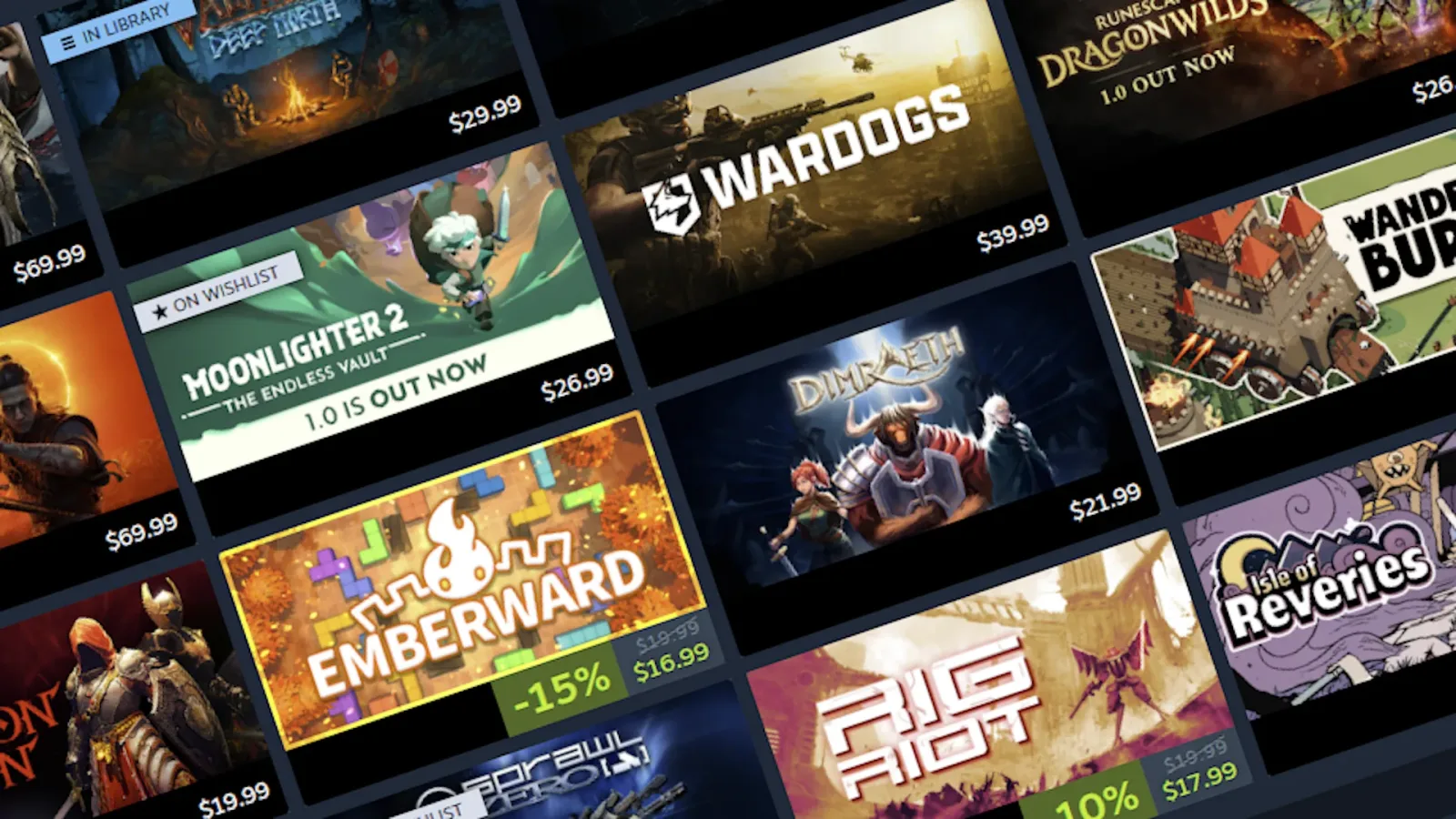
Steam's challenge has never been a shortage of games. It is the opposite: a store so enormous, and supplied by so many new releases every week, that even a well-made game can be difficult to spot unless it arrives with a huge marketing campaign, an established fanbase, or the rare momentum of a viral hit. For years, the discussion around PC game discoverability has revolved around that problem.
Now, recent changes to one of Steam's most prominent homepage features appear to be producing meaningful results for smaller developers. Tim Bender, CEO of strategy, simulation, and RPG publisher Hooded Horse, says Valve has quietly improved the Discounts & Events feed in a way that gives more personalized recommendations a greater role. The effect, based on data shared by Bender and observations from developers, can be dramatic: games that previously saw effectively no traffic from the feed are suddenly receiving thousands of visits.
The implications go beyond a better-looking store page. If the system consistently puts a specialized game in front of players who have already shown an interest in its genre, setting, mechanics, or related titles, Steam may be improving a difficult part of the PC market for both sides. Players spend less time digging through irrelevant promotions, while niche studios gain an opportunity to reach audiences that conventional bestseller-focused placement may have missed.
A homepage feed with a larger role in recommendations
The Discounts & Events section sits in a valuable location on Steam's homepage. Historically, a highly visible area like that naturally favored games with major sales, big launches, prominent promotions, or broad popularity. Those games are commercially important, but a feed dominated by them has limited room for a historical strategy title, a dense simulation, a smaller role-playing game, or a new indie release without a large review count.
For useful background on this topic, read Former Rockstar Designer Questions Whether GTA 6 Needs a Switch 2 Port.
Bender argues that the feed now seems more tailored to individual player behavior. Rather than primarily highlighting games that are already among Steam's biggest performers, it is reportedly allocating more slots to recommendations informed by factors such as playtime, wishlists, and past purchases.
That distinction matters. A storefront can theoretically show the same successful titles to every visitor, but it becomes more useful when it recognizes that one person may want a blockbuster action game while another is far more likely to investigate a turn-based wargame, an old-school dungeon crawler, or an unusual management sim.
Bender described seeing precisely that kind of personalization in action. Alongside smaller indie games with fewer than 100 to a few thousand reviews, Steam recommended the classic Gold Box Dungeons & Dragons games from the late 1980s and early 1990s. Those titles have had their Steam versions available for years and have accumulated fewer than 300 reviews, making them an especially clear example of a recommendation chosen for relevance rather than sheer popularity.
For players, that is the kind of discovery feature that can make a giant digital catalog feel less overwhelming. For developers and publishers, it offers a route to visibility that does not depend entirely on competing with the largest games on the store for the same limited storefront real estate.
Hooded Horse's numbers show an enormous traffic swing
The most striking part of Bender's comments is the data behind them. One Hooded Horse game received 7,355 visits to its Steam page through the Discounts & Events feed over six months. Of that total, 7,341 visits came during the latest month.
Put another way, only 14 visits arrived through that source during the preceding five months. Using the earlier rate as a baseline works out to around 2.8 visits per month. The recent month therefore represented roughly 2,621 times as much monthly visibility from the feed.
It is a startling comparison, even if traffic can naturally fluctuate and one game's results do not establish a universal rule for every release. Still, the scale is important because the earlier figure was so small. For a niche indie, being absent from a major homepage recommendation surface is fundamentally different from receiving an audience of several thousand potentially interested visitors.
A second Hooded Horse title showed a less extreme, but still substantial, increase. It went from about 6,000 Discounts & Events visits over five months to 14,000 in a single month. That pattern supports the possibility that this is not merely an isolated spike affecting one game.
"This change took a source of traffic that was non-existent for niche indies, and suddenly made it the best source of traffic in the entire store," Bender wrote.
Bender also said other developers have reported similar shifts, moving from essentially zero visits via this channel to several thousand. The available examples do not tell us how every genre, price point, release age, or game quality level will perform under the revised system. They do, however, suggest Steam's personalization changes may be creating a new and valuable discovery path for titles that fit a specific audience.
Better matching may matter more than broad exposure
Raw page-visit totals are not the same as sales. A game can receive a large number of clicks without converting many of them into purchases, and Steam's public-facing information does not reveal conversion rates for the examples discussed. But recommendations aimed at the right players should be more useful than generic exposure.
A player who has logged extensive hours in city builders, grand strategy games, tactical RPGs, or retro dungeon crawlers is more likely to take a serious look at a related smaller release than a player shown the same title simply because it is on sale. That does not eliminate the need for strong store pages, accurate tags, compelling trailers, good screenshots, demos where appropriate, or positive word of mouth. It does mean a smaller studio may finally get a more realistic chance to make its case to a suitable audience.
For publishers such as Hooded Horse, whose catalog frequently serves dedicated strategy and simulation communities, that is particularly significant. These genres can inspire long-term loyalty, but their games are not always designed for immediate, universal appeal. A tailored store feed is arguably better suited to connecting these projects with their natural audience than a one-size-fits-all promotional approach.
The same principle extends far beyond strategy and simulation. Experimental puzzle games, visual novels, niche sports games, demanding roguelikes, hardcore tactical titles, and compact narrative adventures can all struggle when measured only against mass-market blockbusters. Personalized discovery does not guarantee success, but it can reduce the odds that a game vanishes before the people most likely to enjoy it even know it exists.
Steam's discovery tools are continuing to evolve
The Discounts & Events changes are part of a broader period of storefront refinement. Bender also praised Steam's relatively recent personal calendar feature, which helps users track releases and relevant dates. Tools like that may sound modest compared with major client updates or headline-grabbing sales, but they can make a practical difference in a store where timing and attention are scarce.
Steam has long offered a mixture of recommendation queues, tags, curator lists, wishlists, search functions, seasonal events, festival pages, user reviews, and algorithmic suggestions. Its discovery system is not a single button or feed; it is an interconnected set of systems that must deal with an enormous and constantly expanding catalog.
Bender pushed back on the frequent claim that game discovery on Steam is simply broken. His view is more nuanced: discovery is inherently difficult when so many games are released, but Valve's store remains a leading experience and has been improving, especially for independent developers.
That is an important distinction. No recommendation system can ensure that every game finds an audience, nor can it make a crowded market uncrowded. What it can do is improve the quality of matches between customers and games. The data shared by Hooded Horse suggests Valve may have found a meaningful improvement in one of the most visible places on the store.
The market remains punishing despite the potential improvement
There is still ample reason to be cautious about declaring the discoverability problem solved. Valve revealed earlier in 2026 that nearly 6,000 games generated more than $100,000 during 2025, illustrating how large Steam's commercial opportunities can be. At the same time, plenty of releases fail to recoup even Steam's $100 fee for listing a game.
Estimates for 2025 indicated that more than 5,000 Steam releases did not earn enough to cover that initial fee. That is a sobering figure, particularly for teams that have spent years building a game. Discoverability is only one factor in an outcome also shaped by production quality, genre demand, pricing, launch timing, marketing, reviews, community building, and competition.
The number of releases is also not slowing down. Development tools have become more accessible, and generative AI-assisted production is adding further pressure to an already crowded release schedule, even as many developers say they do not want to use generative AI in their work. More games mean more choice for players, but also more noise for every creator trying to earn attention.
There is another problem at the lower end of the market: imitation. The forthcoming viral novelty game Needle In A Haystack Simulator has already faced eight apparent copycats before launch, prompting its creators to emphasize that their project is the original. Personalized recommendations cannot entirely prevent such behavior, though better matching and more relevant curation could help players locate authentic games rather than lookalikes.
A potentially meaningful shift for the long tail
Steam's strongest advantage has always been the depth of its library. Its greatest usability problem is helping players navigate that depth. A homepage feed that elevates lesser-known games based on personal relevance may be a quiet feature update, but it addresses that central issue directly.
For now, the reported traffic increases should be viewed as encouraging evidence rather than a guarantee. Developers will need to watch whether the uplift persists, how it affects sales and wishlists, and which kinds of games benefit most. Valve has not publicly detailed the exact mechanics behind the apparent adjustments, so there are limits to what can be concluded from a handful of examples.
Even so, the early signs are promising. If Steam continues to reserve meaningful space for tailored recommendations instead of letting its biggest hits occupy nearly every high-visibility slot, smaller games may have a better chance to be seen by the people who are actually looking for them. In a marketplace defined by abundance, that kind of targeted visibility can be transformative.

Community
Discussion
Start the conversation.
No comments have been posted yet.