
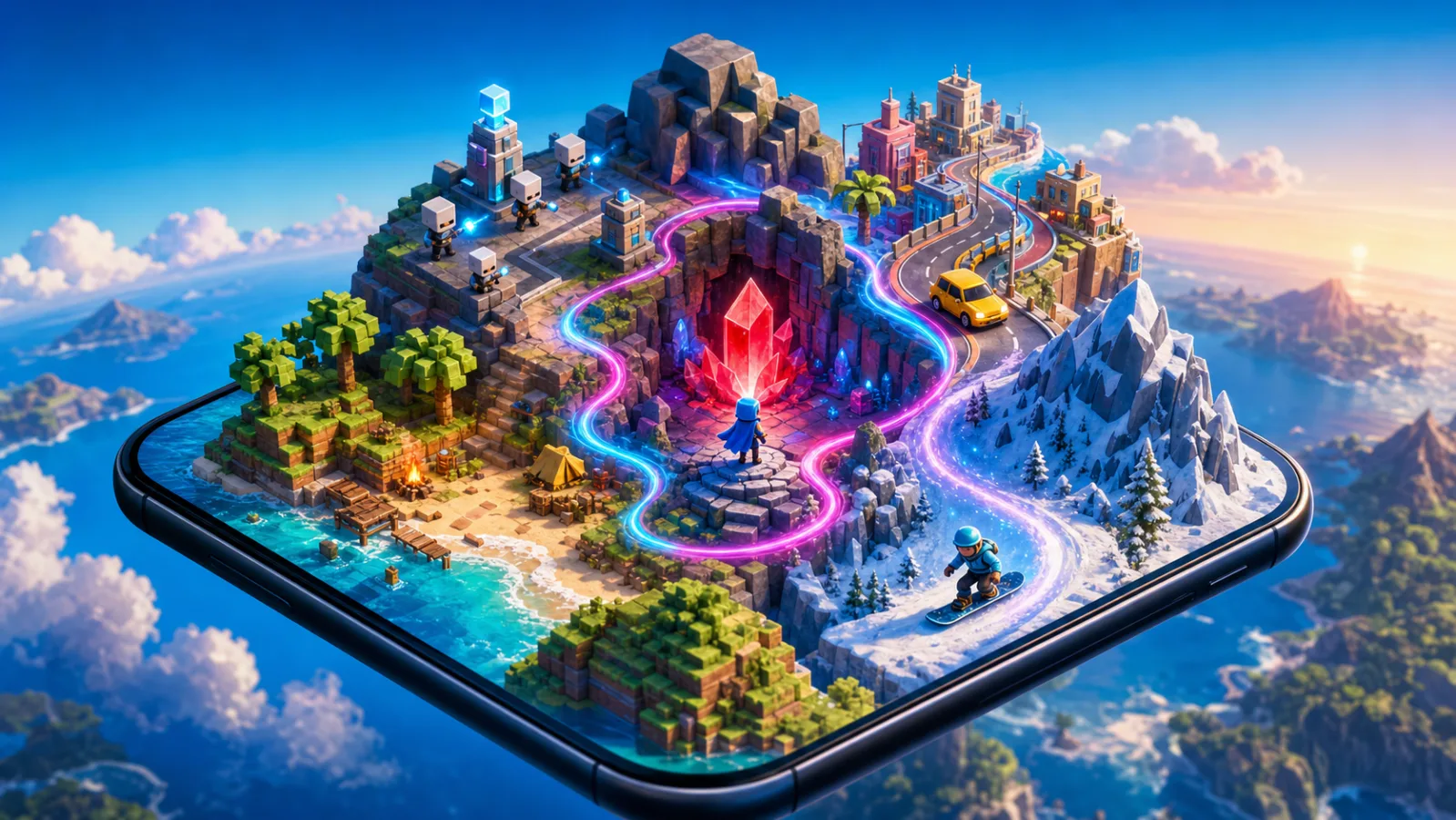
Mobile gaming is often discussed as though it were one genre, one control scheme, or one kind of player. That has never been especially useful. The mobile catalog contains quick-score arcade games, old-school role-playing adventures, strategy games built around compact maps, and tactile simulations that make direct input part of the fantasy. The five games below are worth remembering because each approaches portable play from a different direction.
This is not a list of games that all chase the same audience. It is a ranked selection of five mobile picks from a varied group of records, judged by the clarity of their identity, the strength of their core loop, and the reasons a player might return to them. Some are best for short bursts. Others ask for patience, practice, or a longer-term investment in systems and progression. Together, they make a persuasive case for looking beyond whatever happens to dominate a storefront at a given moment.
A practical note matters with older mobile releases: platform listings tell us where games were released, but they do not guarantee current storefront availability or compatibility with every modern device. Treat this guide as a way to identify the experiences that fit your tastes, then check the platform and version that suit your own setup.
How these five picks were ranked
The most useful top-five lists do more than place familiar names in numerical order. Here, ranking reflects a blend of immediate appeal, distinctive design, replay potential, and how naturally each game's structure complements portable play. A great mobile game does not have to be simple. It does, however, need to communicate what makes it compelling without asking the player to accept a vague promise of fun later.
That standard favors games with memorable loops. Cooking Mama turns food preparation into a series of hands-on tasks. Crazy Taxi makes every passenger pickup a fresh race against the clock. Crimson Gem Saga gives role-playing fans a traditional party-based journey with tactical wrinkles. Cubemen 2 frames strategy around fast action, objectives, and player-made levels. Cosmophony is the specialist's choice: a severe music shooter designed around rhythmic intensity and escalating challenge.
The order should be read as a recommendation path rather than a declaration that one genre is inherently better than another. The number-one choice is the most broadly approachable and immediately legible. The lower entries become more focused, not less worthwhile. In fact, the best match for an individual player may easily be number four or number five.
1. Cooking Mama
Best for: players who want tactile, approachable mini-game design; food-game fans; anyone looking for short sessions with a satisfying sense of completion.
Cooking Mama earns the top spot because it understands the appeal of direct input. Its premise is wonderfully concrete: prepare ingredients, cook food, and combine raw components into finished dishes. Rather than presenting cooking as an abstract menu-selection exercise, it breaks preparation into recognizable actions. Chopping, slicing, pan frying, kneading, grating, mashing, and peeling all become the language of play.
The original design was built around stylus interaction, and its iOS listing makes it a natural title to consider in conversations about touch-friendly games. The important idea is not merely that players tap at food on a screen. Cooking Mama asks them to perform a chain of gestures that resemble the steps of preparation. That gives each recipe a tangible rhythm: first handle the ingredient, then follow the task, then see it become part of a complete dish.
Its 76 recipes give the game meaningful variety. A large recipe count matters because the pleasure of a cooking game can fade if every dish is just a reskin of the same action. Here, the range of activities supports the fantasy that the player is learning a broad collection of culinary processes, even when the experience remains playful rather than realistic. Players can follow recipes or experiment with ingredient combinations, which creates room for both guided play and curiosity.
Cooking Mama also makes a strong case for replayability without requiring an enormous open world or a competitive ladder. Repeating a preparation task can be enjoyable because the goal is inherently easy to understand: execute the motions more cleanly, keep the sequence flowing, and make the finished result feel earned. That is exactly the kind of compact, self-contained reward loop that suits handheld and mobile habits.
The sharing feature adds a social dimension as well. Recipes can be shared with up to four other players, and a saved game can be sent wirelessly to a friend. Even without treating that feature as the main attraction, it reinforces the game's friendly, communal spirit. Cooking is an activity associated with making and sharing, and the game's design recognizes that connection.
Choose Cooking Mama if you value clear feedback, task-based play, and a game that can be rewarding in a brief window of time. It is the most welcoming pick on this list, but that does not mean it lacks depth of engagement. Its depth comes from variety, repetition, and the pleasure of mastering small actions.
2. Crazy Taxi
Best for: arcade fans, score chasers, racing players who prefer momentum over simulation, and anyone who wants immediate action.
Crazy Taxi is one of the clearest examples of an arcade premise that remains compelling because it wastes no time. You are a taxi driver. Passengers need rides. Time is running out. The city is crowded, the route is yours to improvise, and every second carries pressure. It is a game about turning navigation into performance.
The central decision-making starts the moment a customer is chosen. Colored circles indicate the length of a ride and its potential fare. Green markers signal longer journeys with more money, while red markers mark short trips. This simple visual language gives the player a quick read on opportunity and risk. A longer job may promise a bigger payoff, but it also requires more route awareness and more time spent threading through a busy environment.
The world is built to reward boldness. Players navigate streets, sidewalks, and even underwater routes while avoiding the costly loss of momentum that comes from poor driving. Traffic and pedestrians fill the courses, but pedestrians dive out of the way rather than becoming targets. That design keeps the focus squarely on speed, route choice, and the exaggerated stunt-driving energy of arcade racing.
For mobile play, Crazy Taxi's greatest strength is that its loop is instantly intelligible. There is no long tutorial needed to understand the next objective. Pick up a fare, find a destination, drive quickly, and repeat. Yet the game is not mindless. Better runs require familiarity with the city, confidence in the vehicle, and judgment about when to take a risky shortcut. This gives it an appealing progression curve: the player's knowledge, rather than a complicated upgrade tree, becomes a major source of improvement.
It is also a useful choice for players who do not usually seek out conventional racing games. The fantasy is less about finishing a formal circuit in first place and more about surviving a series of fast, messy deliveries. That makes it feel closer to a score attack game with a steering wheel than a simulation of motorsport.
Crazy Taxi was released across an unusually broad range of systems, including Android and iOS alongside arcade, Dreamcast, PC, PlayStation, and Xbox platforms. That history helps explain its broad appeal: its design is direct enough for quick sessions but layered enough to reward repeated attempts. Pick it if you want mobile gaming at its most energetic and uncomplicated.
3. Crimson Gem Saga
Best for: players who want a traditional Japanese-style RPG, turn-based combat fans, and anyone who prefers a sustained adventure over quick-score sessions.
Crimson Gem Saga is the list's choice for players looking for a more deliberate, story-led experience. It follows Killian von Rohcoff, whose graduation goes badly and whose attempt to find work leads into events involving an ancient artifact called the Wicked Stone. From that point, he joins a group of new acquaintances and faces dangers that steadily become more significant.
The setup is classic role-playing material, but the game's systems are what make it noteworthy for a portable RPG audience. Exploration takes place through an isometric overworld, while combat is turn based. That basic structure offers a welcome rhythm for players who enjoy planning rather than constant reflex tests. You can take in the battlefield, decide on actions, and develop a party over time.
There are important touches beyond straightforward turn-taking. Battles include critical combo chains and an ambush system, adding action-oriented tension to the traditional RPG foundation. These systems suggest that combat is not simply a matter of repeatedly selecting the strongest available command. Timing, encounter conditions, and party interaction all have a place in the flow of battle.
Character growth is also split between individual leveling and a shared pool of skill points used to unlock party abilities. That distinction encourages players to think about development on two levels. Individual characters improve through their own progress, while the shared resource asks the player to consider which new abilities will benefit the group as a whole. Some skills are combination attacks, further emphasizing party composition and coordination.
For mobile players, that makes Crimson Gem Saga a strong fit for a different kind of session. It is not necessarily the game to open when you have only a minute and want one immediate burst of action. It is better for a commute, a quiet evening, or any time you want to settle into a campaign and make steady progress. Turn-based combat can be especially comfortable in that context because it allows the player to move at a measured pace.
Its iOS and PlayStation Portable release gives it a distinctly portable identity. The game is a follow-up to Astonishia Story, but a new player does not need that fact to appreciate what is clearly presented here: a standalone RPG structure built around an escalating artifact-driven story, party management, exploration, and tactical battles.
Choose Crimson Gem Saga if your ideal mobile game feels like a real journey rather than a sequence of disconnected rounds. It is for the player who wants systems to grow into, characters to build, and combat that rewards thoughtfulness.
4. Cubemen 2
Best for: strategy players, competitive players, creators who enjoy level editors, and groups looking for objective-based battles.
Cubemen 2 is the most systems-rich competitive pick in this ranking. It is a fast-paced, action-focused 3D strategy game centered on commanding Cubemen units through attacking and defending objectives. That blend is crucial. This is not strategy built around slow, sprawling management; it is strategy that aims for urgency.
Its selection of modes provides several ways to engage with that core. Capture the Flag, Skirmish, and Territory are explicitly included, alongside additional modes. Those names immediately communicate a useful variety of goals. Capture the Flag asks players to balance aggression and defense. Skirmish puts the spotlight on direct confrontation. Territory shifts attention toward controlling space. Players who grow tired of one objective format have clear reasons to explore another.
The game supports online solo and team battles for up to six players, with either human or AI opponents. That flexibility is one of its best features. A player can use AI opponents to learn the flow of a mode or fill out a match, then move into human competition when they want less predictable opposition. Lobby support for hosting or joining online matches helps frame the game as a social strategy experience rather than only a solitary puzzle.
Single-player players are not left behind. Cubemen 2 includes two single-player modes and a Campaign mode, with online rankings also part of the package. More importantly for longevity, it includes user-generated levels and a built-in level editor for creating and sharing stages. A level editor changes the relationship between player and game. Instead of only learning the designer's layouts, committed players can experiment with their own objectives, paths, sightlines, and defensive positions.
Locally stored levels can be played offline. That detail is especially valuable in a portable context because it means player-made content is not purely tied to an active connection once it has been stored locally. It also makes the game easier to imagine as something that can shift between connected competition and independent play.
Cubemen 2 ranks fourth not because it lacks ambition, but because its tactical, multiplayer-forward design is more specialized than the games above it. It asks players to learn its modes and to enjoy the tension of managing units under pressure. For the right audience, though, it may be the most enduring entry here. The combination of campaign content, AI battles, rankings, online play, and user-made levels gives it multiple avenues for return visits.
It was released for Android and iOS as well as Linux, Mac, Nintendo Wii U, and PC. Choose it if you want mobile strategy with a competitive edge and the extra appeal of building or playing community-created stages.
5. Cosmophony
Best for: experienced action players, music-game fans, and anyone who actively wants a difficult score-chasing challenge.
Cosmophony is the most demanding recommendation in this top five, and that is exactly why it belongs here. It is an intense musical shooter designed for experienced gamers. You control the heart of a fallen goddess moving through a dying universe in pursuit of her destiny. The premise is abstract and dramatic, but the central appeal is mechanical: survive an escalating barrage while staying attuned to the game's audiovisual pulse.
The levels are constructed around a drum and bass soundtrack by DJ Salaryman. Cosmophony's design is described as synesthetic, connecting music and gameplay rather than treating the soundtrack as mere background. That distinction matters. In a strong music-driven action game, sound helps establish timing, intensity, and mood. The player is not simply listening while shooting; they are reading a world whose movement and atmosphere are tied to the music.
Psychedelic background videos and HD graphics reinforce that approach. The game aims to surround the player with a high-energy sensory experience, one in which the universe, the soundtrack, and the threat pattern all contribute to a single feeling of forward motion. It is a sharp contrast to the cozy task structure of Cooking Mama or the methodical decision-making of Crimson Gem Saga.
Its difficulty gradually increases, but remains very high. That is an important expectation to set before playing. Cosmophony is not built as a relaxed introduction to shooters. It is for players who enjoy failing, recognizing why they failed, and coming back with sharper reactions and better control. The satisfaction comes from improvement under pressure, not from being protected from pressure.
This makes it a particularly good fit for an experienced player who feels that many mobile games are too passive or too forgiving. The portable format can be a great home for focused mastery games: launch a stage, lock in, attempt to survive and improve, then put it down. The intensity may be high, but the session structure can still be compact.
Cosmophony was released on iOS along with Linux, Mac, Nintendo Wii U, PC, PlayStation 3, PlayStation 4, and PlayStation Vita. Choose it if you want a mobile action game that makes no effort to disguise its challenge. It is the list's specialist recommendation, and for rhythm-minded shooter fans, it is the one most likely to become a personal obsession.
Why the remaining games still deserve attention
Limiting a list to five means leaving out worthwhile alternatives. Cube Life: Island Survival is the clearest omission for sandbox players. Its unknown-island setting supports both Creative Mode and Survival Mode. Creative Mode focuses on building 3D constructions in procedurally generated worlds, while Survival Mode asks players to maintain health, explore caves, gather resources, craft tools, find food, build shelters, and handle danger after nightfall. It is the pick for players who want open-ended construction and survival routines, particularly on Android.
Cool Boarders 2 is the notable alternative for sports and snowboarding fans. It offers stock riders and tracks, further content through progression, codes, or secrets, races against CPU competitors or another player in split-screen Vs mode, plus a half pipe, Boardpark, and Trick Master Run. Its move list includes grabs, flips, and spins, and its tutorial introduces those techniques. Android is among its listed platforms. It misses this particular top five because it is a more narrowly targeted retro sports experience, but that specificity is a virtue if trick-focused snowboarding is what you want.
The best pick for your kind of mobile play
The strongest choice depends on the feeling you want when you pick up your device. Choose Cooking Mama for tactile tasks and cheerful structure. Choose Crazy Taxi for instant momentum, route improvisation, and arcade urgency. Choose Crimson Gem Saga for a longer role-playing campaign with turn-based strategy and party development. Choose Cubemen 2 for objectives, tactical unit control, multiplayer options, and creation tools. Choose Cosmophony for punishing, music-driven action.
That variety is the real takeaway. Mobile play can mean a carefully prepared dish, a reckless dash through city traffic, a measured RPG encounter, a contest for territory, or a fight to hold together amid a pounding soundtrack. These games remain worth keeping on your radar because they know what they are trying to be. Pick the one that matches the kind of session you want, and you will get far more from it than from a generic search for the next thing to play.
Community
Discussion
Start the conversation.
No comments have been posted yet.