

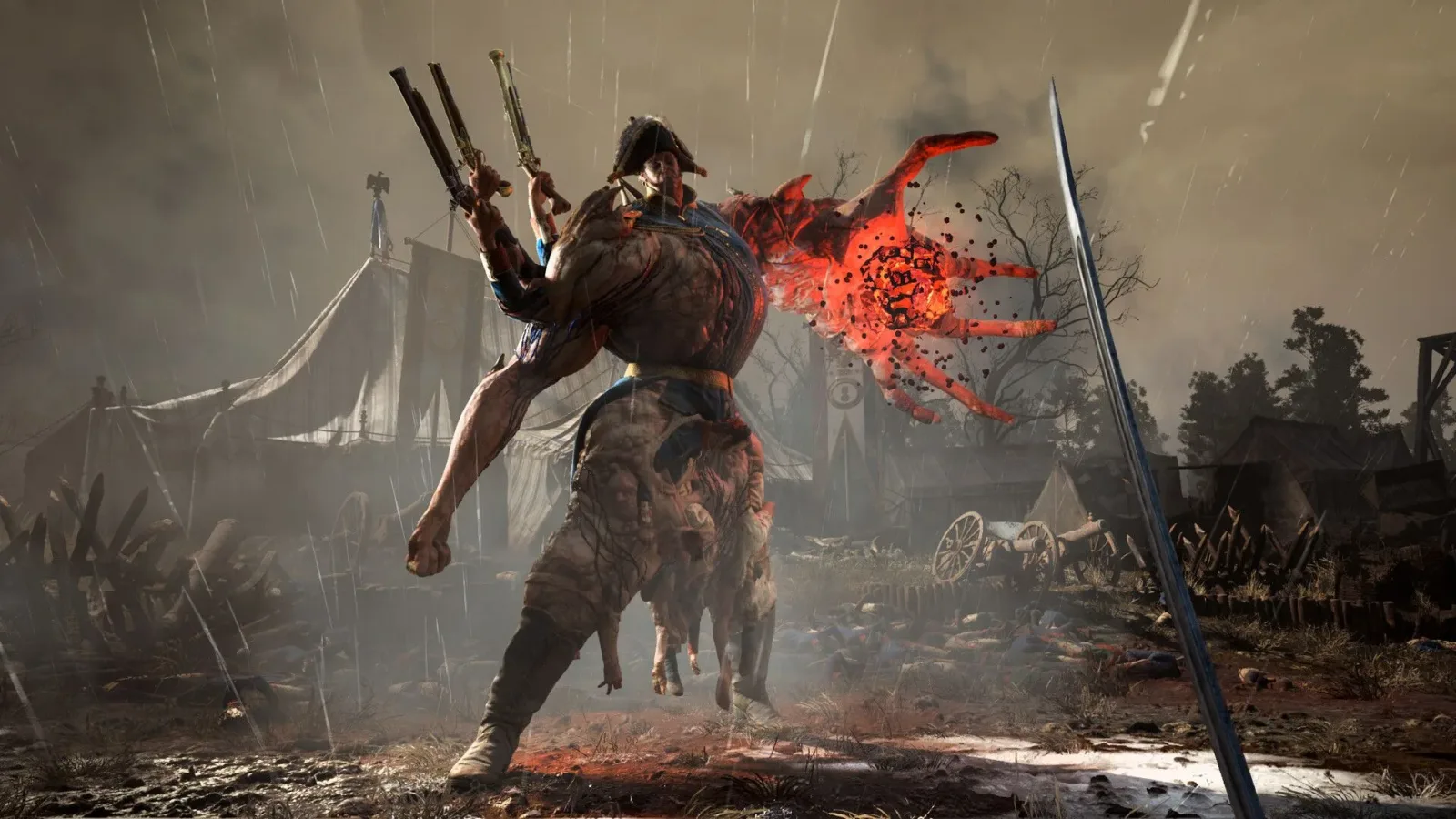
Valor Mortis, the upcoming first-person soulslike from the developer behind Ghostrunner, will launch at a $40 price point. Publisher Lyrical Games is framing that decision as a deliberate response to an unusually congested fall 2026 calendar, one expected to include industry-defining releases such as Grand Theft Auto 6 and a remake of The Legend of Zelda: Ocarina of Time.
The pricing strategy is not being presented as a sign that the team lacks confidence in the game. Quite the opposite: Lyrical Games boss Blake Rochkind said the company debated the choice extensively, particularly because a lower price can create assumptions about a game's scale or quality. Ultimately, though, the publisher concluded that Valor Mortis has a better opportunity to stand out as an accessible additional purchase in a season when many players will be choosing carefully between enormous releases.
That distinction matters. Rather than asking consumers to treat Valor Mortis as the one game they buy during a packed month, Lyrical wants it to be the game they can add to their library alongside another major release. It is an increasingly familiar challenge for new intellectual properties: establishing an identity while launching amid sequels, remakes, and franchises with vastly larger audiences and marketing footprints.
A crowded launch window changes the calculation
Fall 2026 has become remarkably crowded even before considering the effect of GTA 6, which is scheduled for mid-November. Publishers have long treated a Rockstar launch as an event capable of reshaping release schedules across the market, and the concentration of games in September and October appears to reflect studios attempting to secure attention before that juggernaut arrives.
For useful background on this topic, read Dungeons & Degenerate Gamblers Deals PS5 and Switch Release for October 9, 2026.
At one point, Valor Mortis had been set for September 24. By the time that original date was announced, however, Rochkind said the team already knew a delay was coming. That timing would have placed the game in an exceptionally busy stretch, near titles including Control Resonant, Harvest Moon: Echoes of Teradea, Hot Wheels Infinite Rush, Dragon Quest 11 Nintendo Switch 2 Edition, and Silent Hill: Townfall. Onimusha: Way of the Sword later moved forward into early September, further altering the shape of the month.
The pressure does not ease immediately afterward. The following week has been associated with Ace Combat 8, Gears of War: E-Day, and Star Wars: Galactic Racer, while Rayman Legends Retold has since been delayed. For a completely new series, that lineup represents an uphill battle for storefront visibility, coverage, streaming attention, and, most importantly, player time.
Valor Mortis has therefore moved away from its initially announced September 24 slot, although a new release date was not detailed alongside the $40 announcement. The revised timing may give the game more room to breathe, but Lyrical Games is clearly treating pricing as just as important as calendar placement.
The case for being an "and" game
Rochkind's central argument is that a lower price lets Valor Mortis become an "and" game rather than an "or" game. In practical terms, that means a player who has already committed to a premium-priced blockbuster may still feel comfortable picking up a $40 action game that offers a different kind of experience.
It is a simple idea, but one with major implications in a premium console and PC market where new releases frequently demand a substantial upfront investment. A player facing multiple large games in a short period may postpone, skip, or wait for a discount on all but their highest-priority purchases. A $40 price can lower that barrier without turning the game into a budget product in the eyes of its creator.
"We want this to be a game that you can pick up alongside these other great games," Rochkind said of the publisher's approach.
Rochkind said his biggest concern was that the lower cost could send the wrong message about Valor Mortis. That concern is understandable, particularly for a new action property trying to persuade soulslike fans that it deserves attention in a genre with demanding audiences and established competitors. Pricing does not just affect a purchase decision; it can influence expectations about length, production values, replayability, and ambition.
Still, the company views the decision as an expression of confidence. Rather than avoiding a difficult release period or attempting to match the pricing of the largest games in the market, it is betting that a distinctive premise and a more approachable price can make Valor Mortis attractive to players who are already spending heavily elsewhere.
A first-person soulslike looking for its own space
Valor Mortis is notable not only because of its launch strategy, but because it takes the soulslike formula into a first-person perspective. The genre is strongly associated with deliberate combat, punishing encounters, precise timing, exploration, and the cycle of failure, learning, and eventual mastery. A first-person viewpoint can change how all of those elements feel, making enemy proximity, spatial awareness, and combat feedback more immediate.
The developer's history with Ghostrunner also gives the project a clear point of interest. That game earned attention for its first-person movement and high-intensity action, so there is a natural curiosity around how the studio's experience with speed, perspective, and precision will translate into a more soulslike structure. Valor Mortis will need to define its own identity, but its perspective alone separates it from many of the genre's most prominent third-person games.
An earlier hands-on opportunity during Steam Next Fest suggested that the game could be worth watching, giving players an initial chance to evaluate its direction before release. For an unfamiliar IP, playable demos and direct exposure can be particularly valuable. Marketing can communicate a setting or visual hook, but action games often live or die on how their controls, combat rhythm, and challenge feel in players' hands.
That is especially true for soulslikes. The label creates expectations, but it also invites intense comparison. Fans will examine whether a game's difficulty feels demanding but fair, whether encounters reward observation and improvement, and whether its systems encourage persistence rather than frustration. Valor Mortis does not need to imitate every convention associated with the genre, but it must give players a compelling reason to invest in its particular interpretation.
New IP faces a different kind of risk
Rochkind described Valor Mortis as one of the relatively few new IP launches in what he called an extraordinarily hectic fall. That status can be both an obstacle and an opportunity. Established brands enjoy recognition: audiences already know what GTA, Zelda, Gears of War, Dragon Quest, and Silent Hill represent. A new name must first answer a more basic question: why should players care?
On the other hand, a crowded slate full of known properties can create space for something that feels unfamiliar. Players who have seen countless trailers for sequels and remakes may be more willing to take a chance on a game with a fresh setting, different perspective, or more modest asking price. The "and" game strategy is built around that possibility. Valor Mortis is not positioning itself as a replacement for the season's giants; it is asking to coexist with them.
The approach also touches on a broader conversation around AA development. Mid-budget games can occupy a valuable middle ground between small independent experiments and blockbuster productions, but publishers often see them as financially risky. Rochkind has argued that the industry needs more breakout successes in the mold of Clair Obscur: Expedition 33 before companies stop treating smaller-scale releases as an automatic danger.
That observation reflects a difficult commercial environment. The costs and expectations surrounding top-tier games are enormous, yet there remains a substantial audience for focused experiences that do not need to be the biggest game of the year. A $40 game with a defined premise may be easier for some players to justify than another full-priced, dozens-of-hours commitment.
What the price signals for players
For prospective players, the confirmed information is straightforward: Valor Mortis is planned as a $40 release, and it will not arrive on its previously announced September 24 date. The new date has not been provided. Its presence at Steam Next Fest indicates a PC audience is part of the plan, while no additional platform availability was confirmed here.
The larger story is how Lyrical Games is choosing to navigate a release season crowded with titles that could dominate the conversation. The publisher is not trying to pretend that a new first-person soulslike can command the same level of immediate attention as GTA 6 or a new take on Ocarina of Time. Instead, it is making a case for value, timing, and coexistence.
Whether that positioning works will depend on the finished game. A favorable price can get a player to look twice, but it cannot substitute for satisfying combat, strong encounter design, a memorable world, and the sense of progression soulslike fans expect. If Valor Mortis delivers those fundamentals, its $40 cost could become a meaningful advantage at precisely the moment players are deciding which additional game deserves a place beside the season's biggest purchases.
Community
Discussion
Start the conversation.
No comments have been posted yet.