


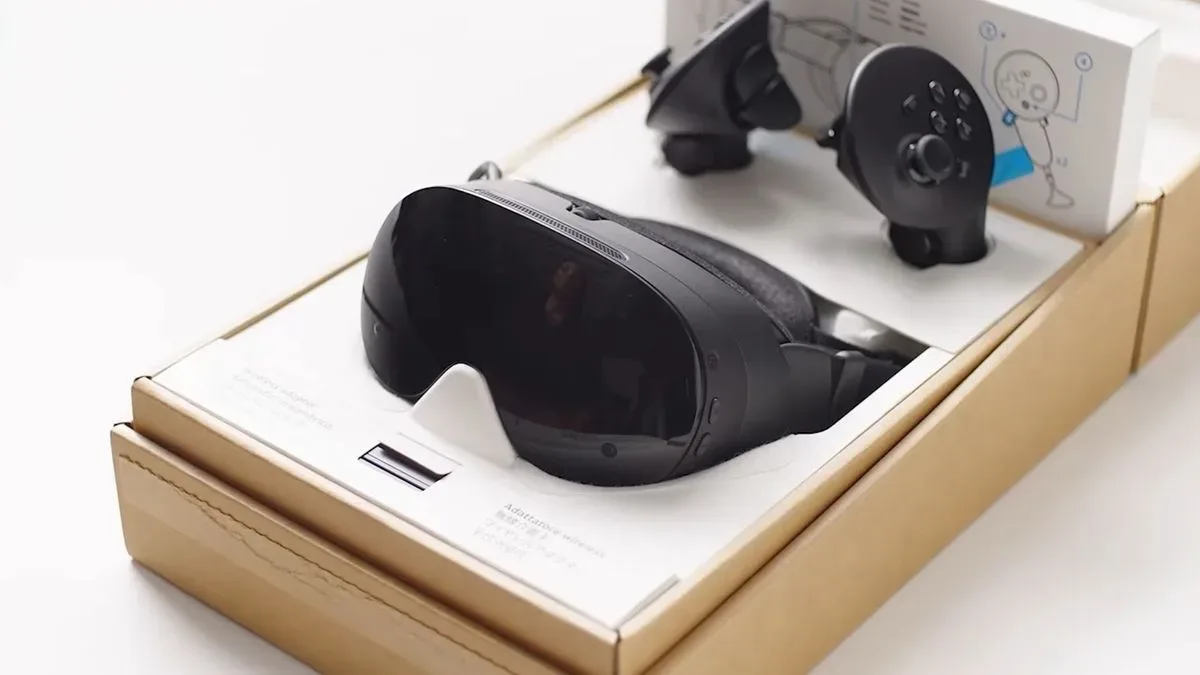
Valve's Steam Frame may arrive with Half-Life: Alyx, one of virtual reality's defining games, but the decision is not simply a matter of leaning on a beloved back-catalog success. The company's work bringing the 2020 VR game to the headset's standalone mode reflects a broader technical priority: making as much of the existing Steam library as possible function well on new ARM-based hardware.
For players hoping the launch of Steam Frame would also bring a newly made Valve VR adventure, that focus may be disappointing. A new headline game would have been an obvious way to demonstrate the hardware's potential. Instead, Valve is bundling a six-year-old title that many PC VR owners already know. Yet Half-Life: Alyx remains an unusually meaningful choice. It is a landmark for the medium, a game built around high-end wired PC VR expectations, and therefore a demanding test of whether Steam Frame can credibly deliver a standalone Steam experience rather than merely another headset with a limited mobile-style ecosystem.
Valve's developers have indicated that making the broad Steam catalog usable was the more valuable use of the team's efforts. Pierre-Loup Griffais, a SteamOS developer, described the appeal of having a large body of existing experiences ready to introduce people to different sides of the hardware. In practical terms, that means Steam Frame's pitch is larger than a single new exclusive. It is intended to support conventional games in a portable-style context as well as fully immersive VR software.
Why Alyx Became the Technical Target
In that context, Half-Life: Alyx was more than a bundle item. It was a proving ground. The game was created for powerful gaming PCs connected to premium VR headsets, where desktop-class CPUs and GPUs could handle the demands of detailed environments, responsive physics, dense interactivity, and the high, stable performance VR requires to remain comfortable.
For useful background on this topic, read Monster Hunter Wilds: Ascendance Raises the Stakes With Skybound Eyrie and Fiercer Hunts.
Steam Frame's standalone mode changes that equation. Rather than relying on a nearby gaming desktop to do all of the rendering work, the headset must run software through its own smaller and more power-conscious processor. The hardware's ARM foundation makes the task still more involved, because much of the established PC gaming world has been built around a different processor architecture.
Robin Walker, a Valve programmer and co-creator of Team Fortress 2, said that the large majority of fixes made for Alyx are applicable to almost anything running on Steam Frame. That detail is important. It suggests Valve did not treat the port as a narrow, one-off rescue effort for a prestigious bundle game. The work was also used to reinforce the underlying platform, potentially improving the prospects for other games and applications that need to operate in the headset's native standalone environment.
That is why an established game could be a more useful launch project than a brand-new Valve VR release. A newly designed game could be built around Steam Frame's limits and capabilities from the beginning. Getting Alyx running natively required Valve to confront the friction that comes with adapting existing PC software. Solve enough of those problems at the platform level, and the benefits can extend beyond one game.
ARM Is Efficient, but PC Compatibility Is Complicated
ARM processors are increasingly attractive for compact devices because they can offer strong efficiency while producing less heat. Those qualities matter enormously in hardware that must be light enough to wear, quiet enough to use comfortably, and capable of operating without a permanent cable to a large external PC. A headset cannot simply be treated like a desktop tower strapped to someone's face; power draw and thermal limits directly affect weight, battery behavior, noise, and sustained performance.
The difficulty is that efficiency does not automatically equal seamless compatibility. Traditional gaming desktops, laptops, and much of the software made for them have long centered on more familiar PC processor designs. Games, middleware, tools, and supporting applications may all carry assumptions tied to that established environment. Moving them to ARM can require translation layers, updates, code changes, or deeper optimization work.
For Steam Frame, the challenge is especially visible because Valve's ambitions encompass existing Steam games, not merely titles built specifically for the headset. Running software natively on ARM is a different proposition from streaming it from a PC. Streaming can keep demanding rendering workloads on the player's desktop or laptop and send the resulting image to the headset. Native operation asks the standalone device to carry far more of that work itself.
This is not a problem unique to Valve. ARM-based gaming devices are drawing increased attention across the industry, and companies pursuing them face compatibility issues that can involve emulation, anti-cheat systems, graphics APIs such as DirectX and Vulkan, drivers, and game-specific behavior. Nvidia's work around gaming performance for its RTX Spark processor also illustrates how much development remains when hardware moves away from the assumptions of conventional PC setups.
None of this means ARM hardware is unsuitable for gaming. Rather, it underscores that the software transition can be as important as the silicon. A device may have an appealing power-performance profile, but users still judge it by whether their favorite games launch, run reliably, support necessary services, and perform at a level appropriate for the type of game being played. In VR, performance consistency has an even sharper edge because frame-time problems can affect player comfort as well as visual quality.
A Wider Library Matters More Than One Exclusive
Valve's stance makes sense from a platform-building perspective. A polished first-party launch title can create excitement, but a sustainable headset needs reasons to return after the initial showcase is over. Steam already has an enormous software legacy, including early VR standards such as Superhot VR and Beat Saber. Griffais specifically pointed to those kinds of enduring titles as examples of games that remain highly effective for showing newcomers what VR can do.
That library-based argument also addresses one of the recurring concerns around VR hardware: whether a platform has enough software to justify the investment. A new exclusive can be memorable, but it cannot alone solve a sparse catalog. Valve's effort to ensure that games already associated with Steam can provide a good experience on Steam Frame offers a different value proposition. The goal appears to be a device that connects to the breadth of PC gaming culture while still functioning as a purpose-built VR headset.
For Half-Life: Alyx, players will have more than one route. It can be played through Steam Frame's standalone mode following Valve's update, while PC or laptop streaming remains an option for those with suitable hardware. That flexibility is significant. Native play may be desirable for convenience and reduced dependence on another machine, whereas streaming can preserve access to the horsepower of a dedicated gaming PC for games that demand it.
The coexistence of those approaches could be central to Steam Frame's identity. Not every VR game has to make the same trade-offs if it can be streamed from a PC, and not every experience needs desktop-level resources to be compelling. Smaller, focused, or older VR titles may be excellent candidates for native standalone play, while visually ambitious software can continue to benefit from external rendering where available.
What This Means for Valve's Next VR Game
The obvious unanswered question is whether Valve's compatibility investment eventually leads to another original VR release. The company has not confirmed such a project, and the arrival of Half-Life: Alyx with Steam Frame should not be read as proof that a sequel or new Valve VR game is imminent.
Still, the work has potential long-term importance. A stronger native compatibility base gives developers clearer technical foundations and may reduce the effort needed to bring existing software to Steam Frame. If Valve's Alyx fixes really do apply broadly, the title's standalone version could become an early marker of a maturing software environment rather than simply a nostalgic pack-in.
There may also be design implications for future games. Developers targeting standalone ARM hardware may need to think carefully about rendering budgets, simulation complexity, asset detail, and battery-conscious performance. That does not necessarily mean VR must become less ambitious. Better tools, targeted optimization, and PC streaming can all preserve room for high-end experiences. But the balance between wireless convenience and maximum graphical fidelity will remain a defining question for hardware designed to work away from a wired GPU connection.
For now, Valve's message is more practical than speculative. Steam Frame's launch is being supported by an established VR classic because bringing that classic to standalone ARM hardware helped tackle problems relevant to the wider Steam ecosystem. For anyone waiting on Valve's next original VR leap, that may not be the announcement they wanted. For Steam Frame's future software support, however, it may prove to be the more consequential one.

Community
Discussion
Start the conversation.
No comments have been posted yet.