

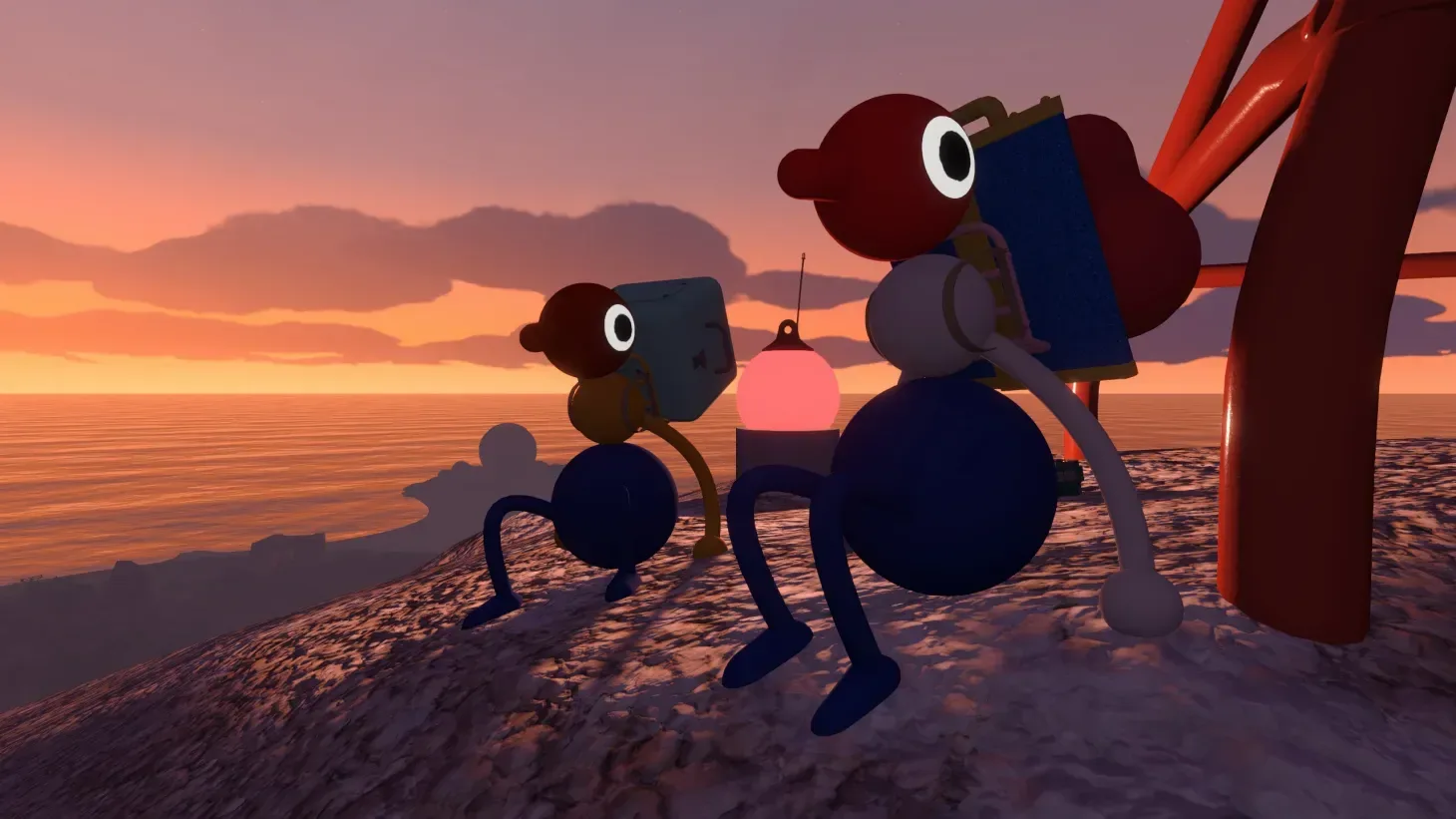
Big Walk is a cooperative adventure about something games often rush past: the time spent between destinations. It has puzzles to solve, strange devices to uncover, a broad island to explore, and a larger mystery that steadily comes into focus. Yet its defining achievement is not any one of those pieces. It is the way House House makes a group's casual conversations, minor disagreements, wrong turns, and ridiculous improvised solutions feel like the true content of the game.
On PC, Big Walk asks players to slow down and treat an online session less like a quick matchmaking activity and more like a planned social occasion. That can sound restrictive, particularly in a genre full of drop-in co-op games, but the restrictions are fundamental to why this unusual journey works so well. A good walk becomes a shared story, and Big Walk understands that the story is shaped as much by the people taking it as by the place they are walking through.
A co-op game that insists on togetherness
Big Walk requires cooperation. There is no solo route through the island, and puzzles scale for groups of two, three, or four players. Lobbies can hold up to 12 people, although puzzle layouts remain designed around four participants. Those boundaries mean that assembling a session can feel closer to organizing a board game night than casually inviting someone into a standard multiplayer game.
The game also strongly favors its built-in proximity voice chat over an external voice call or local split-screen arrangement. It cannot fully force players to follow that preference, but it is clearly designed around the idea that voices should fade with distance. If friends wander away from each other, they must solve the practical problem of reconnecting. A walkie-talkie, a radio, or even a whiteboard can become essential equipment rather than decorative flavor.
That design decision gives the island a rare sense of physical separation. A teammate who is nearby can hear a quiet comment. A teammate over a ridge may be reduced to a distant, unintelligible sound. When the group needs to split up, communication must be planned, and when everyone regroups after exploring separate paths, it feels like a genuine reunion. Big Walk does not merely tell players to cooperate; it makes the act of maintaining contact part of the adventure.
Expressive bodies make simple moments funny
Every player controls an orbish, bird-like avatar, and the early tutorial area is filled with tools and interactions that teach the game's playful language. Characters can lift their arms, point, wave, stretch outward, crouch, jump, sit, slide down slopes, pick up objects, and even kick items away. These are small actions, but they make movement feel unusually tactile and social.
In many co-op games, communication is almost entirely verbal: a player describes an object, gives a direction, or calls for help. Big Walk adds body language to that conversation. Pointing at a clue is clearer and more satisfying than describing where it is. A triumphant pose after solving a challenge can be its own punchline. Sitting down during a lull or tumbling down a hill gives players a way to inhabit the world even when no formal objective is active.
This physicality supports the game's light, mischievous tone. A whiteboard may not be as useful as a radio in a practical sense, but it can still become the source of an extended joke when someone writes a message and attaches it to a friend's backpack. The best moments often emerge from these tools being treated as toys rather than mere solutions. Big Walk is generous with opportunities to be silly, and that silliness is crucial to making the island feel like a place friends are visiting together rather than simply clearing.
Communication is the puzzle
The main progression revolves around small red objects that resemble rubber dog toys, informally nicknamed "gourds." Finding and earning these objects generally requires solving environmental puzzle rooms scattered across the island. Their variety is a major strength. Challenges can involve blindfolded obstacle courses, pitching machines, egg timers, light-and-picture logic, mazes, and wooden blocks marked with symbols. The repeated question is not simply how to understand the puzzle, but how the group can communicate its understanding.
Big Walk is especially sharp when it interferes with familiar forms of communication. Soundproof spaces demand gestures, observation, and invented signals. Helmets can muffle voices and limit vision. A player may need to guide a teammate through a task with only incomplete information, leading to increasingly specific instructions, improvised vocabulary, and plenty of mistakes. A phrase as mundane as "move a little to the left" becomes an event when the person receiving it cannot easily see or hear what is happening.
These puzzles evoke the best kind of summer-camp activity: a challenge that is deliberately a little awkward, but satisfying because the group must work out how to function together. The game rewards patience and observation without turning every room into an exhausting test of precision. It also encourages teams to develop their own shorthand around symbols, objects, and recurring situations. By the time a group has spent several hours on the island, its members are likely to have built a private language that belongs to that specific journey.
An island of useful discoveries and long walks
Gourds can be placed at designated locations, and collecting enough of them opens secondary puzzles that unlock new island features. These reveals are among Big Walk's most exciting surprises, so the exact nature of each is best left undisclosed. What matters is that they continually recontextualize the environment. A place that once seemed like scenery can become relevant again, while an object that appeared minor can acquire a new purpose.
The island is not merely a sequence of puzzle chambers. It is a space designed for wandering, getting separated, meeting back up, and stumbling across something unexpected. Walking takes real time, not a meter or a resource to manage. That deliberate pacing creates downtime, and downtime is where some of the game's fondest memories are likely to form. A group might debate who gets to carry a newly discovered megaphone, search the dark for a dropped key item, or simply poke around with equipment that has no immediate objective attached.
Equipment choices add a modest but effective layer of tension. At first, players can hold only one item at a time, meaning the group must decide what to bring along. A flashlight may appear unnecessary during the day, then become vital when night falls. Radios and walkie-talkies are extremely useful when the group divides. Meanwhile, more whimsical tools can be left behind because they are less efficient. The limitation creates meaningful choices, though it also occasionally gets in the way of playfulness. A whiteboard is an inspired nonverbal communication device, but it can be hard to justify carrying when a more functional radio is readily available.
Friction in the journey
Big Walk's willingness to make travel substantial is usually a virtue, but the balance changes somewhat as the group becomes more focused on unlocking the island's deeper layers. Later progress can pull attention away from the carefree pleasure of wandering and toward the forward momentum of puzzles, secrets, and the eventual ending. The world continues to offer surprises, including a larger post-credits puzzle chase for players who want to keep digging, but the early sensation of simply going somewhere together is strongest before completionism takes hold.
There are also occasional mechanical frustrations. Jumping up uneven terrain and scrambling onto ledges can feel finicky, which is particularly noticeable in a game where crossing the landscape is such a central activity. It is not enough to derail the experience, but it can turn a simple climb into an unnecessary struggle. Players should also know that Big Walk is unapologetically social. Anyone without a reliable group, or anyone who prefers a co-op game that can be enjoyed alone, will find its entry requirements difficult to overcome.
Who should take the walk?
Big Walk is best for friends willing to set aside several evenings and embrace the game on its own terms. A group that uses proximity chat, tolerates detours, and enjoys laughing at failed plans will get the most from it. Puzzle fans will appreciate its constant invention, but the ideal audience is broader than people who simply want brainteasers. This is a game for players who value the stories that arise around a puzzle: the badly communicated plan, the accidental discovery, the person who carried the wrong tool, and the eventual realization that the absurd method somehow worked.
A crew of three can reach the ending in roughly nine hours, though the time will vary with puzzle-solving pace, exploratory instincts, and how much time the group spends just fooling around. Its finale lands because it recognizes what the entire structure has been building toward. The destination matters, but the shared journey matters more.
Final takeaway
Big Walk earns its 9 out of 10 by committing completely to cooperative presence. It turns proximity chat into a design tool, gives players expressive bodies and delightful objects, and builds puzzles that are as much about learning how to communicate as they are about finding correct answers. Some traversal roughness and a more objective-driven late-game rhythm prevent the walk from being perfectly effortless. Still, few co-op adventures so convincingly capture the feeling of traveling somewhere with friends. Big Walk is not just a game to finish together; it is a place to make the kind of small, strange memories that remain after the map has been explored.
Community
Discussion
Start the conversation.
No comments have been posted yet.