

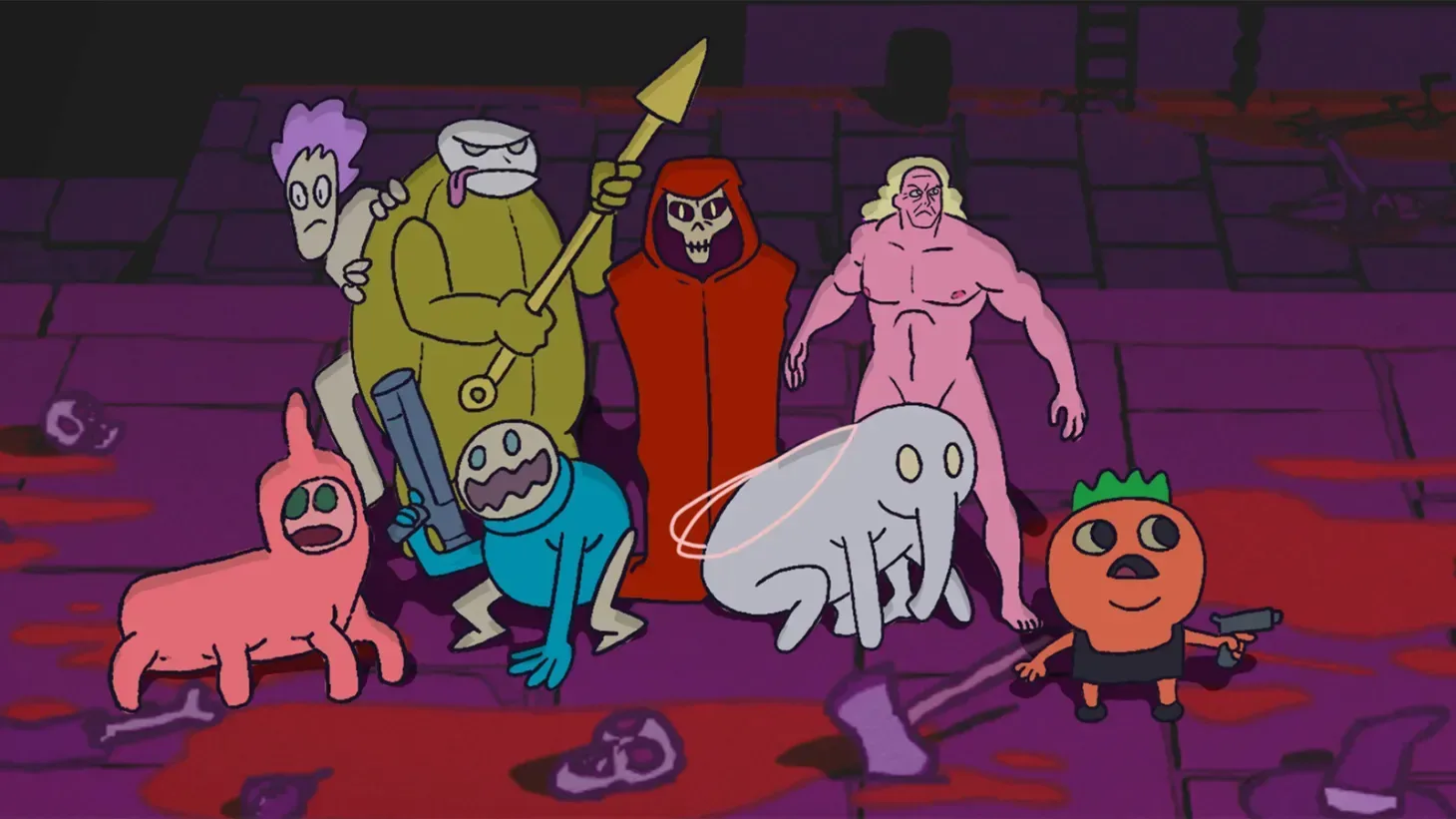
Blood Dungeon is a bullet-heaven game that refuses to let its players drift into autopilot. On PC, it takes the familiar survival-run structure of mowing down enormous enemy crowds, gathering experience, choosing randomized upgrades, and escalating into screen-filling chaos. Yet it gives that formula an unusually physical foundation: the characters are capable platforming heroes before the first weapon improvement ever arrives. They jump cleanly, scale walls and ceilings, move across fences, and swim through the environment. That mobility changes the rhythm of the entire game.
Released on August 24, 2026, Blood Dungeon arrives in a genre crowded with games built around increasingly passive power fantasies. Those experiences can be immensely satisfying, especially when a carefully assembled build reaches the point where it practically plays itself. Blood Dungeon has a different ambition. It wants positioning, traversal, timing, and route selection to remain meaningful even while hundreds of enemies flood the screen. The result is a strong and often thrilling take on the format, though balance problems and murky long-term progression prevent its best ideas from landing with complete consistency.
An opening verdict: movement is Blood Dungeon's great advantage
The central reason to play Blood Dungeon is simple: moving through it feels good. Its nine characters mostly share the same basic movement language, with two standing apart more noticeably, but the core toolkit is compelling across the roster. Running, leaping, climbing, clambering, and swimming create a sense that the levels are places to be navigated rather than merely arenas in which to circle enemies endlessly.
That distinction matters. In many survivor-style games, movement is primarily a defensive necessity used to keep danger at a manageable distance. Here, movement is a source of expression and a survival skill in its own right. A wall can become an escape route, a ceiling can become a temporary refuge, and an elevated route can provide a way to slip past a crowd that would otherwise end a run. Blood Dungeon can look like a chaotic action game, but underneath its projectile storms and horde pressure is a legitimately functional platformer.
Even with no upgrades at all, the game already has a convincing mechanical identity. The platforming is not simply decoration pasted onto a familiar formula; it is the feature that makes Blood Dungeon feel different. When a close escape comes from climbing away from a pursuing mass or using the terrain intelligently instead of relying on raw damage output, the game's design feels particularly sharp.
The familiar loop still works
Blood Dungeon does not abandon the pleasures expected from the genre. Enemies are defeated, blood is collected, levels are gained, weapons improve, and randomized choices offer new weapons or passive effects. The escalating build process is recognizable and satisfying. A promising run still carries the familiar excitement of spotting a helpful option in the upgrade selection, stacking useful effects, and gradually turning a fragile starting character into a far more dangerous presence.
Many of the available upgrades are easy to appreciate when they appear. They offer clear utility, support different approaches, and encourage the "one more run" momentum that defines the genre at its best. There is also a useful layer of permanent progression. Bones earned after a run can be invested in lasting character improvements, giving failure a sense of forward movement and providing an immediate reason to return to the dungeon.
That loop is particularly effective because Blood Dungeon remains demanding. A successful run is not merely about choosing upgrades and watching the damage numbers climb. Smart selections remain important, but staying alive often requires attentive play. The game asks players to keep engaging with the terrain and reacting to threats rather than settling into the comfort of an unstoppable build.
Power balance is the game's biggest complication
For all of its strengths, Blood Dungeon does not always make its many upgrades feel equally valuable. Some options can seem underwhelming, while a small number become so desirable that their absence can make a run feel dramatically less viable. The basketball is one notable example: it unleashes a flurry of orange balls that bounce through the environment, creating the kind of persistent, widespread damage that can be crucial in a crowded level. Another major option doubles everything, making it similarly difficult to ignore.
These upgrades are entertaining and effective, but their effectiveness creates a problem. When certain choices feel required to defeat a level's final boss, the randomness of the selection screen can become frustrating rather than exciting. Rerolling for the same pair of powerful upgrades may be strategically sensible, but it narrows the range of builds that feel dependable. The game would benefit from a broader group of weapons and passives that reach a comparable power level in different ways.
This is a difficult problem to solve in any randomized action game. Variety requires differences in behavior, purpose, and synergy, while balance requires those differences to remain competitive. Blood Dungeon has plenty of interesting tools, but it does not always fully achieve that balance. A failed attempt can occasionally feel tied less to a poor decision or a missed movement opportunity than to not receiving one of the most impactful available upgrades.
Challenge creates tension instead of effortless dominance
Blood Dungeon is surprisingly tough, and that difficulty is both an advantage and a limitation. Each level is completed by defeating three bosses, so runs need to survive more than the ordinary waves of enemies. The escalating pressure ensures that the screen-filling chaos remains threatening. Even after a strong sequence of upgrades, the game does not consistently deliver the overwhelming, untouchable sensation associated with the genre's greatest power fantasies.
For players looking for a game that eventually becomes a passive spectacle, that may be disappointing. Blood Dungeon does not frequently invite anyone to put down the controller and watch the carnage unfold from a safe distance. But its resistance to that style is also why its successes feel earned. The best moments happen when a build is good enough to create breathing room without removing the need for careful traversal. Escaping through the level because of strong platforming instincts can feel more satisfying than simply benefiting from fortunate upgrade rolls.
The game is therefore more intense than many of its peers. It maintains the quick-restart appeal of a survivor-like while demanding the concentration of a platformer. That combination will not suit every player, but it gives Blood Dungeon a clear identity in a genre where systems and pacing can otherwise blur together.
Permanent progression needs clearer direction
Bones provide a welcome reward after each attempt, and spending them on permanent improvements is initially gratifying. Investing in preferred character attributes creates a tangible sense of growth, making repeated runs feel productive even when a boss victory remains out of reach. However, this progression system loses clarity after the early purchases are exhausted.
Eventually, it is possible to run out of immediately available upgrades while other unlockable options remain inaccessible. The requirements for opening those purchases are not clearly communicated, leaving a growing stockpile of unspent bones and little certainty about what must be done next. Instead of feeling like a goal to pursue, the unlock process can seem arbitrary. Clearer milestones, better explanations, or visible requirements would make this part of the game more rewarding and reduce the sense of waiting for an unknown trigger.
A deliberately ugly world with a committed personality
Blood Dungeon's visual style is every bit as distinctive as its movement, though it is more divisive. The characters are purposefully unattractive, the world has a gross and grimy quality, and the overall tone embraces an intentionally unpleasant sense of humor. Its aesthetics are not trying to be elegant, cute, or conventionally cool. They are committed to being weird.
That commitment suits the game's chaotic mood, but it can also become abrasive. The fart cloud upgrade, for instance, periodically releases a useful poison cloud, yet its recurring sound effect may be enough to make some players avoid an otherwise effective tool. The visual and audio presentation is undeniably memorable and coherent, but it will not be universally welcome. Players sensitive to crude humor or deliberately gross effects should know that this is a defining part of Blood Dungeon's personality rather than an occasional flourish.
Who should play Blood Dungeon?
Blood Dungeon is best suited to players who enjoy survivor-style progression but want more direct control over their fate. Those who like responsive platforming, active dodging, route planning, and high-pressure runs will find its strongest ideas immediately appealing. It is also a good match for players tired of games in the genre becoming passive too quickly.
Players seeking perfectly even build variety, transparent meta-progression, or a more polished and pleasant visual style may find its flaws more difficult to overlook. Its challenge and emphasis on continuous input are features, not accidents. Blood Dungeon wants attention from beginning to end.
Final takeaway
Blood Dungeon earns its 8/10 by proving that a bullet-heaven game can be built around movement as much as firepower. Its platforming systems make each run feel active, tense, and skillful, while its weapon upgrades and bone-driven progression supply the repeatable structure expected from the genre. Some balance issues make a few upgrades feel too important, and unclear unlock conditions blunt the satisfaction of permanent progression. Its grotesque style is similarly a matter of taste.
Still, the game's strongest quality is impossible to miss: it is fun to control. Blood Dungeon turns terrain into a meaningful tool and keeps players involved in the chaos rather than asking them to merely observe it. That makes it a refreshing, memorable, and rewarding PC action game for anyone ready to keep moving.
Community
Discussion
Start the conversation.
No comments have been posted yet.