

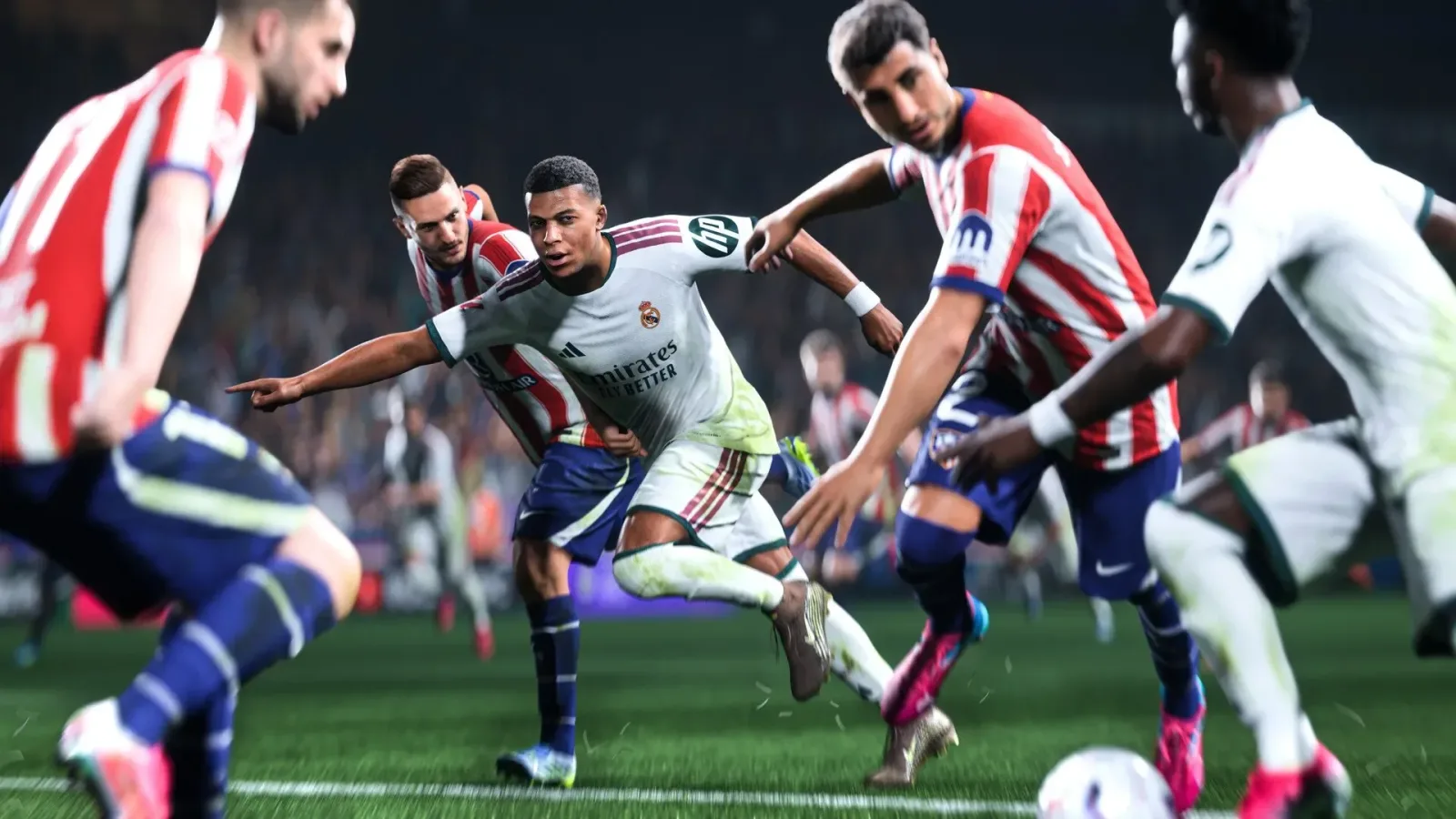
EA Sports FC 27 arrives on PlayStation 5 with a recognizable promise: refine the football rather than reinvent it. This is not a drastic break from the formula established by its immediate predecessor. Instead, it is an annual entry built around smaller adjustments to the action, a stronger set of incentives in Ultimate Team, and a handful of welcome usability improvements across Career Mode. Those changes do matter, especially for players who appreciate more deliberate defending and patient attacking construction. But they also make the game's lingering flaws more visible.
The result is a familiar but capable football package. FC 27 is at its strongest when a match demands close attention: tracking a runner manually, timing an interception, shaping a through ball into space, or directing a forward's movement to stay onside before breaking behind the defense. At its weakest, it can still feel overly dependent on inconsistent player switching and questionable CPU behavior. Its headline new social space, The Grounds, also has more of a foundation than a fully realized purpose. Even so, the core sport remains fluid, dynamic, and engaging enough to make this a season worth continuing for dedicated football fans.
A greater emphasis on control
The most important gameplay adjustments in FC 27 are tied to agency. In Ultimate Team's Competitive setting, CPU-assisted defending has been reduced, putting more responsibility on the person holding the controller. That may initially make defending feel more demanding, but it also gives strong defensive reads more value. Recognizing a passing lane, moving into it at the right time, and cutting out an attack is more satisfying when the game is not doing as much of that work automatically.
This shift complements a set of offensive refinements that encourage more thoughtful buildup play. Through balls require better aim, making them less of a simple release valve and more of a skillful tool. A misplaced pass can give away possession; a well-shaped one can split a back line and create a genuine opening. The added requirement for precision helps make successful passes feel earned rather than routine.
For useful background on this topic, read PlayStation Survey Draws Fresh Calls to Protect Physical Game Discs.
New teammate run options further expand the attacking toolkit. Curved runs are particularly useful because they allow forwards to adjust their route, remain onside, and arrive in better positions to receive a pass. This is a small change with a meaningful effect on the rhythm of attacking sequences. Rather than simply launching the ball forward and hoping a runner beats the line, players have more influence over how an opportunity develops. New corner controls also add another layer of ownership over set pieces.
None of this radically changes the foundations of FC football, but it makes matches more rewarding when players engage with the available systems. The game wants smarter decisions in possession and greater concentration out of possession. That is a positive direction for a series that can sometimes lean too heavily on automated assistance and familiar patterns.
Old frustrations still find space on the pitch
For every satisfying manual intervention, FC 27 can expose a few issues that have long followed the series. Chaotic passages of play, particularly those involving rapid defensive player switching, may leave control assigned to an unwanted footballer. In a game where positioning and timing are becoming more important, that sort of confusion is especially frustrating. A promising defensive stand can unravel not because of a bad read, but because the wrong player is suddenly under control.
CPU teammates can also make decisions that undermine the otherwise more deliberate design. Poor movement, odd positioning, or a lack of awareness in a crucial moment can make the game feel less responsive than its best sequences suggest. These are not new problems, and FC 27 does not fully solve them. The contrast is notable: the game offers more tools for skilled, intentional play, but its AI can still occasionally pull the experience back toward familiar irritation.
That tension defines much of this installment. The football feels polished and frequently exciting, yet it does not consistently demonstrate the kind of broad leap that would make last year's systems feel obsolete. It is an evolution aimed at players happy to find more depth in the details.
The Grounds needs a stronger identity
The most prominent new feature is The Grounds, an instanced open-world area where customizable avatars can queue at locations for Rush variations, other small-sided matches, and mini-games. It also serves as a home for Clubs play. On paper, it sounds like a modern social hub capable of tying several ways to play together. In practice, its current scale and purpose feel limited.
The Grounds is not yet a destination mode in the fullest sense. Its activities do not carry enough novelty or depth to make the area compelling on their own, and its ambitions stop short of creating a truly unified football lifestyle space. Crucially, it remains separate from Player Career, which makes the feature feel disconnected rather than central to the wider package. A shared hub gains value when it links a player's different goals, identities, and modes; The Grounds does not fully make that connection.
It also appears geared most strongly toward highly engaged players chasing FC Season points and Ultimate Team rewards. That gives committed users an obvious reason to visit, but it may make the space less inviting for casual players simply seeking a relaxed social mode. The concept has potential, and a smaller initial rollout is understandable, yet this version feels more like an opening step than a must-visit addition.
Ultimate Team gets the most meaningful new hook
Ultimate Team remains the centerpiece of the overall experience, and FC 27 gives collectors and squad builders an appealing new reason to stay invested. The Gallery works somewhat like a Squad Building Challenge, asking players to place club members into themed sets in exchange for rewards. Its most interesting wrinkle is the grading system: as better cards are added, set scores and grades can improve, creating an ongoing incentive to revisit and upgrade previous collections.
That approach makes the Gallery more than a one-time checklist. It provides a longer-term collection goal, and the ability to include players once owned but later sold is a smart accommodation for anyone who has cycled through a large number of cards. It recognizes a player's broader club history instead of treating every sale as a permanently lost contribution.
Starting Ultimate Team with more coins and tradeable items also helps give early squad building momentum. That boost should make it easier to engage with the Gallery and begin making meaningful choices sooner. The presentation has one small shortcoming: although the feature is framed like a trophy room, it does not offer much direct interaction with that concept. Still, the fundamental loop of building, improving, and re-grading sets is strong. Among FC 27's additions, this is the one most likely to keep Ultimate Team regulars returning.
Career Mode keeps taking incremental steps
Manager Career and Player Career receive more modest revisions. Their changes are granular rather than transformative, but several of them make the long seasonal grind easier to manage. Training plans are gone, while Manager Career introduces Dynamic OVR, which provides a clearer view of how a player's form, fitness, and morale affect overall standing. It is an intuitive system that makes monitoring a squad less cumbersome.
Negotiations benefit from a Tension meter that gives back-and-forth discussions clearer context. Unexpected events add some welcome narrative texture as well, such as receiving an opportunity to sign a player who is also attracting interest from a rival. Those moments help a save feel less like a static series of menus and more like an evolving football world.
However, the surrounding simulation can still be shaky. Players may seek transfers as soon as an offer arrives, including situations where there is no longer an effective way to block the move and where the destination does not seem aligned with the player's own interests. That can make squad planning feel arbitrary. Player Career's rivalry system is similarly undercooked. It mostly tracks statistical progress against another player and generates Personality points, but it lacks the presentation and eventful drama needed to make a rivalry feel meaningful.
Who should play EA Sports FC 27?
FC 27 is best suited to returning players who want a refined version of the football they already enjoy. Competitive players willing to embrace more manual defending and more precise passing should appreciate the added emphasis on skill. Ultimate Team regulars have the clearest new feature to explore through the Gallery, while Career Mode fans will find a collection of practical improvements that make managing a club more approachable.
Players hoping for a major reinvention should set expectations accordingly. The Grounds does not yet fulfill the promise of a comprehensive open social football world, and several legacy frustrations remain. This is an entry that improves the flow of play and enriches existing modes more than it changes the series' overall shape.
Final takeaway
EA Sports FC 27 earns its place through polish rather than bold transformation. Its best gameplay adjustments reward intelligent buildup, sharper passing, proactive runs, and hands-on defending. Ultimate Team receives a genuinely engaging collection system, and Career Mode is more manageable even when its simulation logic stumbles. The Grounds is a less convincing debut, while player switching, AI lapses, and restrained ambition keep the game from reaching a higher tier. Still, for players eager to spend another season on the pitch, FC 27 provides plenty of reasons to keep building toward the next match.
Community
Discussion
Start the conversation.
No comments have been posted yet.