

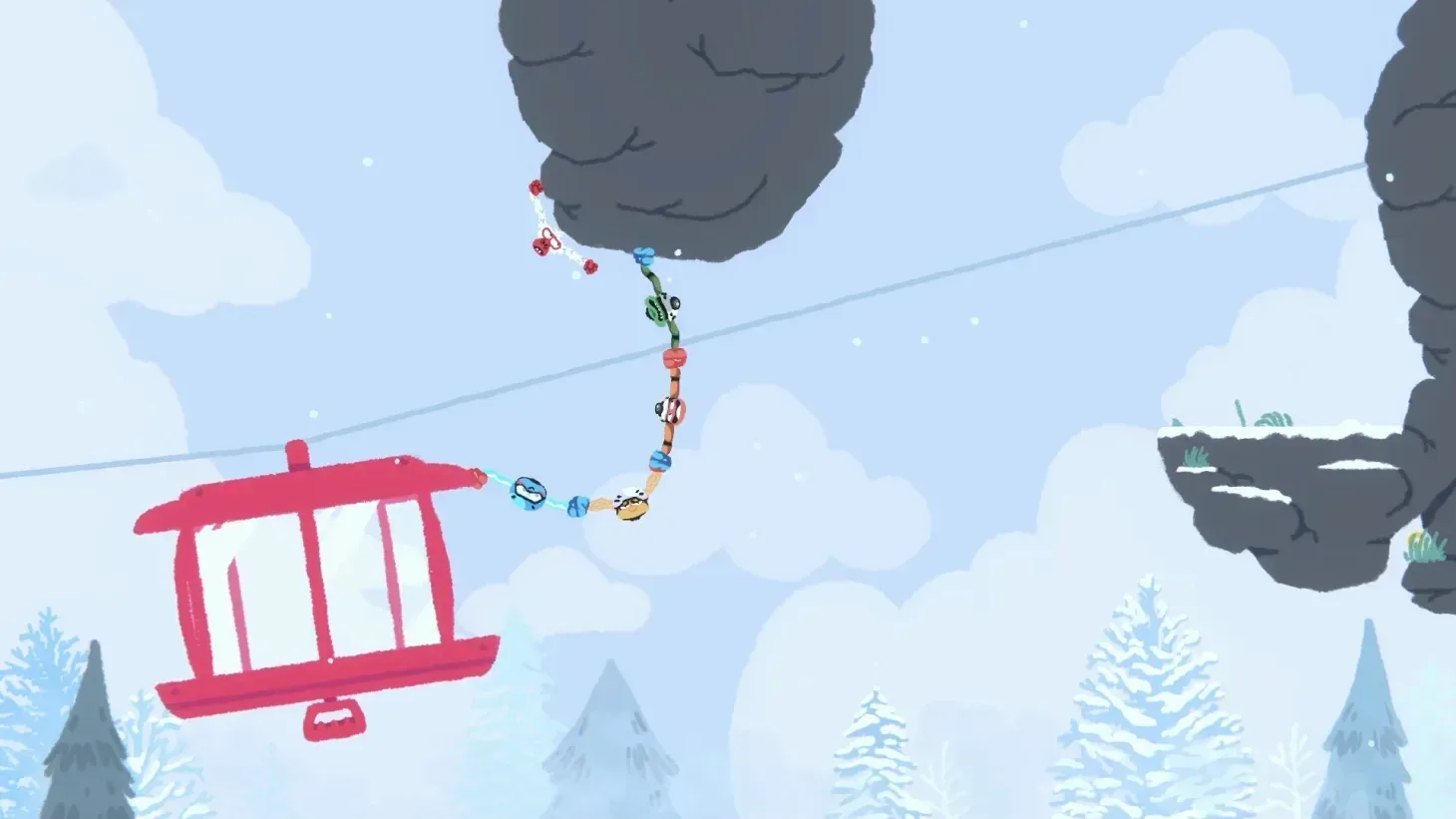
Heave Ho 2 understands that a failed jump can be more memorable than a successful one. Its players are little more than expressive heads with two grasping arms, attempting to swing, cling, climb, and fling themselves through a series of colorful obstacle courses. This premise is immediately ridiculous, but the sequel gives the slapstick a sturdy foundation. Controls are responsive, the campaign continually introduces new ideas, and the inevitable disasters carry almost no penalty. The result is a cooperative game where a friend dropping the group into a pit can prompt laughter rather than frustration.
Available on Switch 2, Heave Ho 2 is built entirely around multiplayer. It works best with a room full of family or friends willing to communicate badly, panic loudly, and accept that a carefully planned maneuver may collapse because someone grabbed the wrong ledge. Beneath that chaos is a surprisingly smart design. Players need timing, coordination, and a growing understanding of momentum, yet the game never loses sight of the comedy of several dangling bodies becoming an accidental knot.
A simple idea with plenty of physical comedy
Every player controls a head equipped with two arms. Each hand can grab nearby surfaces or objects through a button press, and movement comes from swinging, extending, releasing, and trusting teammates not to let go at the worst possible moment. The basics are easy to describe but take time to internalize. Early attempts can be a mess of missed grips and overambitious launches, especially when a group tries to cross a gap that clearly exceeds its reach.
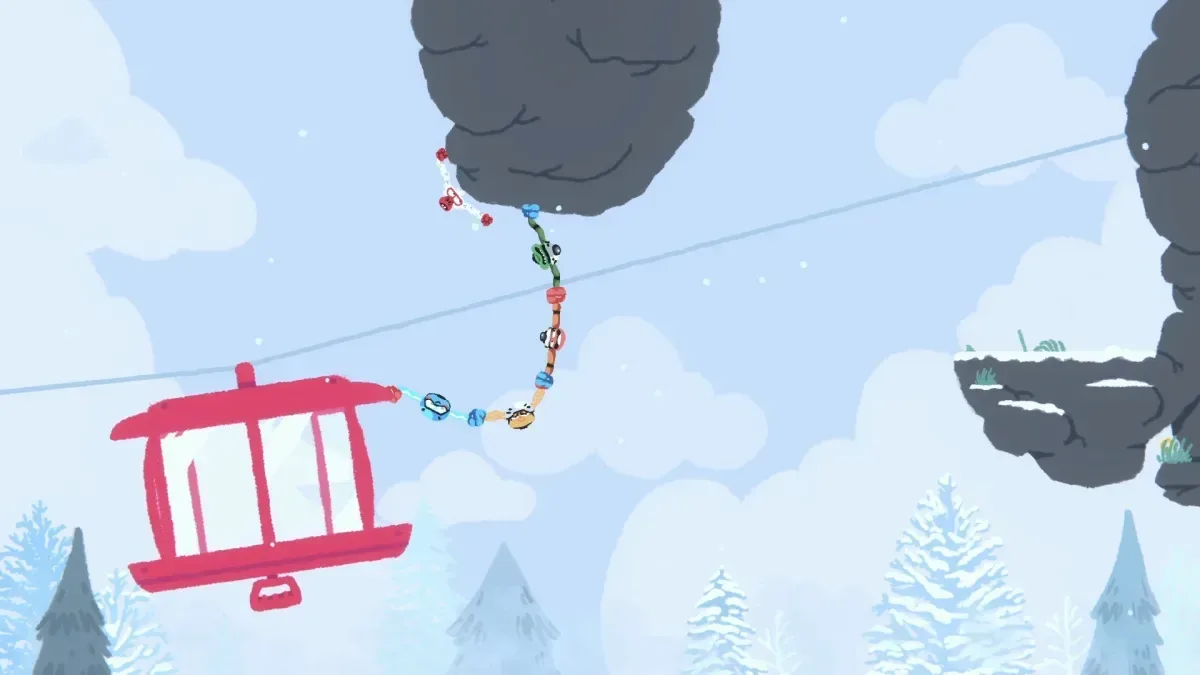
That learning process is central to the appeal. Heave Ho 2 makes its characters look absurd at every stage, whether they are linked together into a living rope, hanging from a gondola, or desperately trying to stop a teammate from sliding off a cliff. Crucially, this comedy is not the result of loose or unreliable handling. The game's physics-driven movement has enough precision to reward skill, while still producing the occasional glorious accident. As groups improve, they begin making confident swings and daring handoffs, but there is always room for one spectacular miscalculation.
The forgiving structure helps enormously. Setbacks are brief, allowing teams to return to the challenge before annoyance has time to settle in. That makes experimentation feel natural. A risky long jump might fail repeatedly, but trying it is entertaining enough that restarting never becomes a chore. Heave Ho 2 captures the best quality of strong party games: it keeps everyone involved even when things go wrong.
An eight-world campaign that keeps changing the rules
The campaign contains roughly 60 levels spread across eight worlds. Many stages ask the group to reach the other side of a map, sometimes as a tightly connected chain and sometimes through more individual progress. However, the game avoids relying on that basic format for too long. Each world brings a different theme, set of obstacles, or objective, giving sessions a welcome sense of forward momentum.
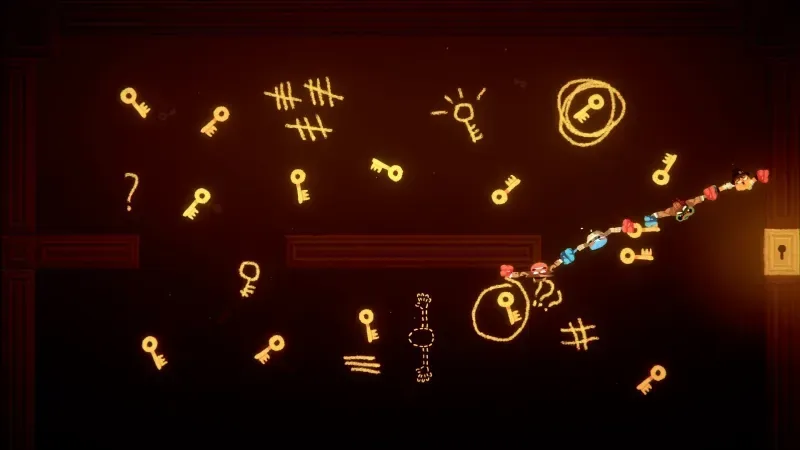
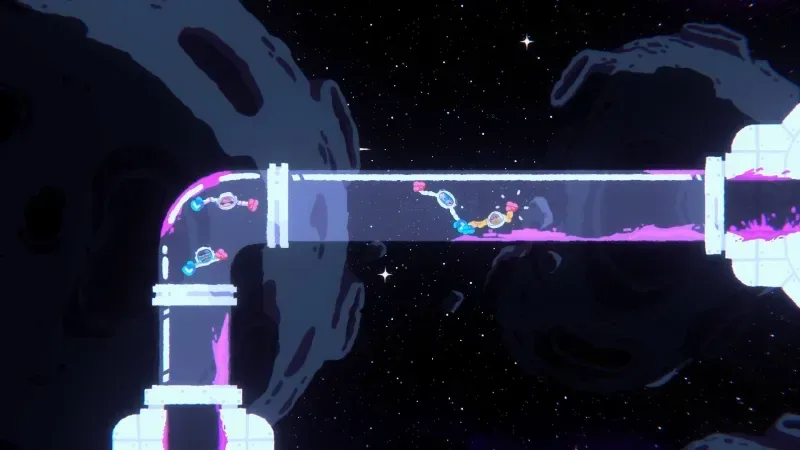
Flying High is a standout example, using ski lifts, gondolas, and icy mountain environments to turn traversal into a fresh series of coordination challenges. Manor Mysteries shifts the focus by hiding keys needed to open exits, creating more of a scavenger-hunt rhythm. Spacebound Squad introduces zero gravity and even asks players to work together to pilot a spaceship. These changes ensure that launching the game does not mean simply repeating the same type of swing across a new backdrop.
This willingness to experiment is one of Heave Ho 2's greatest strengths, even when not every experiment works. The campaign often finds ways to test the same hand-grabbing foundation from a new angle, asking players to reassess their habits rather than merely execute what they have already learned. It is a smart approach for a game with a modest core mechanic, and it gives the journey more personality than a straightforward sequence of obstacle courses would have had.
Not every ambitious challenge lands cleanly
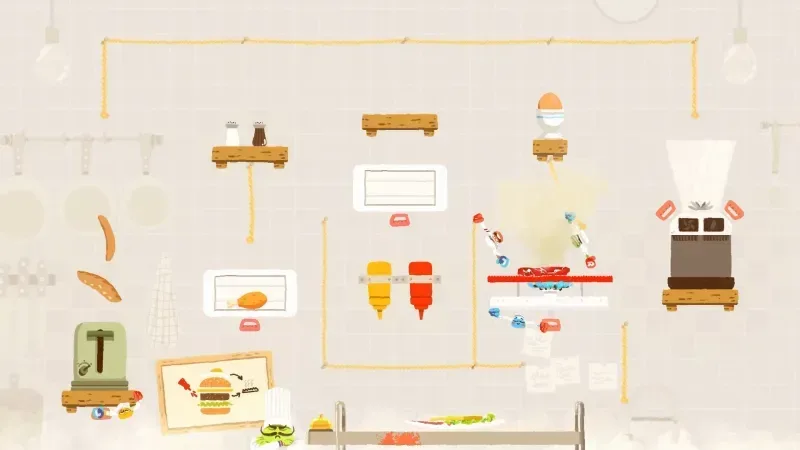
Some of the campaign's riskier ideas are less successful. Chef's Orders revolves around stacking ingredients on a plate, and it can be consistently frustrating. Heave Ho 2 is at its strongest when characters are moving through space or carrying relatively small objects. Handling much larger items does not feel as natural, and the strain of keeping the group organized can outweigh the fun of the puzzle.
Medieval Travels presents a similar issue in stages built around transporting a king sitting on a throne. The goal is to move him forward without tipping him over, but the process can feel unintuitive. These are the moments where the game's physical chaos loses some of its charm because players are not simply recovering from a hilarious mistake; they can be wrestling with an objective that does not suit the controls as elegantly as the rest of the campaign.
There is at least a built-in safety valve. After a long period of struggle, a cat drone can appear to help the group advance. It is effectively a way to escape a stage that has become a sticking point, and its presence keeps the campaign from becoming needlessly punishing. The uneven levels do not erase the appeal of the stronger worlds, but they do show that more variety is not automatically better. Heave Ho 2 is most compelling when it lets its movement system do what it does best.
Optional objectives make the campaign worth revisiting
Completing the main route takes around eight hours, but the campaign has considerably more to offer for groups that enjoy chasing extras. Every level includes two or three optional objectives. These may require finishing under a certain time, finding mysterious hands to grab, or fitting the group into hidden silhouettes. There is also an equippable camera that can be carried through stages for additional photo tasks, often requiring the party to capture particularly silly scenarios.
These objectives make replaying levels feel purposeful rather than obligatory. The achievement list is robust, and it helps stretch the game's content by encouraging players to revisit earlier environments with more confidence and a better grasp of the mechanics. A team that only wants to see the ending can do so, while more dedicated groups can spend many more sessions chasing full completion.
Unlocks add another incentive. Some rewards are cosmetic, including crossover skins such as an Among Us Crewmate and Henry from Kingdom Come: Deliverance II. Others have real mechanical applications. The Ima Rock lets a character freeze in midair so an ally can use them as a platform, while arm spray extends a teammate's reach to help them grab distant surfaces. These tools are particularly effective because most encourage players to support each other instead of simply granting individual advantages.
The only disappointment is the pacing of those unlocks. Some useful equipment may not arrive until players return to previously completed stages, which means an item such as the umbrella, capable of enabling Mary Poppins-style floating, can show up after it would have been especially helpful during the first run. The broader system is excellent, but a faster introduction of these toys would let the main campaign benefit more fully from its own creativity.
Showdown is a distraction, not the main event
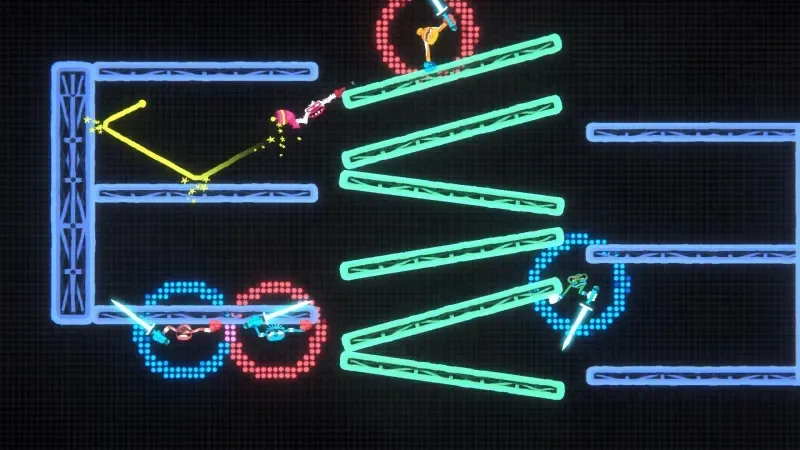
Showdown offers a competitive alternative to the cooperative campaign, but it is much less substantial. Players compete across a rotating selection of maps in races, survival contests, or challenges to reach and grab a handle first. The first player or team to earn five wins takes the match.
It can be amusing for a round or two, especially for a group already gathered around the game, but it lacks the evolving ideas and long-term rewards of the campaign. Its handle-grabbing objective is essentially another form of racing, and the limited ruleset does not provide much reason to return once the novelty has passed. Showdown is a perfectly acceptable extra, but it should not be the reason to pick up Heave Ho 2.
Who should play Heave Ho 2?
Heave Ho 2 is an especially good fit for local groups looking for a game that rewards cooperation without demanding perfect execution. Families, casual party-game players, and friends who enjoy physics-based mayhem will find plenty to enjoy. It is also a strong option for players who like a sense of progression: the optional objectives, achievements, cosmetics, and useful equipment give the campaign more depth than its playful presentation initially suggests.
Those hoping for a serious competitive mode or a perfectly consistent puzzle-platforming experience should temper expectations. A few worlds ask the controls to handle awkward large-object tasks, and Showdown is too thin to sustain regular competitive play. Still, those issues are small beside the campaign's many inspired stages and its reliable ability to turn failure into a shared joke.
Final takeaway
Heave Ho 2 succeeds because its silliness is backed by careful design. The flailing arms and accidental plunges are funny, but the responsive movement, inventive worlds, and cooperative equipment give the comedy real structure. Some ambitious level concepts are awkward, and the competitive offering is forgettable, yet the core campaign remains a buoyant and highly replayable multiplayer adventure. For Switch 2 groups seeking several lively afternoons of teamwork, experimentation, and gleeful catastrophe, Heave Ho 2 is an easy game to recommend.
Community
Discussion
Start the conversation.
No comments have been posted yet.