

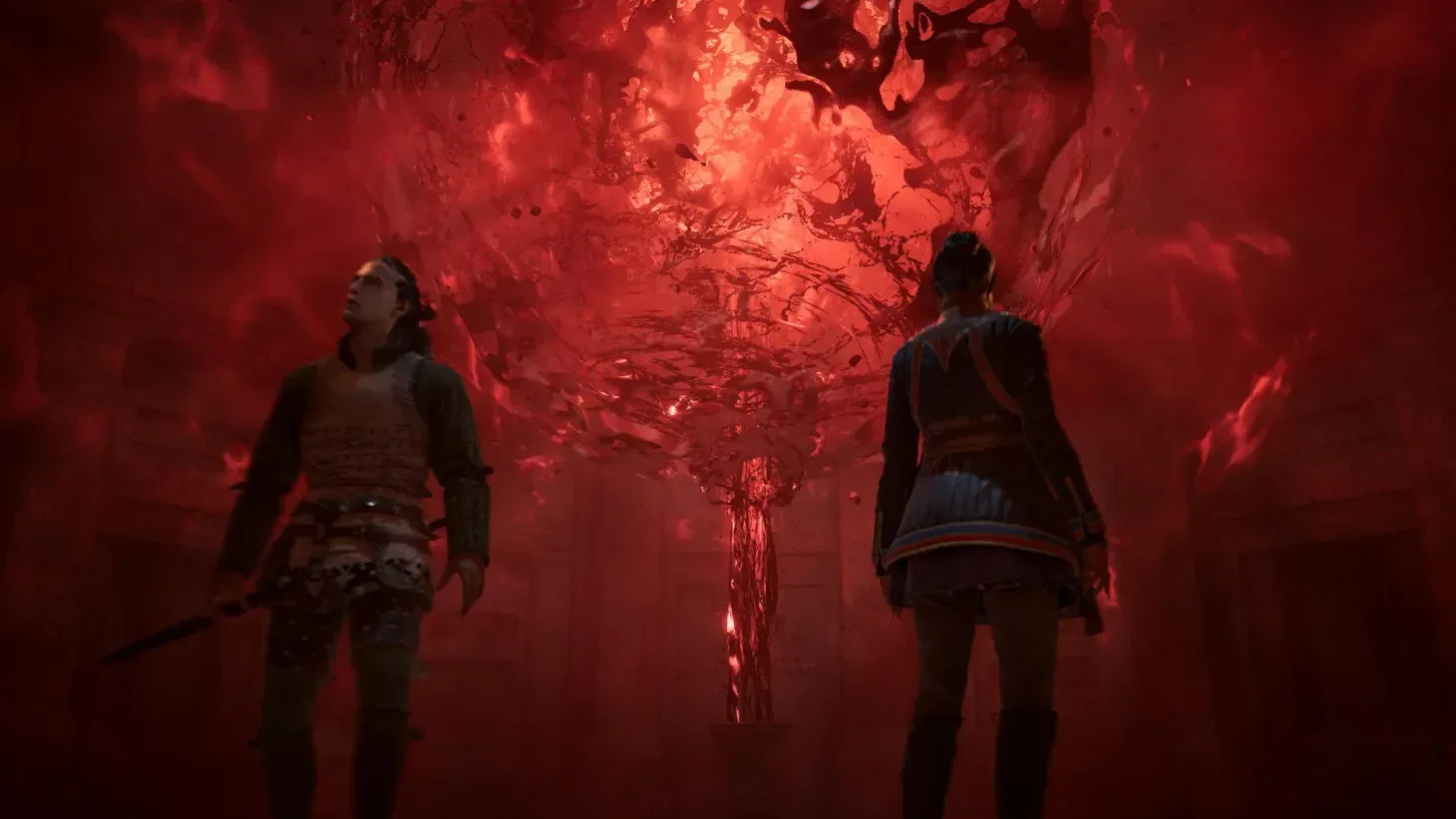
The Blood of Dawnwalker begins with a premise built to put pressure on every decision. Coen of Laslea has 30 days to save his family from a vampiric court, and the looming rescue mission turns what could have been another enormous map full of distractions into a more carefully curated role-playing journey. On PlayStation 5, this dark fantasy adventure is at its best when it asks a simple but uncomfortable question: what, exactly, is worth spending precious time on?
That question gives the game an identity beyond its familiar open-world RPG foundations. There are clear echoes of celebrated monster-hunting fantasy adventures in its dialogue-driven quests, map design, monster-filled countryside, and morally murky local dramas. The resemblance can be difficult to ignore, especially when moving from one question-mark icon to another or working through a quest whose outcome hinges on a tense conversation. But The Blood of Dawnwalker is not content simply to repeat that formula. Its greatest contribution is a limitation: an adventure that deliberately refuses to let players do everything.
Not every part of that ambition lands cleanly. The combat has an intriguing idea at its center but often settles into predictable routines. Coen's vampire nature creates promising day-and-night contrasts, yet its most frightening possible consequences are easy to avoid. The ticking clock itself can become surprisingly toothless as the story nears its conclusion. Still, the game remains engaging because its world, its central conflict, and its eventual reckoning give its choices weight. This is a 7/10 RPG with excellent instincts, even when its mechanics cannot always support the drama they are meant to create.
Thirty Days to Make a Life
The central time system is both The Blood of Dawnwalker's boldest feature and the source of its most memorable moments. Time does not pass constantly while wandering the world. Instead, specific actions consume dedicated day or night slots. Coen is a Dawnwalker, human during daylight and vampire after sundown, so each cycle presents opportunities tied to one of those identities. Unearthing buried treasure may cost a single slot, while helping family members, tracking missing scouts, or pursuing larger quest lines can require several.
In the opening stretch, this works remarkably well. Every task becomes a calculation. Improving a skill is useful, but purchasing its upgrade also costs time. A local in trouble may lead to an alliance that matters in the final battle, but investigating their problem can take several chunks out of the remaining month. The game does not merely ask players to choose between good and evil, reward and sacrifice, or combat and dialogue. It asks them to decide which people, problems, and possibilities deserve a limited life.
One early side story demonstrates the strength of this structure. A grave robber steals a dead young man's silver necklace to fashion anti-vampire arrows. Recovering it is only part of the emotional task; returning it to the grieving mother is what gives the errand its meaning. Running out of time before completing that final gesture leaves the necklace sitting in the inventory, transforming an otherwise ordinary fetch quest into a quiet reminder of a promise not kept. The game does not need a grand cutscene to make that failure sting. The limitation itself creates the consequence.
That is the potential of The Blood of Dawnwalker in its purest form. The game makes absence meaningful. A player may be strong enough to kill a monster but unable to help every village. They may discover a lead but lack the hours to pursue it. Rather than treating incomplete quest logs as a flaw to be corrected, the design makes incompletion part of Coen's story.
An Urgent Premise That Eventually Relaxes
The final objective is visible almost immediately. After the prologue, Coen can attempt to confront the central vampire antagonist. Doing so this early would be extraordinarily difficult, of course, which is why the following 30 days are spent becoming stronger and recruiting potential allies. Other members of the vampire court can also be hunted down, reducing the opposition before the decisive confrontation.
This openness is appealing. It makes the main enemy feel like an actual presence in the world rather than a distant objective locked behind dozens of mandatory hours. It also gives character growth a practical purpose: every new skill, relationship, and victory can potentially improve the odds of saving Coen's family.
Unfortunately, the sense of urgency does not remain consistent. The closer the remaining days move toward the end of the month, the more the system's pressure can erode. A warning about the point of no return arrives with 13 days still available, and additional routes toward the conclusion emerge soon afterward. What initially feels like a restrictive countdown increasingly suggests that the story is ready to be finished. The impulse to carefully ration every action fades once it becomes clear that there is enough room to reach an ending without using every remaining opportunity.
That does not erase the impact of earlier decisions, but it does weaken the premise. The best time-limit systems remain stressful because the end stays uncertain until the final moment. Here, the game reaches a point where the looming deadline feels less like a threat and more like a signal to stop exploring. The result is an uneven arc: early caution and anxiety give way to late-game relief.
A Human by Day, a Vampire by Night
Coen's split existence gives the game another strong conceptual foundation. During the day, he uses magic. At night, his magical toolkit is replaced by vampiric powers. Certain quests and activities only appear in a particular cycle, while equipment can provide different bonuses for Coen's human and vampire sides. Maintaining two armor-focused builds and deciding how each identity approaches a problem gives the role-playing layer welcome texture.
The structure also suits the world. Coen is never simply a hero with a supernatural power set; his changing nature shapes where he can go, what he can do, and how he prepares for trouble. The idea of daylight magic and nighttime predation makes the day-night divide more meaningful than a visual change in lighting.
Yet the hunger system attached to vampirism rarely reaches the same level of tension. At night, Coen must feed from animals or humans to satisfy his craving for blood. Failure carries a genuinely unsettling possibility: hunger could overwhelm him during a conversation, potentially leading to the death of an important character. That is an excellent narrative threat, one entirely appropriate for a protagonist who fears becoming a monster.
In practice, it is difficult to encounter. Blood is connected to health, healing items are plentiful, and targets are readily available both in and outside combat. Feeding during a fight is possible, but there is rarely a shortage of safer opportunities. The system therefore remains more compelling as an idea than as a persistent survival concern. A mechanic intended to make vampirism frightening instead often becomes simple upkeep.
Combat That Needs More Teeth
Combat has a similarly mixed profile. Defensive play requires attention to directional cues, with successful blocks enabling ripostes. On paper, that creates a more deliberate rhythm than simply striking until enemies fall. It asks players to read attacks and answer them correctly, making a well-timed defense feel like part of Coen's developing expertise.
The problem is repetition. Many regular enemies rely on familiar movesets, turning encounters into routine exercises in recognizing the same signals. Outside of major boss battles, fights can feel like a rigid game of Simon Says rather than evolving clashes that force adaptation. The foundations are functional, and the strongest confrontations show how much more dynamic the system could have been, but too much of the journey is spent facing opponents who do not demand enough variety from the player.
This weakness matters because combat sits beneath so many other systems. Building skills, switching equipment, and developing both human and vampire abilities should make growth exciting. When ordinary encounters are predictable, however, the satisfaction of that growth is diminished. Coen becomes more capable, but the game does not always provide equally interesting challenges for those capabilities.
A World Worth Investigating
Even with those mechanical shortcomings, The Blood of Dawnwalker sustains interest through its setting. The vampire court is not merely a collection of powerful villains occupying a castle. Its influence has seeped into the daily lives, beliefs, and institutions of the surrounding population. The court's brutality extends beyond killing: faith is distorted, vampires position themselves as religious icons, and blood takes the place of holy water in corrupted baptisms.
These details give the world a bleak, invasive quality. The horror lies not only in fangs and supernatural violence, but in the way oppression reshapes traditions and convinces people to accept the unthinkable. Exploring towns and pursuing local stories reveals the social damage left by the court's rule. That grim atmosphere helps elevate familiar quest structures, ensuring there is usually a compelling reason to learn what happened in the next troubled settlement.
The story also delivers where it most needs to: at the end. The final confrontation reflects the paths Coen has taken, the relationships he has built, and the choices he has made along the way. It turns prior decisions into ramifications that must be confronted rather than leaving them as invisible variables. Even if the time limit has stopped feeling especially oppressive by then, the limitation has already shaped the adventure's emotional texture. The ending understands that a life defined by limited opportunities should include regrets as well as victories.
Who Should Enter Laslea?
The Blood of Dawnwalker is best suited to players who want an open-world RPG that values selective engagement over completionism. Its 30-day structure is especially appealing for anyone tired of games that imply every icon on the map must be cleared before the credits can roll. Those who enjoy gothic fantasy, morally uncomfortable local stories, and consequences that arise from what is left undone will find plenty to appreciate.
Players looking primarily for deep, varied action combat should temper expectations. Major fights offer more excitement than the regular battles surrounding them, but repetition remains a persistent issue. Likewise, anyone hoping for a demanding vampire-survival system may be disappointed by how manageable Coen's hunger becomes.
Final Takeaway
The Blood of Dawnwalker succeeds because it recognizes that an RPG does not need endless content to feel immense. By placing Coen under a 30-day deadline, it creates room for missed chances, difficult priorities, and personal versions of the same journey. Its most inventive mechanics do not always deliver on their promises, and its combat often lacks variety, but the game's dark world and consequential finale carry it through those flaws.
With a score of 7/10, The Blood of Dawnwalker is a promising, atmospheric RPG whose limitations are often its greatest strength.
Community
Discussion
Start the conversation.
No comments have been posted yet.