

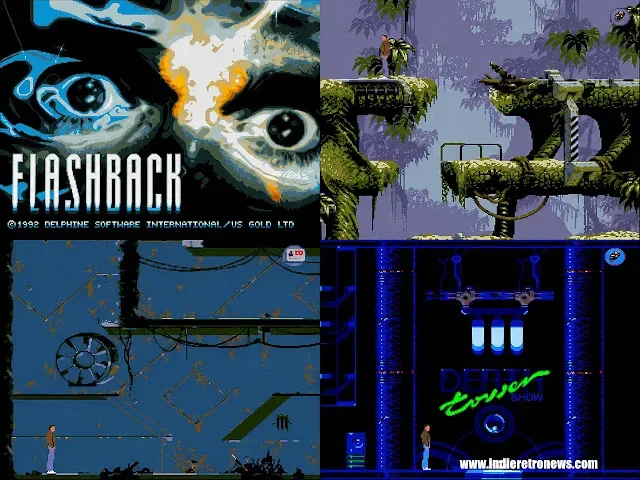
More than three decades after Flashback became one of the defining cinematic platformers of the 16-bit era, Atari ST owners are getting an opportunity that never arrived during the machine's commercial lifetime. Developer Neil Rackett is working on an Atari ST version built around REminiscence, Gregory Montoir's modern re-implementation of the original game engine.
The project remains a work in progress, but it is already a particularly interesting piece of retro development. Flashback, originally created by Delphine Software and released in 1992, appeared on several prominent systems of its day. The Atari ST was not among them, despite its close association with the wider European 16-bit computer scene. Rackett's effort is intended to address that absence, using STDL alongside Amiga game data files to make the experience run on genuine Atari hardware.
For fans of both Flashback and the Atari ST, this is not simply a matter of checking another port off an old platform list. The game's animation-heavy presentation, cinematic staging, and distinctive screen layout introduce meaningful technical challenges on the ST. The current build tackles those constraints with platform-specific optimization, configurable display behavior, and different performance expectations depending on which member of the ST family is being used.
A long-missing 16-bit conversion
Flashback earned its reputation through an approach that felt unusually filmic for the early 1990s. Its protagonist, Conrad B. Hart, moves through hostile futuristic locations with carefully rotoscoped animation, interacting with doors, ledges, weapons, elevators, traps, and environmental puzzles. Rather than relying on the immediate responsiveness of a traditional arcade platformer, it gives actions a deliberate weight. Every leap, holster movement, weapon draw, and climb is part of the game's visual identity.
For useful background on this topic, read Xenogears Remake Prospects Look Complicated as Square Enix Director Reflects on the PS1 Classic.
That identity made the game technically demanding in its original era. It was designed around rich animation and detailed scenes, while also needing to maintain readable play across dangerous, puzzle-filled levels. Bringing it to a platform that missed out originally means accommodating hardware limitations without losing the rhythm that makes the game feel like Flashback.
Rackett's project does not appear to be a conventional recovery of an abandoned historical ST conversion. Instead, it uses REminiscence, the engine re-implementation created by Gregory Montoir. Such projects can be invaluable to preservation and platform experimentation because they recreate the logic needed to run game data on hardware that was never officially supported. In this case, the Atari ST build uses the Amiga version's data files, meaning players will need access to those files when preparing the game.
The distinction is important. This is a community-driven, in-development technical port rather than a newly discovered official Atari ST release from the 1990s. Its goal is nevertheless easy to appreciate: let the ST run a convincing version of one of the generation's most celebrated action-adventure platformers.
Performance targets for ST, STE, and Mega STE machines
One of the most notable elements of the port is its attention to frame rate across the Atari hardware range. On standard Atari ST and STE systems, animations have been optimized for a steady 25 frames per second. That target should help preserve the deliberate motion and timing of the original game without asking basic configurations to reach beyond their practical limits.
Owners of a Mega STE have an additional advantage. On that hardware, the port can reach a capped 30 frames per second. It is a sensible ceiling for a project that needs to balance performance against the behavior of a game built with cinematic pacing in mind. A higher number alone is not the only objective; stable playback and reliable controls matter just as much for a game where jumps and enemy encounters depend on precise animation states.
The stated requirements are also worth noting for anyone considering testing the build on original equipment. An Atari ST with at least 2MB of RAM is required. However, 4MB of RAM is strongly recommended, along with 3MB of hard disk space, for a more suitable experience. Those recommendations reflect the reality of running an ambitious game through a modern re-implementation on vintage hardware: minimum specifications may get the software running, but extra memory and storage headroom can make a substantial practical difference.
For retro enthusiasts, this hardware guidance is useful beyond this single project. Atari ST setups vary considerably, from base machines configured around floppy disks to expanded systems with hard-drive solutions, accelerators, and higher memory capacities. The port recognizes those differences instead of presenting the ST as one fixed target.
Solving the Atari ST screen-height problem
Display handling is another major consideration. The game's original presentation uses a 224-pixel height, while the standard Atari ST screen is 200 pixels tall. That mismatch could easily produce awkward cropping or compromised composition if handled in only one rigid way.
To address it, the port includes several menu options: Fit, Fill, and an experimental Overscan mode. Each option gives players a different method for dealing with the height difference, allowing them to favor a particular balance between the visible play area and the way the image occupies the screen.
While the precise result will depend on a player's monitor, hardware, and preferred setup, the inclusion of these options is encouraging. Retro ports often have to make difficult choices about aspect, resolution, borders, and clipping. Offering alternatives acknowledges that there is no universally perfect answer when adapting a game designed around one video layout to another.
The experimental label on Overscan is equally appropriate. Overscan techniques have long been part of the Atari ST scene's effort to push beyond standard display boundaries, but they can come with compatibility considerations. Players interested in trying that option should treat it as an enthusiast feature rather than assuming it will be ideal for every configuration.
Cutscenes, audio limitations, and current visual quirks
The port is already capable of running the game's cinematic sequences, an essential part of the Flashback experience. At present, however, cutscenes skip frames by default in order to preserve their intended pacing. It is a practical trade-off. A cinematic sequence that maintains an appropriate tempo, even while dropping visual frames, may be preferable to one that plays too slowly and undermines the timing of its storytelling.
There are also some unfinished visual details. One especially amusing issue sees Conrad's trousers blend into the background colour in the opening area. It is the kind of bug that is immediately noticeable once seen, but it also serves as a reminder that the project is not yet being presented as a finished, polished release. Color handling, sprite behavior, and scene composition can all expose unexpected edge cases when a game is transferred to hardware with different display characteristics.
Audio support is similarly shaped by the differences between Atari models. Standard sound effects are reserved for STE machines. That means owners of an original ST should not expect the same sound-effect implementation available on the enhanced STE hardware. Experimental YM-chip music support is included across all configurations, though, giving the broader ST family an avenue for music playback through the platform's familiar Yamaha sound capabilities.
These limitations should not be read as failures of the project. They are a straightforward expression of what the hardware can and cannot do under this particular implementation. In the retro scene, transparent documentation about machine-specific features is far more useful than pretending every computer in a family has identical capabilities.
A project inviting testing rather than promising finality
Rackett is inviting Atari ST users to test the build, consult the included README configuration information, and provide feedback or pull requests that could help improve it. Technical support is not being offered, so this is best approached by users comfortable with experimenting on vintage systems, reading setup notes, and troubleshooting their own configurations.
That collaborative approach fits the nature of the project. Ports such as this benefit enormously from being tested across real machines and varied setups. Emulator testing can establish a great deal, but actual ST, STE, and Mega STE hardware may reveal timing differences, display behavior, storage issues, controller oddities, or memory-related problems that are not obvious elsewhere.
It also gives the Atari community a role in shaping the eventual result. Feedback from players using minimum-memory systems, expanded machines, different display modes, and different storage arrangements can help identify where the port is already strong and where more work is needed. Pull requests can turn that testing into direct technical contribution.
Why this port matters
The Atari ST has never lacked for excellent platformers or technically ambitious homebrew projects, but its missing version of Flashback has remained a notable what-if for fans of the system. The new port cannot change the release history of 1992, yet it can finally let the machine participate in a game that has long belonged in conversations about the 16-bit generation.
Its current state calls for realistic expectations. Players should expect an unfinished build, configuration requirements, model-dependent audio, frame-skipping cinematics, and a few visible quirks. At the same time, the core achievement is already substantial: Flashback is being adapted to run on Atari ST hardware with deliberate attention paid to speed, resolution, memory, and the variations within the ST family.
For longtime Atari users, that makes this a project worth watching and testing. For retro game preservation more broadly, it is another example of how engine re-implementations and dedicated community developers can extend the life of classic games in ways that once seemed permanently out of reach.
Community
Discussion
Start the conversation.
No comments have been posted yet.