

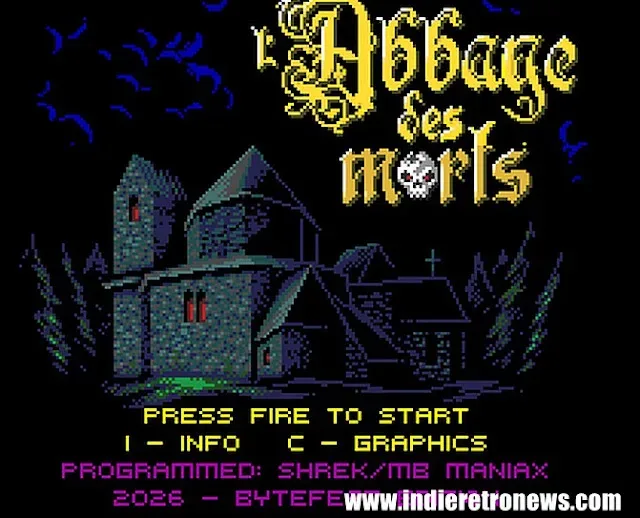
L'Abbaye des Morts, the platform adventure originally created by Locomalito, has received a dedicated conversion for the ZX Spectrum Next. Created for ByteFest 2026 by Shrek/MB Maniax, the new version adapts the game around the capabilities of the modern Spectrum-compatible machine while retaining a deliberately compact format: a single non-linear adventure estimated to last around 30 minutes.
The conversion's feature list points to an effort that is not simply about making the game run on different hardware. It includes two selectable visual presentations, Spectrum Next-specific background and sprite work, revised audio and interface elements, plus support for both keyboard controls and a Kempston joystick. For players who enjoy contemporary releases designed around classic-computing platforms, it is a notable new destination for one of Locomalito's best-known platform games.
Two Ways to See the Adventure
One of the conversion's central additions is its pair of switchable graphics sets. Players can choose a classic 8-bit look or a shaded 16-bit version, offering two distinct visual approaches within the same release. The graphics are presented at the original 256 × 192 pixel resolution, preserving the underlying image dimensions while giving Spectrum Next users an option between a more period-minded presentation and a richer shaded alternative.
That choice is especially fitting for the ZX Spectrum Next. The machine occupies an unusual space in retro gaming: it is rooted in the language, form factor, and community traditions of the original ZX Spectrum, but its enhanced hardware allows developers to pursue techniques and presentations that would not have been practical on older Spectrum models. A release with both an 8-bit-oriented mode and a more heavily shaded one directly acknowledges that dual identity.
For useful background on this topic, read 8BitDo Reveals Tomb Raider 30th Anniversary Ultimate 3 and Pro 3 Controllers.
The classic setting gives players a visual route closer to the expectations associated with early home-computer platform games. Meanwhile, the shaded 16-bit set offers a different reading of the same game's art, emphasizing colour and depth without changing the stated original resolution. Rather than treating one aesthetic as the definitive replacement for the other, the port makes the two approaches available as options.
Spectrum Next Hardware Takes Center Stage
The conversion also makes use of Layer 2 backgrounds and hardware sprites. Those features are important because they signal that this is a version built specifically with the ZX Spectrum Next in mind, not merely a basic compatibility exercise. Layer 2 provides a more capable graphics layer for detailed backdrops, while hardware sprites can handle moving characters and objects separately from the background display.
For a platformer, that hardware focus can matter a great deal to the overall feel of a port. Background art, animated elements, player movement, and interface information all need to coexist clearly on screen. The use of dedicated sprite and background facilities gives the conversion tools that are more flexible than those historically available on the original Spectrum. The announced feature set does not promise a reinvention of the game, but it does establish a version tailored to the characteristics that make the Next appealing to developers.
The status panel has also been adapted for the platform. That is a small but meaningful part of any conversion. A game's status display has to communicate useful information while fitting the screen layout and visual design of the host hardware. Revising it for the ZX Spectrum Next helps the port feel considered as a complete edition rather than a game screen placed beside an untouched interface.
A Short, Non-Linear Platform Journey
L'Abbaye des Morts is described as a single non-linear adventure with an approximate duration of 30 minutes. That concise structure is worth underlining. In an era where platform games are frequently built around long campaigns, extensive progression systems, and dozens of hours of content, there remains a place for works that aim for a focused session with a clear beginning and end.
Non-linearity adds a further dimension to that brevity. A game does not need to be long to invite exploration or make players consider different routes through its spaces. The stated half-hour estimate suggests a tightly designed experience, while the non-linear designation indicates that it is not defined solely by a straight line from one stage to the next. That combination suits the quick-start nature of classic-computer gaming particularly well: a player can sit down for a contained adventure without necessarily losing the pleasure of discovery.
It also helps explain why a platform-specific conversion can be attractive even for people familiar with an earlier edition. The underlying adventure remains the work of Locomalito, but the Spectrum Next release presents it through a distinct technical and audiovisual frame. The alternate graphic modes, Next-oriented display features, adapted panel, and revised audio implementation all give the conversion its own identity.
Credits Behind the New Edition
The original game is credited to Locomalito. Music and sound effects are credited to Gryzor87. The development history behind this Spectrum Next edition also includes an open-source SDL port by nevat and contributors, which forms part of the project's acknowledged foundation.
For the ZX Spectrum Next version itself, the credited work was created for ByteFest 2026 by Shrek/MB Maniax, with code and music specifically attributed to Shrek/MB Maniax. The credit breakdown makes clear that this release is a collaborative continuation of work spanning the original game, its sound design, an open-source porting effort, and a new hardware-focused adaptation.
That kind of chain is common in the most interesting corners of retro development. Older systems and modern retro-compatible machines continue to receive games not only through wholly new projects, but also through respectful adaptations that build on open-source technical work and clearly identify the creative contributors involved. Properly recognizing those layers is important, especially when a conversion introduces its own programming, music, presentation, and platform-support work.
Controls for Classic Spectrum Play
Control support includes the keyboard and the Kempston joystick standard. Keyboard play remains essential in the Spectrum ecosystem, where many players expect to use traditional key-based controls. Kempston joystick support is equally welcome for those who prefer a dedicated stick and a more arcade-like approach to platform movement.
Including both methods gives the edition flexibility without overcomplicating its stated control setup. Players can use the input style most natural to their Spectrum Next arrangement, whether that means a keyboard at a desk or a joystick-connected retro setup. For a short platform adventure, responsive and familiar input options are as important as the display features that define the port's presentation.
A New Home for a Modern Retro Favorite
The ZX Spectrum Next has become a compelling platform for developers who want to work within the history of 8-bit computing while accessing more expansive visual and audio possibilities. L'Abbaye des Morts appears to embrace that opportunity directly. Its 256 × 192 presentation remains grounded in a classic screen format, but the selectable graphics, Layer 2 backgrounds, hardware sprites, adapted status panel, and platform-specific music and sound work ensure that the result is designed around the Next rather than merely associated with it.
For fans of Locomalito's original game, the release offers another way to experience a concise, non-linear platform adventure. For Spectrum Next owners, it provides a conversion that foregrounds the machine's enhanced toolkit while still acknowledging the visual language that brought so many players to Spectrum software in the first place. And for the broader retro scene, it is another example of how classic-inspired games can continue to evolve through careful, credited, hardware-aware new editions.
Community
Discussion
Start the conversation.
No comments have been posted yet.