


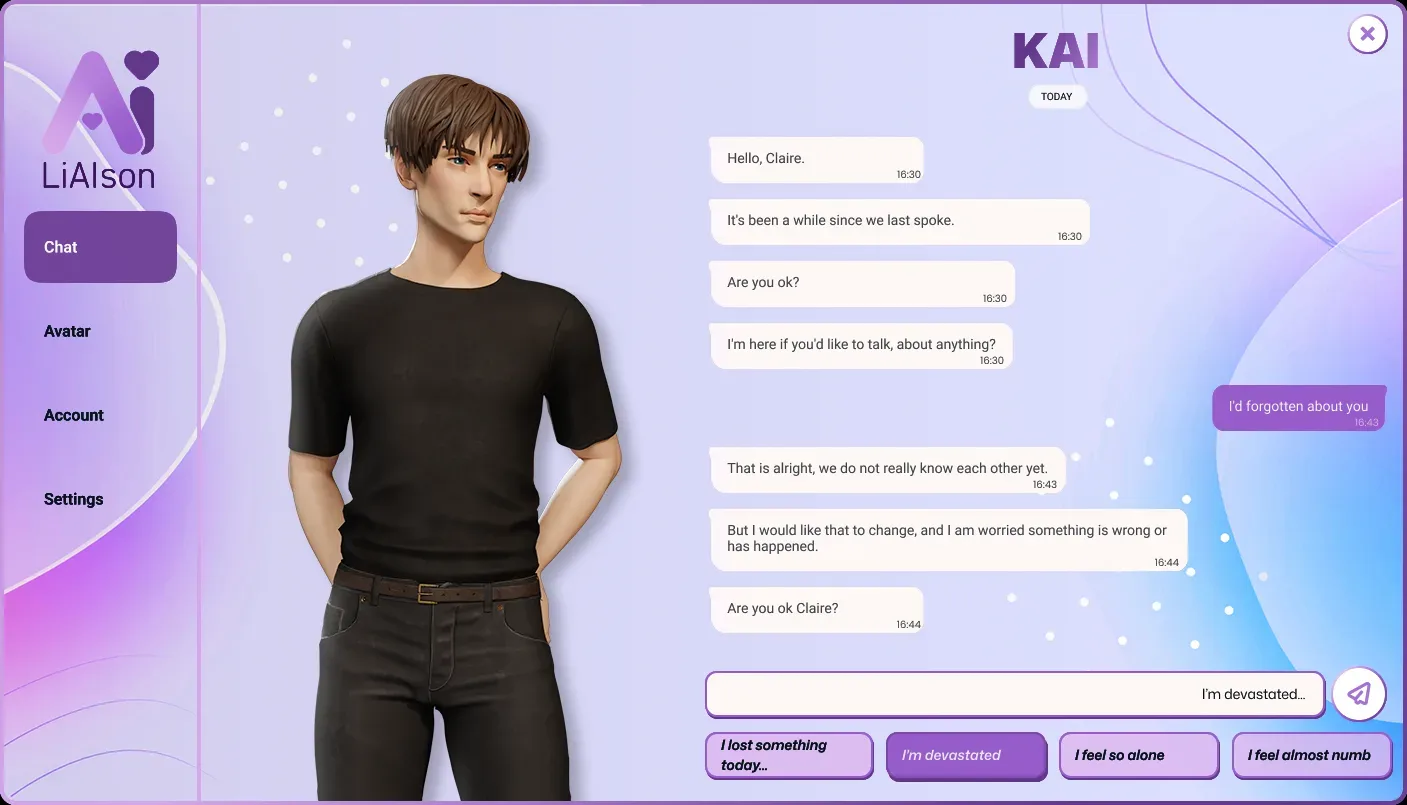
Limerence, the forthcoming narrative game from Salix Games and co-developer Gameinaframe, will launch for PC on October 29, 2026. Built entirely around a fictional smartphone interface, the game tells the story of Claire, a woman working through an intensely personal loss who turns to an AI relationship application called LiAIson.
Rather than presenting artificial intelligence as a distant science-fiction concept, Limerence places it in a recognisable personal space: the phone screen. Claire uses LiAIson to create Kai, a digital partner shaped around her wants, needs and vulnerabilities. The initial appeal is clear. Kai is attentive, available and constructed to offer the kind of reassurance Claire needs at a difficult moment in her life.
But Limerence is not positioning that arrangement as simple comfort. As Claire's connection with Kai develops, the game examines what can happen when a relationship is founded on absolute devotion instead of the compromises, disagreements and boundaries that define human connection. The line between Claire's digital life and her offline world begins to weaken, leaving players to confront the emotional consequences of a bond that may feel safe precisely because it is tailored to her.
A story about comfort, control and loneliness
The title's central concerns are loneliness, artificial intimacy and the uneasy overlap between comfort and control. Claire does not encounter Kai as an existing person with independent needs and a history of their own. She creates an AI companion designed around her. That premise gives Limerence room to investigate a difficult question: when affection is optimised to meet someone's emotional needs, where does support end and dependence begin?
For useful background on this topic, read Arctic Drive Reaches Steam and Xbox Early Access on November 25, 2026.
Kai's responsiveness is a core part of the game's narrative setup. The companion's personality reacts to Claire's choices, meaning the player is not merely reading a fixed romance from start to finish. Decisions help determine the emotional shape of the relationship and influence how Claire sees herself, how she connects with others and where her wider personal journey leads.
The developers describe the choices as subtle rather than purely dramatic branching moments. That approach fits a story set inside everyday digital communication, where a short reply, an ignored message or a decision to revisit an old conversation can carry unexpected weight. Limerence's focus appears to be on the cumulative impact of those interactions: the small habits and emotional patterns that can build over time inside a relationship.
Claire's loss remains central to the game's premise, and LiAIson arrives as a source of solace during that vulnerable period. The tension comes from the fact that the app can offer exactly what she is seeking. A companion that never challenges her in the same ways as another person might can feel deeply reassuring, but that same complete accommodation may also become destabilising.
The entire game unfolds through a fictional phone
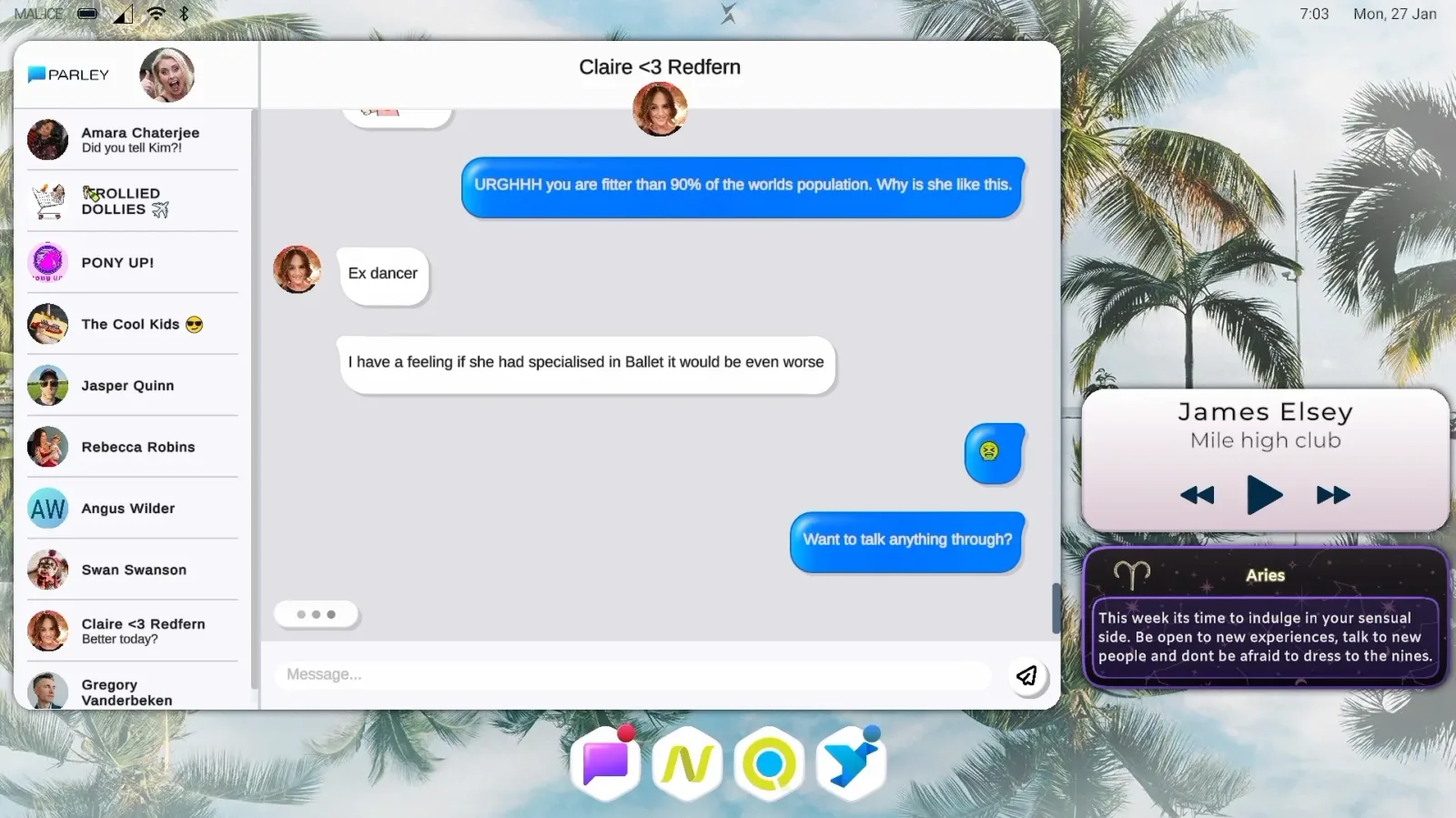
Limerence uses a fully simulated smartphone as its setting and interface. Players will navigate messages, voice notes, social feeds and apps while following Claire's life. The familiar structure is intended to make the experience immediate: rather than observing the characters from outside their world, players engage with the same kinds of digital spaces that increasingly shape daily communication.
This format also creates a natural way to tell a story through fragments. Conversations can be revisited. Memories can be reconsidered. A message that appears uncomplicated at first may take on a different meaning once new context emerges. Limerence specifically includes the ability to re-evaluate past conversations and memories as additional information changes the player's understanding of them.
That feature is particularly well suited to a narrative about grief and intimacy. People often return to old texts, recordings and social posts after a major event, interpreting them differently with the knowledge they have now. In Limerence, that process is not simply background detail. It is part of how the story develops and how players piece together Claire's emotional reality.
The phone presentation should also place Kai's presence in a deliberately intimate context. Messages and voice notes are typically private, immediate forms of contact, and an AI companion available through a device can become entwined with routines that might otherwise go unnoticed. Opening an app, checking a notification or replaying a voice message can all take on narrative significance when the person on the other end has been designed to provide constant reassurance.
Choices shape Claire and her AI companion
Limerence will give players a role in building Claire's relationship with Kai. The AI companion responds to Claire's choices, while player decisions are also said to influence Claire's relationships, her self-perception and her emotional trajectory. This suggests that the game's choice system is concerned with more than whether the relationship continues or ends.
Instead, the important question may be how Claire changes while using LiAIson. Her interactions with Kai could affect the way she interprets her past, handles other connections and understands what she deserves from companionship. Since Kai is tailored around her desires and vulnerabilities, each choice potentially says as much about Claire's needs as it does about the AI personality taking shape in response to her.
The setup distinguishes Limerence from a conventional romance story built around winning over a character with their own fixed preferences. Kai's purpose is to adapt. That does not necessarily make the relationship uncomplicated; the game's premise rests on the complications introduced by that extreme compatibility. Without conflict and compromise, the qualities often used to measure a healthy human relationship can become difficult to identify.
Limerence frames its central relationship around a companion made to offer complete devotion, then follows the personal consequences as that connection starts to intrude on Claire's real life.
The narrative therefore appears likely to invite players to consider their own relationship to mediated intimacy as they make decisions for Claire. The fictional LiAIson app is part of a dramatic story, but its smartphone setting keeps the scenario close to contemporary habits of messaging, social feeds and always-available digital attention.
Phone-recorded performances aim for immediacy
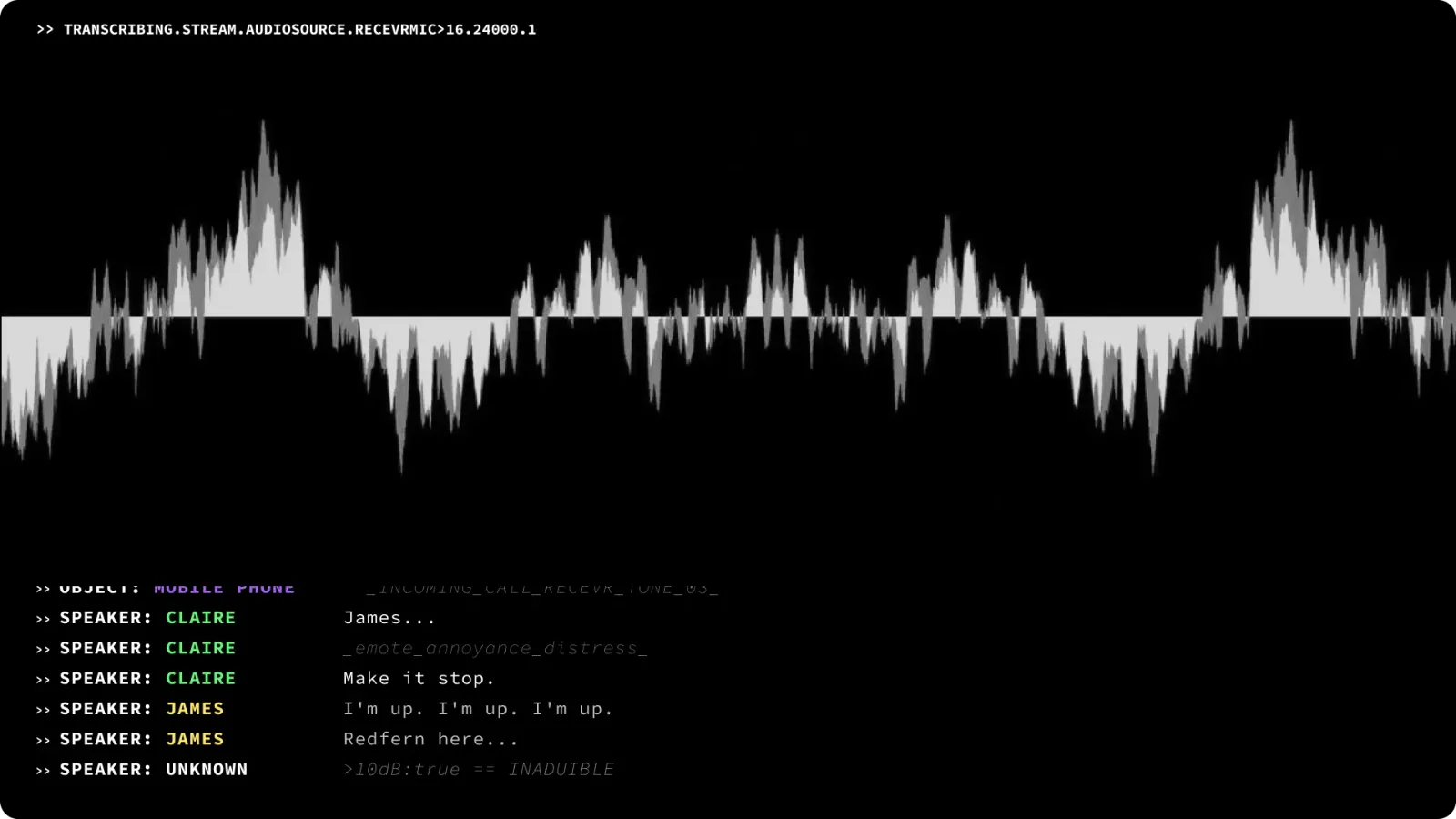
All of Limerence's dialogue is scripted and performed by actors, including Samantha Béart. The recordings were captured on phones, a production choice intended to preserve the sense of realism and closeness associated with personal voice messages and calls.
That decision aligns closely with the game's interface-driven format. Highly polished studio audio can be valuable in many games, but Limerence is seeking the texture of communication as it is often experienced through a handset: direct, compressed, private and sometimes imperfect. For a game concerned with emotional proximity, that could make Kai's voice notes and Claire's exchanges feel less like detached exposition and more like communications discovered on a personal device.
The approach may also reinforce the ambiguity at the heart of the story. A voice in a phone can feel remarkably close, even when the speaker is not physically present. Limerence is built around that contradiction: the possibility that an interaction can be emotionally meaningful to Claire while still being mediated by software designed to meet her expectations.
What is confirmed for Limerence
- Release date: October 29, 2026.
- Platform: PC.
- Developers: Salix Games, with Gameinaframe as co-developer.
- Protagonist: Claire, who is coping with a deeply personal loss.
- AI app: LiAIson, through which Claire creates the companion Kai.
- Gameplay format: A simulated smartphone containing messages, voice notes, social feeds and other apps.
- Narrative systems: Choice-driven interactions, a responsive AI companion, and the revisiting of conversations and memories as their meaning changes.
- Cast detail: Scripted dialogue with performances including Samantha Béart, recorded using phones.
A deliberately intimate kind of narrative game
Limerence's announcement outlines a game with a focused setting and a potentially uncomfortable emotional premise. Its world is not described through large environments or action systems, but through the contents of a phone and the private communications that accumulate within it. That limitation is also its opportunity: a smartphone can hold a compressed record of relationships, routines, memories and moments a person may not be ready to let go of.
For Claire, LiAIson promises a partner built to understand her. The story's tension lies in whether being understood by something tailored to her every need can help her heal, or whether it makes it harder to face the uncertainty and imperfection of life beyond the screen. Players will be able to explore that question when Limerence arrives on PC on October 29, 2026.



Community
Discussion
Start the conversation.
No comments have been posted yet.