

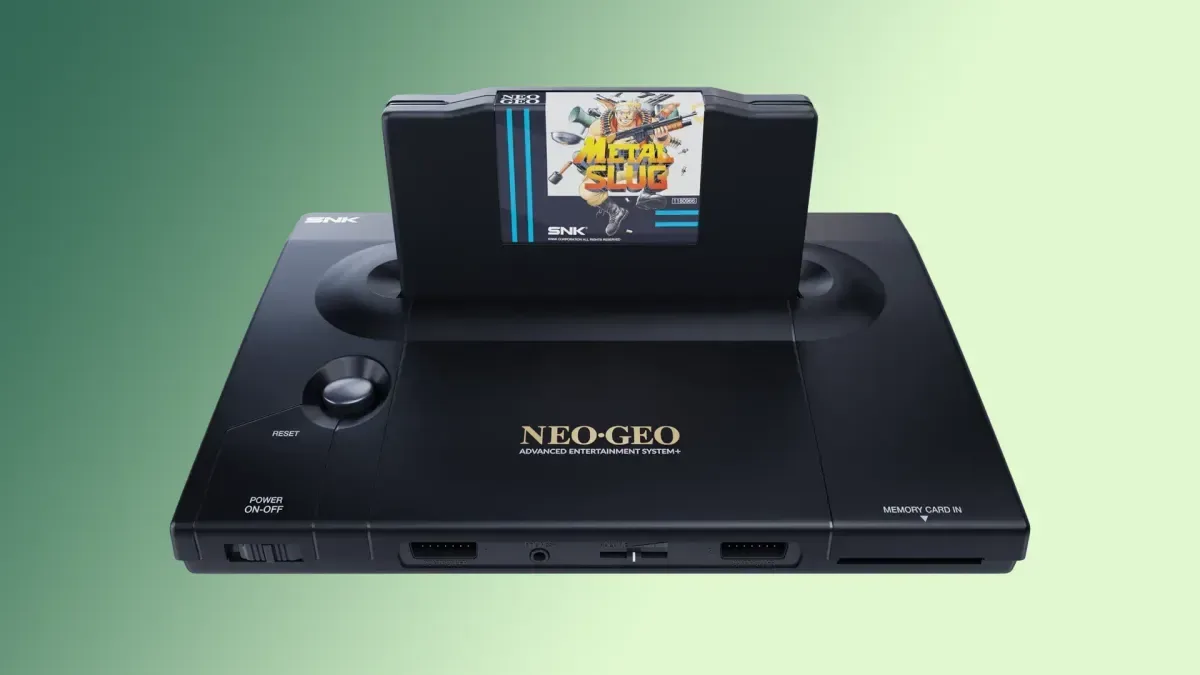
The long wait for the Neo Geo AES+ appears to have a clearer explanation: the project ran into an unexpected component shortage after attracting a far larger pre-order response than anticipated. Plaion director of hardware and software Ben Jones has said the company was unable to secure the chips it needed after the system was announced, an experience he described as unprecedented across nearly two decades working in the field.
The AES+ has already been delayed by an entire year, a major disappointment for retro enthusiasts who committed to the device early. The delay also became a point of frustration because news began circulating after a Japanese customer was informed of the change, while a broader official announcement did not arrive until months later. Now, Jones' comments provide more detail on the technical and supply-chain problems that put the project at risk.
Rather than a simple manufacturing slowdown, the issue was apparently tied directly to demand. The scale of AES+ pre-orders prompted Plaion to move quickly into procurement, only to find that its component partners could not fulfill the requested chip order. Jones said this was the first time he had been refused chips in his lengthy career with Plaion.
"After we announced AES+, we received an overwhelming response and really significant levels of preorders," Jones said. "So I straight away went into the procurement phase, and advised our partners in the Far East what our requirements were, and it's the first time I've ever been refused ordering chips."
For useful background on this topic, read Sonic's First Movie Helped Keep the Hedgehog Franchise Alive, Says Takashi Iizuka.
A successful announcement created a difficult production problem
It is an unusual situation for a hardware revival: interest in the product was strong enough to complicate the effort to build it. Pre-orders are normally a positive sign for a niche retro system, giving a manufacturer a clearer view of demand and helping justify investment in production. In this case, however, the unexpectedly large response seems to have collided with a market in which crucial components were difficult to obtain on acceptable terms and within the required timeframe.
Jones identified AI as part of the explanation for the constrained chip market. While he did not outline every affected part or provide a full breakdown of the AES+ bill of materials, his comments point to a wider competition for semiconductors. That competition has had consequences beyond this particular project, especially for smaller-volume hardware products that may not have the buying power or ordering scale of larger electronics companies.
The situation is especially notable for Neo Geo hardware because the original platform has specific technical requirements. A modern recreation cannot simply substitute every unavailable part without considering compatibility, behavior, and the way software expects the machine to function. For a product intended to honor a classic system, preserving the necessary technical relationship with the original hardware can make component changes more complicated than they might be for a newly designed console.
The flash-memory workaround that kept the project moving
The key obstacle discussed by Jones involved flash memory. The Neo Geo uses parallel flash, but the company explored an alternative based on Serial NOR flash, which Jones said was easier to source. The proposed solution was not a direct drop-in replacement. It required a conversion approach that would allow the system to work with serial flash despite the Neo Geo's reliance on parallel flash.
Jones characterized Serial NOR flash as functionally similar in the relevant respect, while stressing that the conversion work was needed because of the platform's original design. This appears to have been the pivotal engineering challenge for the delayed hardware. Without a workable flash solution, he suggested, the entire AES+ effort could have ended.
"If you hadn't had the solution for the flash, I think everything was dead," Jones said.
That statement illustrates how narrow the path forward became. A one-year delay is substantial, but it is preferable to a cancellation for customers who have been waiting for a new Neo Geo product. At the same time, the length of the delay also shows that identifying a substitute component was only one part of the job. The revised design still needed engineering work, manufacturing coordination, and a viable supply arrangement before it could move toward production.
Jones said the team explored every available option, including a trip to Taiwan and discussions with potential partners. The work was driven by a determination to see the project through after years of development. He described the effort as a moment when the team had to stay focused and ensure the product could still be delivered.
Why the delay matters to early buyers
The AES+ delay has been particularly sensitive because it affects customers who supported the system before it was available. For collectors and dedicated retro players, a new Neo Geo release is not an ordinary hardware launch. The platform remains one of gaming's most recognizable premium console brands, associated with arcade-focused software and a distinct place in 1990s gaming history.
That legacy helps explain the heavy interest in the AES+, but it also raises expectations. Buyers are likely to be especially attentive to communication, production progress, and any changes that could affect the final hardware. A year-long postponement naturally tests confidence, particularly when the first signs of the revised timetable were not communicated broadly right away.
Jones' explanation does not erase that frustration, but it does establish that the delay was linked to a concrete production issue rather than an apparent lack of interest or a sudden abandonment of the concept. In fact, the stated cause is nearly the opposite: demand was strong enough to expose weaknesses in the available component supply.
A familiar challenge for retro hardware makers
Component availability has become a recurring issue across the retro-device market. Smaller companies working on enthusiast-oriented systems can face pressure around memory, displays, processors, and other parts, even when the products they are making are comparatively modest in scale. Availability is not always the only issue; manufacturers also need components at prices that allow a project to remain economically viable.
The AES+ situation demonstrates the extra complications involved when a device is designed around older hardware standards. A company may be able to find a more readily available modern part, yet still need to create additional hardware or engineering logic to make that part work correctly with an established architecture. That can mean more development time, more testing, and more potential points of failure before a product is ready for customers.
Serial NOR flash offered a possible route through the shortage because it was easier to obtain, but moving to it was not simply a purchasing decision. The conversion had to be engineered around the Neo Geo's parallel-flash expectations. For a project with authenticity and compatibility at its center, getting that process right is likely essential.
What happens next for AES+
Plaion's team now appears to have a manufacturer and engineers working to evolve the design and bring AES+ to market next year. However, no exact revised release date, pricing update, or detailed production schedule was provided in Jones' comments. That leaves some uncertainty for pre-order customers, even with a clearer account of why the initial timeline changed.
It is also important not to treat the new plan as a guarantee until production progresses further. Jones' account suggests the project survived a serious supply crisis thanks to the flash-memory workaround and continued work with manufacturing partners. But the AES+ is still navigating a delayed development and production path, and hardware projects can face further complications before they reach buyers.
For now, the most meaningful takeaway is that the system's delay was not presented as the end of the project. The heavy pre-order response remains evidence of substantial interest in a new Neo Geo hardware release, while the company's engineering effort has focused on adapting to the parts that can actually be sourced. Whether that solution delivers smoothly will determine how this difficult chapter is remembered: as a painful but necessary delay, or as the warning sign of a more troubled road ahead.
Community
Discussion
Start the conversation.
No comments have been posted yet.