

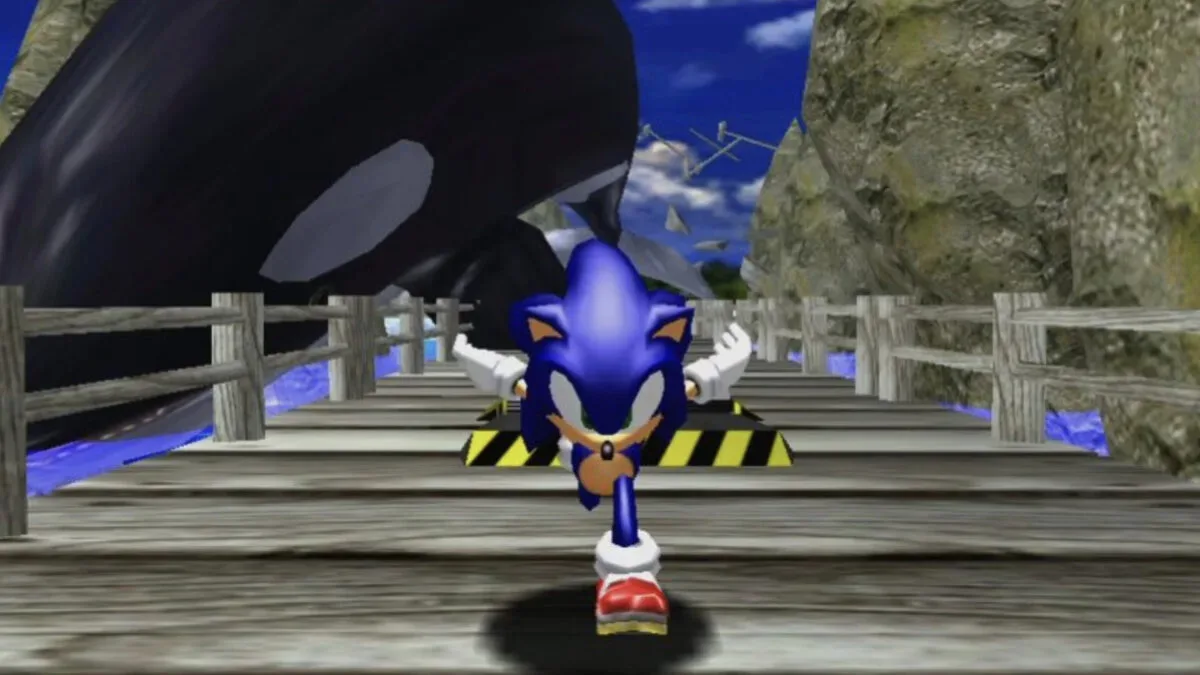
Sonic Adventure remains one of the most consequential games in Sonic the Hedgehog history. It was a major reinvention for Sega's mascot, bringing the character's high-speed platforming into a fully 3D world at a time when the team had little precedent for how that experience should work. For players, the result was an ambitious adventure filled with multiple campaigns, spoken dialogue, exploration, action stages, and the memorable Chao Garden. For the people building it, however, the project was anything but simple.
As Sonic prepares to mark its 35th anniversary, prominent Sonic Team figures Takashi Iizuka, Kazayuki Hoshino, and Jun Senoue have looked back over the series' long history in an interview with Continue magazine in Japan. Their reflections paint Sonic Adventure as an especially demanding production: a game that required the studio to solve fundamental design questions while also managing a much larger volume of material than the team had previously faced.
Iizuka, now the head of Sonic Team, singled out the original Sonic Adventure as the game that left the strongest impression on him personally. He was directly involved in defining the game's specifications as well as working on its development staff, but his memories are not centered on an easy or carefree production. In his view, the first Adventure was extraordinarily difficult to make, whereas work on its sequel, Sonic Adventure 2, was a more enjoyable experience.
That distinction says a great deal about where Sonic Team stood at the time. Sonic Adventure was not simply another sequel with an established template. The team was attempting to translate a franchise known for fast, side-scrolling stages into a different dimension, while retaining the momentum and excitement that had defined Sonic from the beginning.
For useful background on this topic, read Fishing Derby - Amiga Edition Reels in an Enhanced 68000 Remake.
A Leap Into Unknown 3D Territory
The core challenge was making Sonic's speed feel compelling in 3D. Iizuka explained that Sonic Team initially tried bringing Green Hill Zone into a three-dimensional form. Yet the basic act of running through that environment did not immediately feel entertaining. That early realization forced the developers to confront a difficult question: what actually makes high-speed Sonic gameplay satisfying once players are no longer moving along a side-scrolling route?
The team did not have an obvious model to follow. At that point, Iizuka noted, there were no comparable 3D games built around this particular kind of running. Sonic Team could not simply study a proven formula and adapt it. Instead, it had to discover its own solutions through repeated experimentation across the full development process.
That trial-and-error approach helps explain why Sonic Adventure grew into such a broad game. Its speed-focused Sonic stages were only one part of the experience. The title also featured stories for six playable characters, each with distinct gameplay ideas, alongside hub-like field areas, voice acting, and the Chao and Chao Garden systems. The game's scope reflected a desire to establish what a 3D Sonic adventure could be, but every additional element also increased the production burden.
Senoue, Sonic Team's composer and sound director, recalled just how unprecedented that workload felt. Development began in 1997, and he said he had never before encountered a project with that scale of work. The game required music not only for action stages but also for field areas, while its multiple character stories and voice performances created further demands that the team had not previously handled in the same way.
For a franchise that had built much of its identity on tightly focused, cartridge-era platforming, this was a substantial expansion. Sonic Adventure had to establish a new technical presentation, broaden the series' narrative ambitions, and support a collection of different modes and characters. It is little surprise that the people involved remember the process as an especially intense one.
Why Sonic Adventure 2 Felt Different
The experience gained during the first Adventure appears to have made a major difference for its successor. Iizuka's comparison suggests that Sonic Adventure 2 benefited from a clearer sense of direction and a better understanding of the possibilities available to a 3D Sonic game.
Its development circumstances also helped inspire some of the sequel's identity. The game was made in the United States, with team members living there during production, in an arrangement comparable to the development of Sonic the Hedgehog 2 and Sonic the Hedgehog 3. That environment contributed to concepts such as the famous City Escape sequence, an energetic stage that became one of the most recognizable moments in the franchise.
The difference between the two projects illustrates an important reality of game development. A sequel may still be large and technically demanding, but it can be easier to build once a team has already answered the foundational questions. Sonic Adventure had to prove that Sonic could make the transition. Sonic Adventure 2 could build upon the lessons, tools, and creative confidence that came from that first leap.
That does not diminish the original game's accomplishment. If anything, the comments from Iizuka and Senoue underline why Sonic Adventure continues to stand out. Its rougher, more experimental edges are closely tied to the fact that it was attempting things Sonic Team had not previously done. The game's ambition was inseparable from its uncertainty.
Sonic Frontiers Faced a Familiar Problem
Sonic Team encountered a remarkably similar design challenge decades later with Sonic Frontiers. Iizuka described Frontiers as one of the team's biggest development hurdles, specifically because the project revisited a problem that had also defined Sonic Adventure: how to make running through a large 3D space engaging.
The broad concept behind Frontiers came together quickly. The team knew it wanted Sonic to move through a vast environment. The harder part was deciding how players would interact with that open space in a way that still felt distinctly Sonic. Previous games usually gave players a route to follow, and those paths made it easier to create a fast, directed, exciting experience.
Frontiers intentionally moved away from relying on one fixed path. Rather than sending the player down a single designed route, it presented a huge area with freedom to roam. That freedom created a new design dilemma: without a prescribed course, how should Sonic Team guide players toward satisfying movement, discovery, and momentum?
As with Sonic Adventure, the developers did not begin with a complete answer. Iizuka said Sonic Team was searching for the solution as it built the game, and that it took until roughly the midpoint of development to find the approach that worked. The project therefore became another case where a major Sonic reinvention required the studio to learn while producing the game itself.
There is a clear through line between the two titles. Sonic Adventure confronted the challenge of moving at speed in 3D when the series had been defined in two dimensions. Sonic Frontiers confronted the challenge of preserving that speed and excitement in a vast, open environment where players were not confined to a single route. Both projects asked Sonic Team to rethink one of the series' most basic qualities: forward momentum.
Ambition, Pressure, and Lasting Impact
The developers' comments also point to a pattern across Sonic's history. The games that pose the greatest creative risks can be the ones that demand the most from the team, but they can also become the entries fans remember most strongly. Iizuka identified Sonic Adventure and Sonic Frontiers as difficult productions that ultimately became two of the more successful games in the series.
Senoue also recalled challenges tied to Sonic Generations, particularly in creating its music. That game's premise required it to engage directly with Sonic's legacy, and its soundtrack had to support a celebration of material spanning different eras of the franchise. Like Adventure and Frontiers, it was a project with a significant expectation attached to it, even if its specific production challenges were different.
For Sonic Team, these stories are a reminder that a recognizable character and a long-running formula do not make innovation automatic. Every time the franchise changes its structure in a meaningful way, whether through 3D movement, multiple story campaigns, open environments, or a legacy-spanning format, the developers must determine how the essential feeling of Sonic survives the transition.
Sonic Adventure's place in history comes from more than nostalgia. It was a high-pressure effort to create the rules for a new kind of Sonic game without a clear blueprint. The developers' recollections make that uncertainty especially vivid: the team was not merely polishing a known idea, but discovering the idea's shape as it went.
That process was difficult enough for Iizuka to call the game his most memorable Sonic development experience, and for Senoue to remember its sheer workload decades later. Yet the fact that the game remains such a prominent part of the series demonstrates why Sonic Team was willing to undertake that challenge. Sometimes the most difficult projects are the ones that redefine what a franchise can be.
Community
Discussion
Start the conversation.
No comments have been posted yet.