


Tomb Raider: Legacy of Atlantis faces an unusually difficult remake challenge. Crystal Dynamics and Flying Wild Hog are not simply updating an older action game with sharper visuals and smoother controls; they are revisiting the 1996 title that introduced Lara Croft to the world, then attempting to make its dungeon-delving, isolation, traps, and platforming work for players with very different expectations.
According to a hands-off preview published by GamesRadar+, the project appears conscious of that tension. The preview centers on the Damocles Trial from the game's second level, an infamous room built around lethal swords suspended above Lara's head. It is familiar in purpose to the original sequence, but its presentation, combat, traversal cues, and optional puzzle-support tools reflect nearly three decades of changes in action-adventure design.
Game director Raul Siquera described the goal as retaining what players remember while adding details that help the remake feel appropriate for a modern audience. That means returning players should recognize key places and ideas, while newcomers should still be struck by the scale of the environments even without firsthand nostalgia for the PlayStation-era original.
Legacy of Atlantis is being developed by Crystal Dynamics and Flying Wild Hog, with Amazon Game Studios publishing. It is currently scheduled to launch on February 12, 2027 for PC, PlayStation 5, Xbox Series X, and Nintendo Switch 2.
A remake caught between two eras
The original Tomb Raider arrived in an era when players were often expected to map spaces mentally, experiment with objects, and endure long stretches without overt direction. Its tombs could be cryptic and its movement could be demanding, but that resistance was also central to the appeal. Lara Croft was not being guided through a cinematic set piece every few moments; she was navigating hazardous ruins that could feel lonely, hostile, and difficult to comprehend.
That approach is not automatically compatible with a modern blockbuster action game. Contemporary audiences are accustomed to more responsive movement, clearer feedback, assistive accessibility features, and combat systems with far more complexity than the rigid encounters of 1996. A remake that adheres too strictly to the past could risk feeling dated. One that overcorrects could turn Tomb Raider into a more generic action adventure, diminishing the distinct puzzle-box character that established the series.
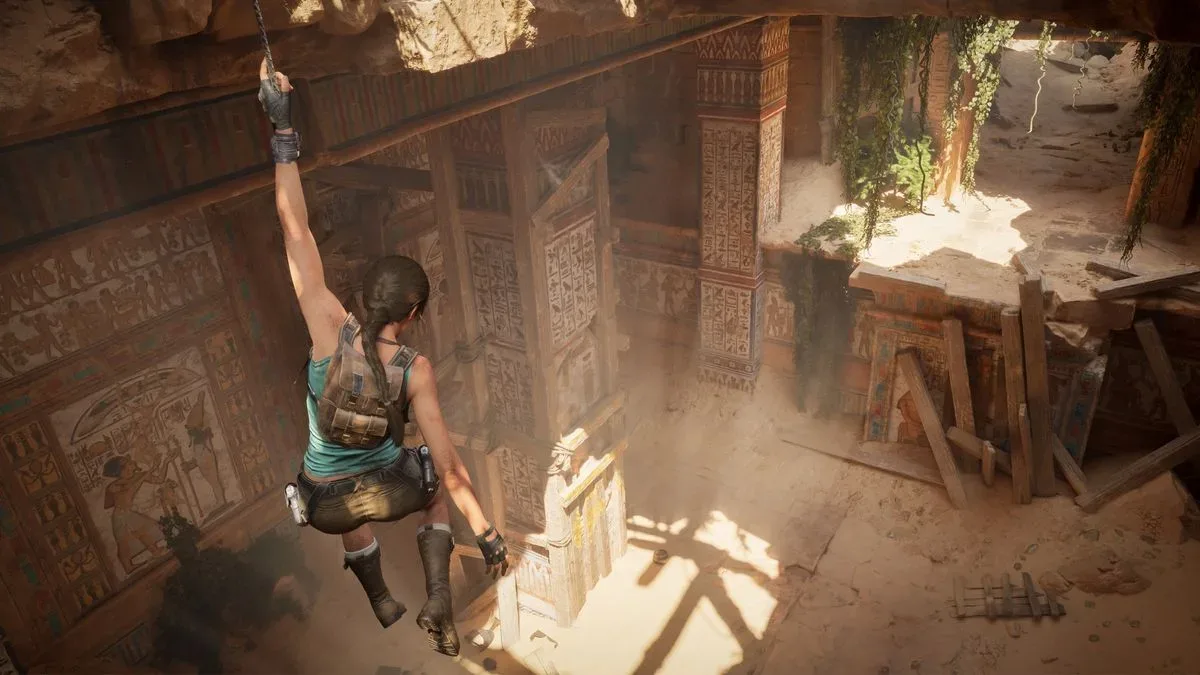
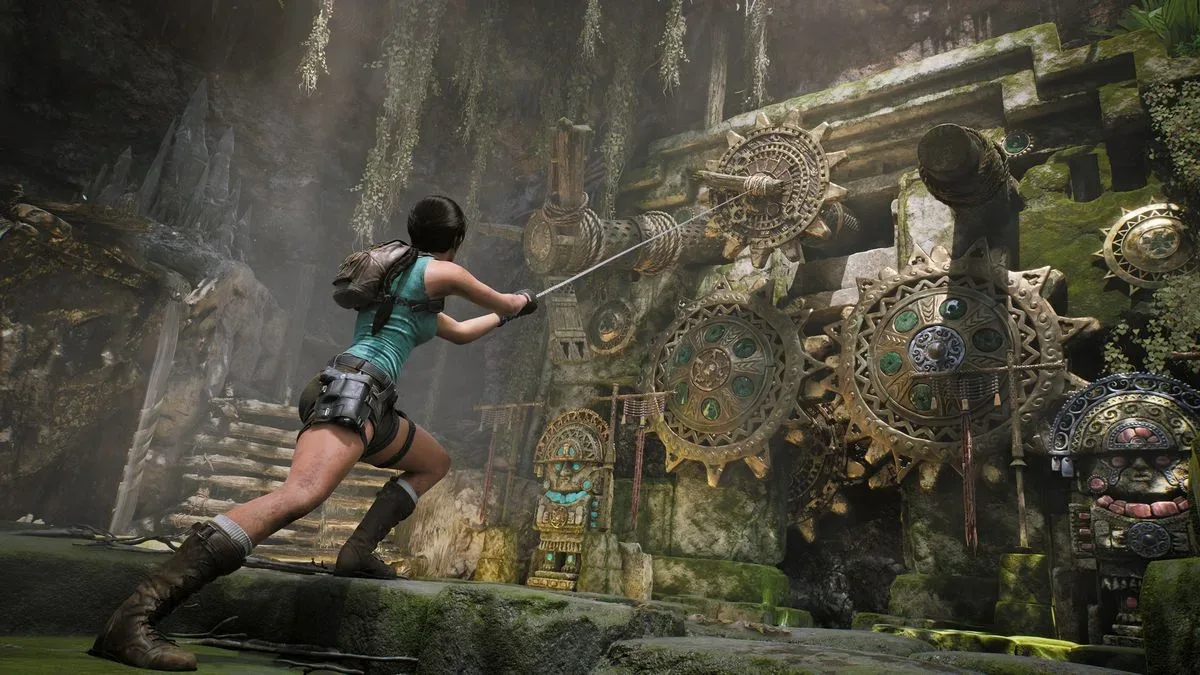
The GamesRadar+ demonstration suggests Legacy of Atlantis is attempting to find a middle route. Its Damocles Trial keeps the original concept: Lara must solve environmental problems while avoiding enormous swords that can fall if she remains in the wrong place. But the trial has been expanded into a grander space, allowing the danger to register with modern audiovisual scale. The core idea remains the same, yet the execution is designed to carry a more imposing sense of spectacle.
That distinction may be crucial for the remake's wider identity. Rather than treating old rooms as museum pieces, the developers appear to be using them as foundations for larger, more elaborate versions of their original concepts.
Combat and survival systems update familiar threats
Some of the clearest modernization comes before Lara reaches the central puzzle. In the demo, she is attacked by bats that behave less like predictable targets and more like an unpredictable swarm. Lara can take damage during the encounter, but she has access to a healing balm created from supplies gathered around the level.
A crafting-related healing mechanic might sound at odds with a recreation of early Tomb Raider, particularly given the genre's association with scavenging systems and resource menus. Siquera's explanation, however, is rooted in world-building rather than a desire to add modern systems for their own sake. The remake aims to avoid the oddity of discovering a contemporary medical kit inside a supposedly undisturbed ancient temple. In that context, a balm assembled from found materials is intended to make greater sense within the adventure's setting.
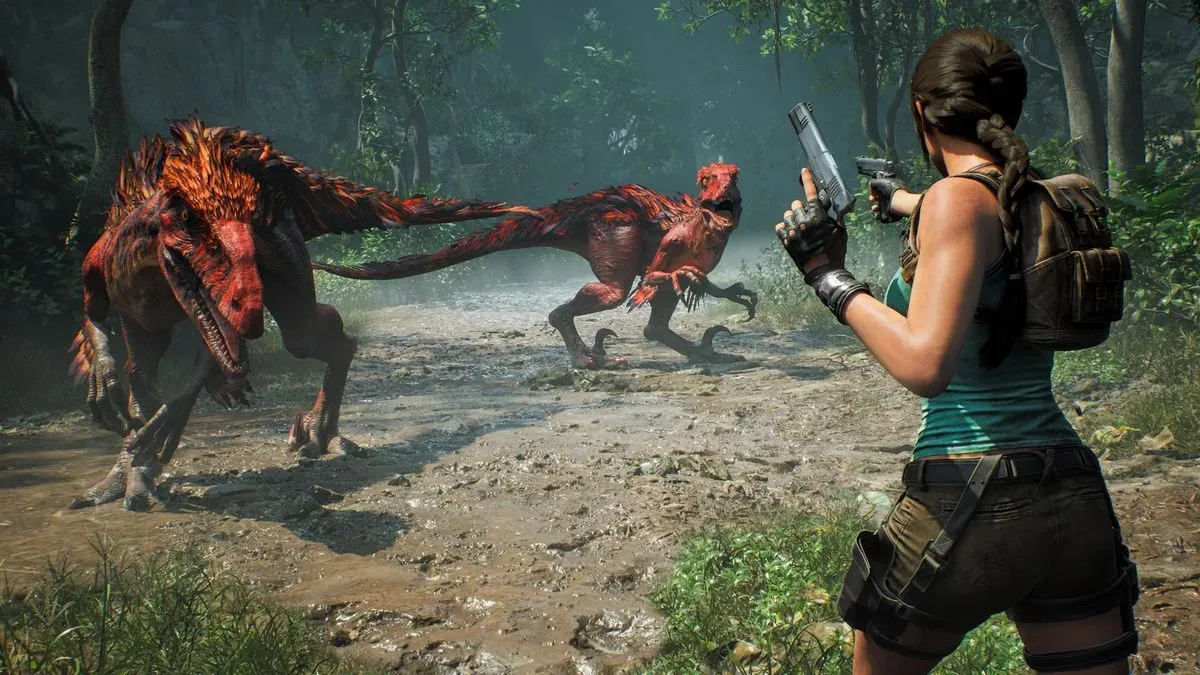
The preview also describes a leopard encounter that substantially revises another recognizable danger from the old game. Rather than merely approaching Lara in a straightforward attack pattern, the animal uses the environment to obstruct her view, retreats into narrow rocky spaces after receiving enough damage, and can circle back to strike from another direction.
Siquera said players are not meant to remain stationary during these fights. Lara's combat is described as quick and mobile, supported by acrobatic dodge-cartwheels. A Focus gauge can slow time temporarily, creating a moment to reassess a frantic confrontation. Together, these changes point to a more dynamic combat model than the original game's encounters, with movement and positioning carrying greater importance.
There is an understandable question over how far this can go before it changes the tone of Tomb Raider too dramatically. Classic Lara Croft's adventures certainly included gunfights, but exploration and environmental hazards were often the larger focus. The early look does not establish how frequently Legacy of Atlantis will deploy more elaborate enemy behavior, nor how much crafting and Focus management will shape the full campaign. Still, the Damocles segment shows that the remake is not limiting itself to cosmetic changes.
Optional guidance may be the key compromise
The more sensitive issue for longtime fans may be puzzle guidance. Tomb Raider: Legacy of Atlantis includes some features that gently point players in the right direction. Lara offers explanatory dialogue, while environmental markings can indicate an intended parkour route. In the preview's assessment, these aids do not appear overwhelmingly intrusive.
The new Scanner tool is more consequential. Lara can use it to identify the components involved in a puzzle, potentially reducing the uncertainty that defined many classic Tomb Raider challenges. In a game built around examining a room, reading its architecture, testing routes, and realizing how distant mechanisms connect, a tool that highlights moving parts could easily become too powerful.
Crystal Dynamics appears to recognize that concern. Siquera said the Scanner is entirely optional, and its tutorial will also establish that it can reveal lore information. That framing makes the device a choice rather than a mandatory solution path: players seeking context and support can use it, while those who want to wrestle with the puzzles more independently can leave it aside.
Optionality is not a perfect answer to every remake debate, but it is an important one here. It allows Legacy of Atlantis to account for players who may be unfamiliar with older adventure-game conventions without forcing the same level of assistance upon everyone. The success of that balance will depend on implementation. If the game's default dialogue, visual cues, and level construction still solve the puzzle before players have a chance to observe it, disabling the Scanner alone will not restore the older rhythm. Conversely, if the primary design remains readable without constant help, the Scanner could serve as a sensible accessibility and lore tool.
Preserving the tombs matters more than copying every mechanic
GamesRadar+'s preview ultimately presents an encouraging, if necessarily limited, picture of the project. The outlet's hands-off demonstration is not enough to answer every question about progression, level structure, enemy density, or the extent of the remake's new mechanics. It does, however, indicate that the team understands the stakes involved in revisiting such a defining game.
Legacy of Atlantis does not appear to be pursuing a strict one-to-one reconstruction. The bats are more reactive, the leopard is more tactical, healing has been adapted to fit the setting, puzzles are larger in scale, and players have access to modern guidance if they want it. Purists may object to some of those additions, especially the Scanner and more overt traversal communication.
Yet the early material also suggests restraint. The Damocles Trial still revolves around the same essential threat and environmental logic. The goal remains to make Lara study a dangerous tomb and survive its traps, not simply rush her through a series of combat arenas. Most importantly, the strongest guidance tool is optional, a decision that acknowledges players who value the original game's demanding exploratory spirit.
For a title positioned as the beginning of a new era for Tomb Raider, that may be the most promising sign. A successful remake should not merely reproduce old geometry or layer fashionable systems over familiar rooms. It needs to understand why those rooms mattered. If Legacy of Atlantis can retain the awe, tension, and puzzle-solving identity of Lara Croft's first adventure while removing only the barriers that no longer serve it, it could offer a meaningful route between classic Tomb Raider and the expectations of 2027.
Community
Discussion
Start the conversation.
No comments have been posted yet.