

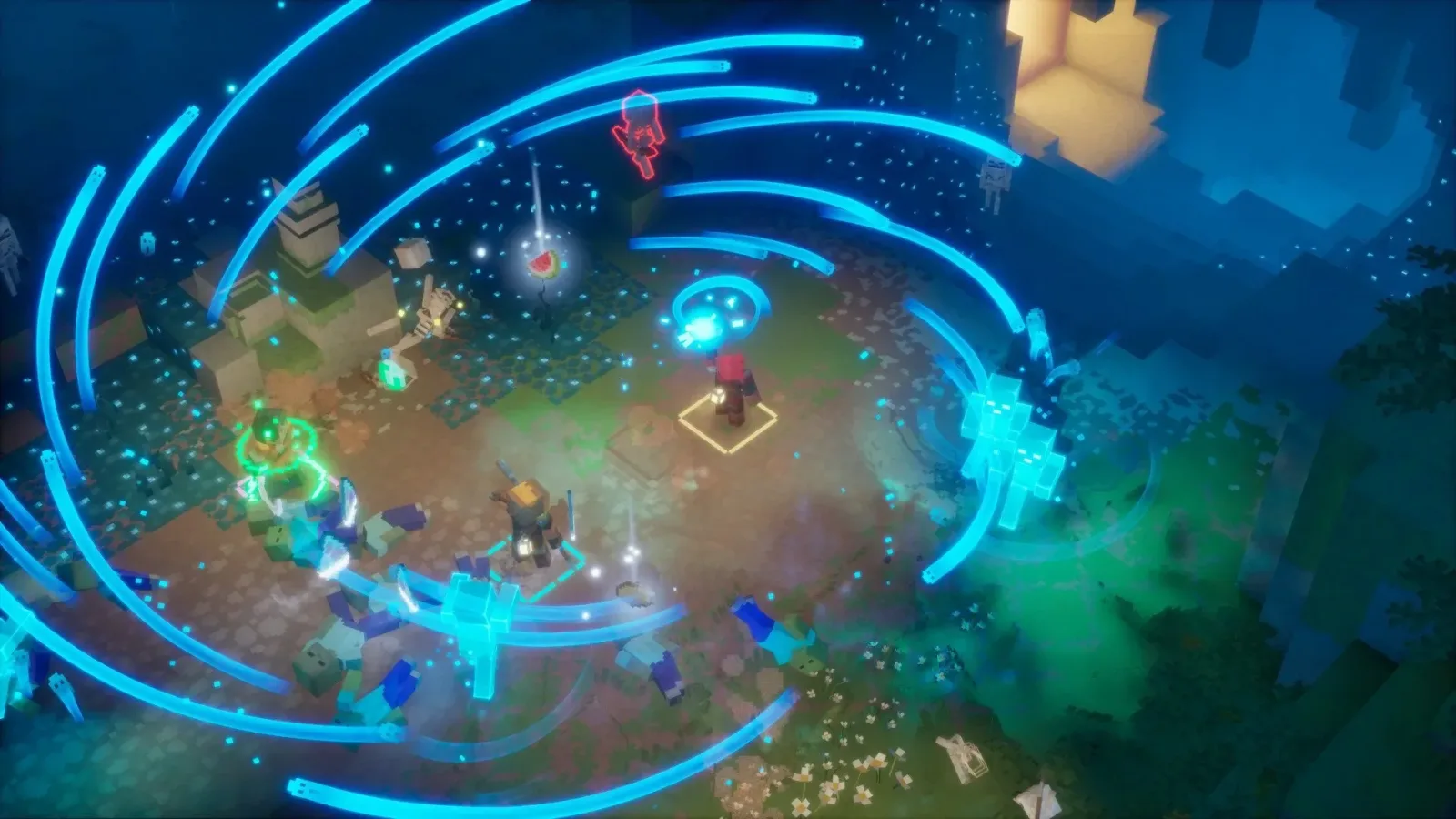
Minecraft Dungeons II is a better, more confident follow-up to the 2020 action-RPG spin-off. It understands the immediate appeal of putting familiar Minecraft tools in players' hands and sending them into swarms of enemies from an isometric perspective. It also improves several fundamentals at once: movement is smoother, menus communicate important details more clearly, and the broader selection of enemies and equipment gives combat a healthier range of possibilities.
Those improvements make this sequel an approachable choice for newcomers to loot-driven dungeon crawlers. At the same time, the game's most compelling feature--assembling a powerful, personalized character build--does not truly come together until the adventure is nearly finished. Minecraft Dungeons II eventually delivers the rush of becoming an unstoppable force, but it takes too long to reach that point, and there is not enough fresh content waiting after it.
A More Agile Minecraft Dungeon Crawl
The foundation remains familiar. Minecraft Dungeons II adapts the action-RPG formula associated with games such as Diablo into a blocky Minecraft setting, emphasizing combat encounters, equipment drops, upgrades, and co-op-friendly progression. It is not trying to become a demanding simulation of mining, crafting, or survival. Instead, its connection to Minecraft is primarily visual and thematic: the Overworld is rendered as a colorful isometric adventure space, and recognizable tools are reimagined as weapons for a fast-moving hack-and-slash game.
The most important mechanical addition is the jump. That might sound modest, but it changes the feel of exploration and combat. Traversal has more momentum, encounters are easier to navigate, and moving through the environment feels less stiff than in the original game. A jump mechanic alone cannot reinvent the genre, but it makes Minecraft Dungeons II feel more responsive in the moments players spend dodging danger, crossing terrain, and positioning around enemies.
For useful background on this topic, read Modern Warfare 4 Will Pause Double XP Token Timers Outside of Matches.
Its presentation also benefits from better information delivery. Menus surface useful details effectively, which matters in a game constantly asking players to compare gear, consider upgrades, and sort through effects. A more readable interface is a welcome quality-of-life improvement when the central progression loop depends on understanding what a new weapon, armor piece, artifact, or talisman can contribute to a build.
Combat gains value from the larger variety of foes and equipment. Boss battles stand out especially well during the earlier hours, when the game's item system has not yet fully found its rhythm. These fights offer the clearest sense of escalation and are often where Minecraft Dungeons II feels most focused. They ask players to react to more than a routine wave of enemies, providing memorable punctuation in an otherwise straightforward campaign structure.
Loot Without a Clear Identity
Minecraft Dungeons II continues to avoid traditional class-based character progression. There are no fixed paths built around labels such as Barbarian or Monk. Instead, a player's combat identity comes entirely from the gear they find. Weapons, armor, artifacts, and talismans all provide distinctive effects, and vendors allow that equipment to be upgraded and enchanted. In theory, this should create freedom: a character can shift between styles without being locked into an early class decision.
In practice, that flexibility can feel less like experimentation and more like drift. Progression is largely driven by finding stronger drops, then learning to use whatever happens to be most effective at the moment. Individual items do not always feel meaningful before they are improved through upgrades and enchantments. As a result, the game can struggle to establish a sense that players are deliberately mastering a particular style of play.
That distinction matters. Great action-RPG progression often makes each new choice feel like a step toward an intentional identity. Minecraft Dungeons II instead frequently encourages a more passive relationship with loot: equip the most powerful available option, keep moving forward, and replace it when something better appears. There is enough variety to support creative combinations, but the path toward those combinations is not always satisfying or well signposted.
The game eventually demonstrates what its item-driven system can achieve. A late-game build built around an Emerald Hammer that electrocutes nearby enemies, a crossbow capable of piercing through targets, and armor enhancements focused on healing and potion effectiveness can create a tremendous feeling of control. At that stage, the pieces begin to reinforce one another. Equipment stops feeling like a collection of temporary stat sticks and starts operating as a coherent set of tools.
This is the power fantasy Minecraft Dungeons II needs more of, and much earlier. When weapons, armor, enchantments, and support effects are working together, encounters become far more enjoyable. The problem is that standard enemy battles only become consistently engaging once the player is already close to the most repetitive section of the game.
A Short Campaign and a Thin Endgame
Minecraft Dungeons II is a compact adventure. The main campaign can be completed in under 10 hours, and roughly 15 hours is enough to see much of what it currently offers. A shorter runtime is not inherently a flaw, particularly for an entry-level action-RPG, but the limited endgame makes the overall package feel smaller than the satisfying build system suggests it could be.
After the main journey, remaining activities revolve around completing unfinished side quests and destroying Storm Generators for randomized loot and upgrade currency. These tasks provide a reason to continue improving gear, but they do not substantially transform the experience. Once a player has found a build they enjoy, the available content does not offer enough new challenges, destinations, or objectives to sustain that momentum for long.
The repetition is especially noticeable because the game's best combat rhythm arrives late. There is a frustrating mismatch between progression and content: just as the gear system begins to produce exciting results, the adventure starts repeating itself. More varied endgame objectives, deeper challenge structures, or additional ways to test specialized builds would have made the late-game reward loop far more durable.
Co-op matchmaking provides one bright avenue for return visits. Joining other players' sessions and assisting less powerful adventurers can be enjoyable, and the game's accessible combat makes it well suited to casual group play. This is not a replacement for a robust endgame, but it does give the game a social, helpful dimension that may extend its life for players who enjoy cooperative dungeon crawling.
The Sift Adds Lore, Not Enough Consequence
The story sends players against the Illiger High Council, a group that has discovered the soul-filled Sift and intends to use the dimension's power to control the Overworld. The Sift is the game's most notable contribution to the wider Minecraft universe and is set to arrive in Minecraft proper in 2027. For players invested in the occasional lore expansion around this world, that connection gives the sequel some added relevance beyond its dungeon-crawling mechanics.
As a narrative, however, the campaign is intentionally light and breezy. It functions mainly as an excuse to travel between the Overworld and the Sift, fight through hostile spaces, and pursue increasingly powerful equipment. That can be perfectly adequate for the genre, but the story's ending does not provide a satisfying conclusion. The world setup also suggests more player impact than the adventure ultimately delivers.
The environments remain appealing despite that lack of consequence. Minecraft's recognizable visual language translates well to the isometric format, and the contrast between the familiar Overworld and the ethereal Sift gives the sequel a distinct sense of place. Still, players looking for extensive mining, meaningful crafting, or a heavily reactive Minecraft sandbox should adjust expectations. This is a combat-first spin-off wearing Minecraft's aesthetic rather than a full blend of both games' defining ideas.
Who Should Enter the Dungeons?
Minecraft Dungeons II is best suited to players seeking an uncomplicated route into action-RPGs, especially those who enjoy Minecraft's look and want an accessible cooperative adventure. Its readable systems, brisk campaign, smoother traversal, and broad equipment pool make it easy to understand why the series can stand on its own. It is also a reasonable fit for groups looking for a game where players can drop into combat, chase better loot, and help one another without committing to an enormous campaign.
Players who expect a deep, long-term loot game may find the limitations more difficult to overlook. The classless equipment system has worthwhile potential, but it does not consistently make every drop feel exciting. Those who want a lengthy endgame of escalating challenges will likely reach the current limits quickly. Likewise, anyone hoping for the fuller mining-and-crafting identity of mainline Minecraft will find that these elements are largely absent.
Final Takeaway
Minecraft Dungeons II proves that this spin-off can grow beyond its original outing. It is more fluid, better organized, and more varied, while the Sift gives the Minecraft setting a new piece of lore to explore. Most importantly, its late-game equipment combinations reveal a genuinely enjoyable build-crafting core.
But the sequel makes players wait too long for that strength to emerge. By the time a build feels powerful and deliberate, the campaign is over and the remaining activities have become repetitive. Minecraft Dungeons II is a solid, welcoming action-RPG with clear signs of progress, yet it still has considerable room to make its loot journey more purposeful and its endgame more rewarding.
Community
Discussion
Start the conversation.
No comments have been posted yet.